Maccabi Tel Aviv's Tactical Masterclass Against Sheriff Tiraspol
Sheriff Tiraspol’s 0-5 home defeat to Maccabi Tel Aviv at Sheriff Stadium was decided less by isolated errors than by a systemic mismatch in structure, tempo, and technical security. Both sides lined up in a 3-5-2 on paper, but only Ronny Deila’s Maccabi managed to turn that symmetry into functional superiority across all phases.
From the opening minutes, Maccabi’s interpretation of the 3-5-2 was aggressive and front-foot. The back three of R. Shlomo, M. Camara and I. Ben Hamo held a high line, compressing the pitch and allowing the wing‑backs S. Jehezkel and R. Revivo to live almost permanently in Sheriff’s half. With 69% possession and 19 total shots (12 on goal), Maccabi established a territorial lock that Sheriff never solved.
In midfield, the triangle of I. Sissokho, I. Shahar and I. Noy (before and after the 64' changes) controlled central lanes both with and without the ball. Sissokho in particular provided vertical thrust, later capped by his 78' goal, while Shahar’s early influence was evident in his 5' assist for S. Abu Farkhi. Sheriff’s central trio of D. Klas, A. Pergjoni and Sapata were pinned deep, forced into reactive defending rather than orchestrating play. The Moldovan side’s 31% possession figure underlines how rarely they could string sequences together; their 10 total shots and 6 on goal came mostly from sporadic transitions rather than sustained pressure.
Defensively, Sheriff’s 3-5-2 lacked cohesion in the first line. J. Asprilla Moreno and L. Jaures‑Ulrich, nominally the front two, struggled to screen passing lanes into Maccabi’s midfield. That allowed Maccabi to progress cleanly through the thirds, often via simple wall passes between the centre-backs and Sissokho or Shahar. Once Maccabi broke the first line, Sheriff’s back three of B. Ciss, S. Magassouba and Rai were repeatedly dragged wide by the wing‑backs, opening central channels that Maccabi exploited with late runs from midfield.
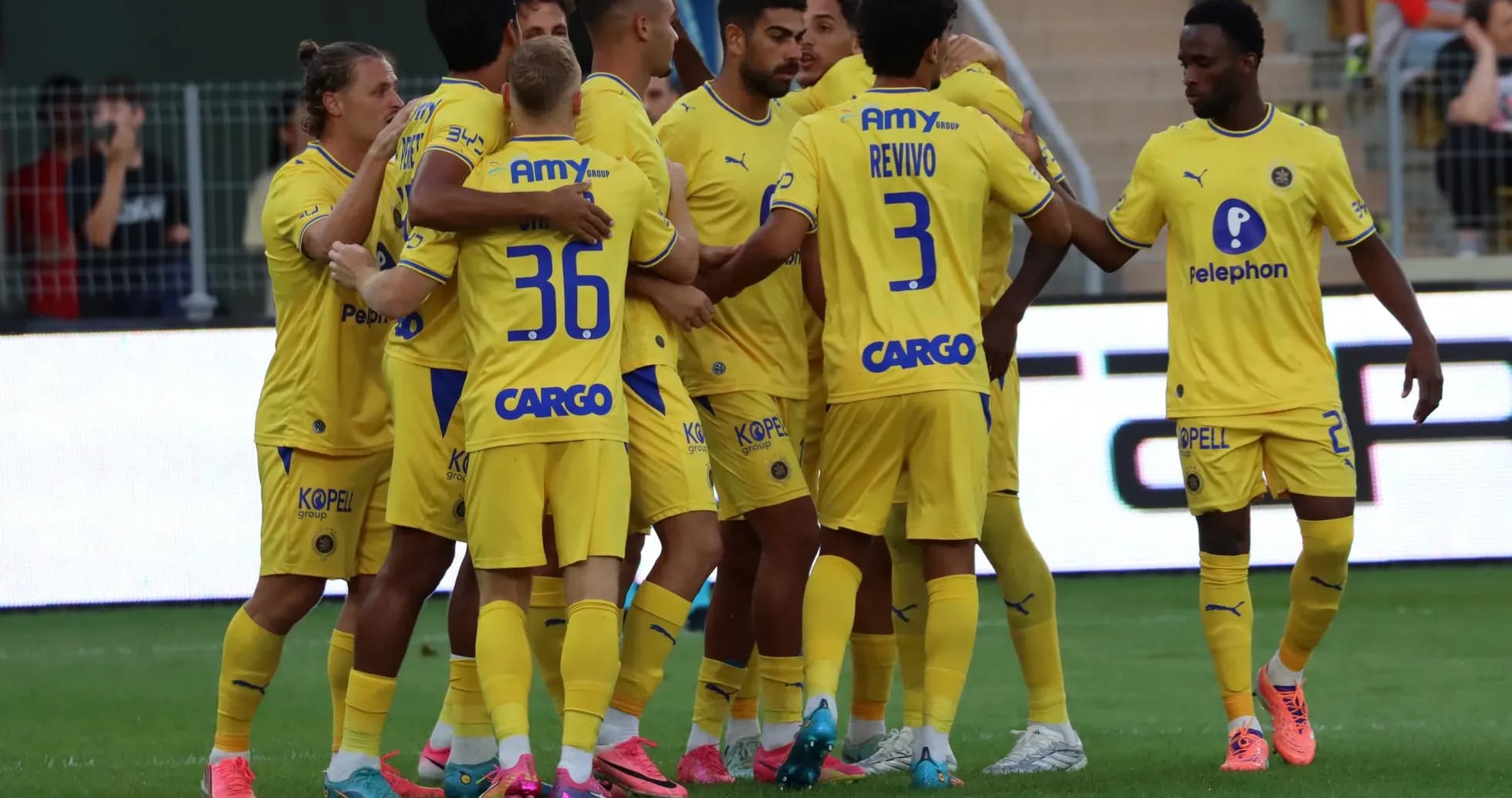
The pattern of the goals reflects this structural dominance. At 5', Abu Farkhi’s opener from Shahar’s assist came after Maccabi easily accessed the half‑spaces, isolating Sheriff’s central defenders. The 29' strike by D. Peretz, set up by Revivo, again originated from wide overloads that forced Sheriff to collapse centrally too late. By half-time, the 0-2 scoreline mirrored a half in which Maccabi dictated tempo and territory, while Sheriff’s 3-5-2 looked more like a 5-3-2 survival block.
Victor Mihailov’s double change at 46' — V. Fratea (IN) for Sapata (OUT) and B. Fomba (IN) for B. Ciss (OUT) — signaled an attempt to inject energy and perhaps tighten the left side. But tactically, the issues persisted. Sheriff still could not contest midfield possession, and their wing‑backs remained pinned by Jehezkel and Revivo. Within seven minutes of the restart, Maccabi punished them again: at 53', Jehezkel himself finished a move created once more by Revivo’s advanced positioning on the left. That goal, coming after Jehezkel’s own yellow card at 48', underlined how free he was to attack despite his booking; Sheriff never managed to turn Maccabi’s aggression into a disciplinary vulnerability.
Mihailov’s further adjustments at 66' — M. Ouedraogo (IN) for Mota (OUT) and S. Kone (IN) for A. Pergjoni (OUT) — aimed to refresh the flanks and central energy, but by then the game state and psychological momentum were firmly with Maccabi. Sheriff’s growing frustration showed in the card count: five yellows, spread across Baye Assane Ciss, Miguel Mota, Soumaila Magassouba, Mamoutou Ouedraogo and Danila Forov. With all card reasons unspecified in the data, the pattern still clearly points to a side defending on the edge and arriving late into duels as they chased shadows.
Maccabi, by contrast, managed the game intelligently after going 3-0 up. The triple substitution on 64' — K. Belic (IN) for I. Shahar (OUT), H. Varela (IN) for S. Jehezkel (OUT), and O. Davida (IN) for I. Noy (OUT) — allowed Deila to rotate his midfield and wing‑backs without sacrificing structure. D. Glazer’s entrance at 72' and T. Asante’s at 80' for I. Ben Hamo further solidified the spine and back line. Despite this rotation, Maccabi’s pressing triggers and rest‑defence shape remained coherent, preventing Sheriff from exploiting any transitional looseness.
The final phase of the match underlined the gulf in control. At 74', Abu Farkhi converted a penalty to make it 0-4, a moment that effectively ended any remaining contest. Four minutes later, Sissokho added the fifth, stepping into the space between Sheriff’s disjointed lines. Sheriff’s last substitution at 80', J. Modelo (IN) for L. Jaures‑Ulrich (OUT), came too late to influence the tactical narrative; it was more about damage limitation and squad management than a genuine attempt to alter the game’s dynamics.
Between the posts, E. Timbur (Sheriff Tiraspol) faced a relentless workload behind a constantly stretched back line, with Maccabi registering 12 shots on goal. O. Melika (Maccabi Tel Aviv), protected by a well‑marshaled back three and proactive midfield screen, dealt with 6 shots on goal but was rarely exposed to high‑quality, multi-phase attacks. The contrast in shot volume — 19 to 10 in Maccabi’s favor — and the territorial dominance suggested by the possession split speak to a match where the away side’s 3-5-2 functioned as a modern, pressing and possession structure, while Sheriff’s mirrored shape never progressed beyond a reactive, low-block version.
In statistical terms, the 0-5 scoreline aligns closely with the underlying dynamics. Maccabi’s 69% possession and 19 total shots indicate sustained control, not opportunistic finishing. Their ability to generate 12 shots on goal from those 19 attempts highlights both shot quality and the efficiency of their final-third patterns, particularly via Revivo’s left‑side deliveries and the timing of midfield runs. Sheriff’s 10 total shots, with 6 on goal, show they did find occasional openings, but those were isolated rather than part of any repeatable attacking scheme.
Set‑piece and territorial indicators also favored Maccabi: 5 corner kicks to Sheriff’s 4, and a single yellow card for the visitors versus five for the hosts, underlining how often Sheriff were forced into last‑ditch or late interventions. With no red cards, Maccabi managed their aggression within limits, while Sheriff’s accumulation of bookings further constrained their ability to press and tackle with full intensity in the closing stages.
Overall, this 2nd Qualifying Round tie at Sheriff Stadium showcased a clear tactical superiority from Maccabi Tel Aviv. Their 3-5-2 delivered control, verticality and balance; Sheriff Tiraspol’s mirrored setup never found the pressing cohesion or midfield structure required to contest either the ball or territory, and the statistical profile — from possession to shots and discipline — fully supports the emphatic 0-5 final score.