Maccabi Tel Aviv's Tactical Mastery in Europa League Win
Maccabi Tel Aviv’s 1–0 win over Sheriff Tiraspol at Batumi Arena in the UEFA Europa League 2nd Qualifying Round was defined less by volume of chances and more by territorial control, set‑piece pressure and a structurally disciplined 4‑3‑3. The Israeli side converted sustained first‑half pressure into the decisive moment via an own goal from S. Kone, then managed the game with mature control of space rather than pure dominance of the ball. Sheriff, also in a 4‑3‑3, never translated their adjustments into penalty‑box threat, failing to register a single shot on target despite a late push and multiple substitutions.
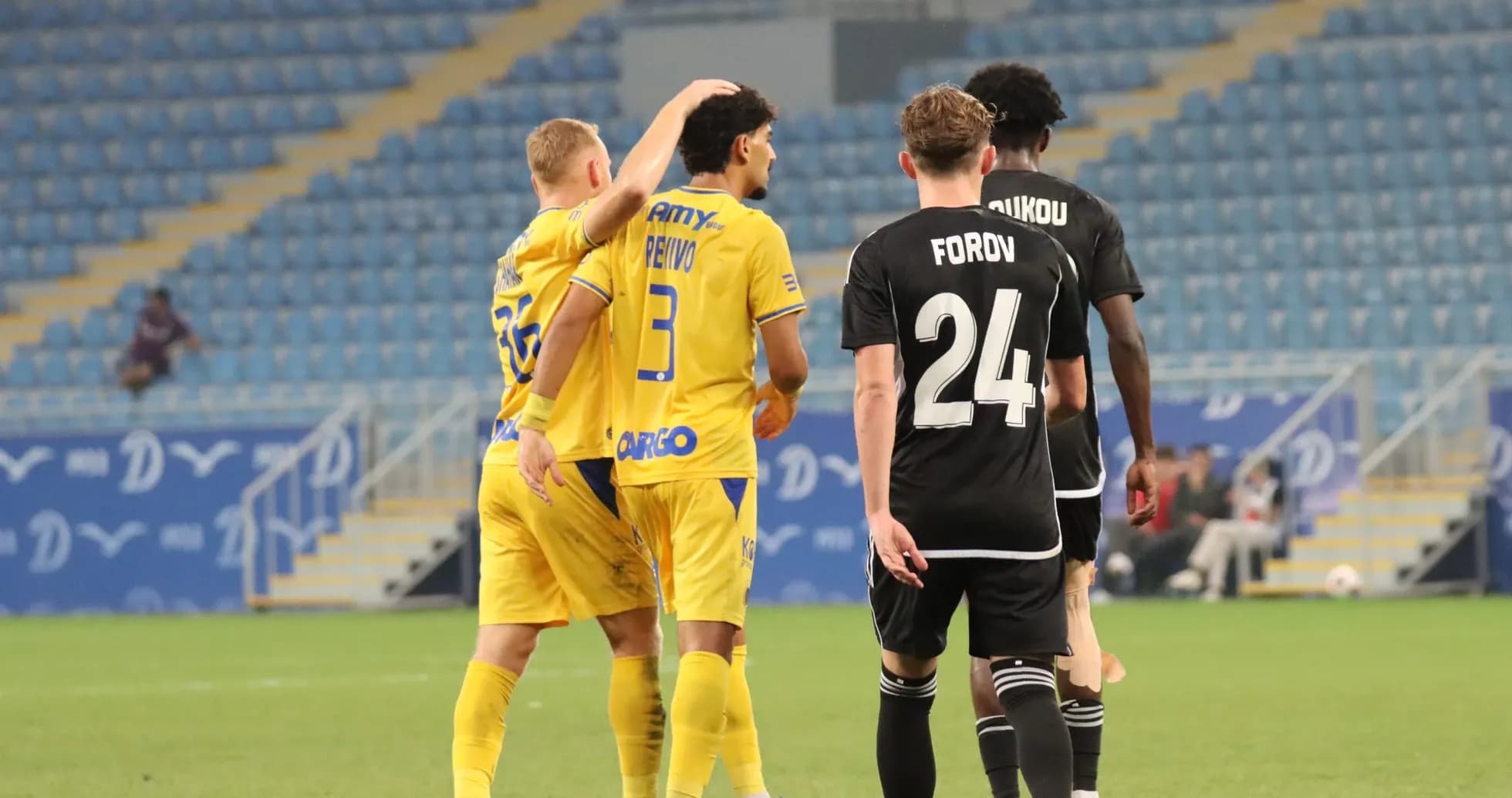
The key tactical axis was Maccabi Tel Aviv’s high, aggressive full‑back positioning within their 4‑3‑3. With R. Revivo and N. Ben Harush stepping high from the back four, the wide lanes were consistently overloaded, supported by the advanced roles of S. Jehezkel and H. Varela from the nominal front line. This structure underpinned a heavy set‑piece count: 12 corner kicks to Sheriff’s 7. Even without a high volume of clear chances (only 3 shots on goal), Maccabi’s repeated ability to trap Sheriff deep, win restarts and keep the ball in the attacking third created the pressure that led to the 29th‑minute breakthrough.
The decisive action came from Sheriff’s own defensive instability. In a phase where Maccabi were pinning Sheriff back, S. Kone, deployed as a midfielder in the visitors’ 4‑3‑3, turned the ball into his own net. Because it was an own goal, it is credited to Maccabi Tel Aviv, perfectly illustrating how Kenny Miller’s side used territory and volume of deliveries into the box to force errors rather than relying solely on clean, constructed finishing. From that point on, the match became a question of game management and structural control.
Midfield Dynamics
In midfield, the trio of D. Peretz, I. Sissokho and I. Shahar gave Maccabi both vertical and horizontal balance. Peretz anchored and screened in front of the centre‑backs, while Sissokho and Shahar offered staggered lines between Sheriff’s midfield and defence. Their positioning helped Maccabi hold a 50% share of possession that was tactically more valuable than Sheriff’s equivalent share: Maccabi’s touches came higher up the pitch, as evidenced by the corner count and 5 shots off goal plus 3 blocked shots. Sheriff’s 50% possession was far more sterile, with no shots on goal and only 4 off target, underlining their difficulty in progressing the ball through Maccabi’s compact mid‑block.
Sheriff’s initial 4‑3‑3, with Mota and A. Pergjoni supporting from deeper lines and L. Jaures‑Ulrich, S. Kone and D. Forov in advanced midfield roles, struggled to connect the thirds. Long phases of build‑up were forced wide or backwards, and when they did reach the final third, Maccabi’s back four—M. Camara and R. Shlomo centrally, flanked by Revivo and Ben Harush—protected the box aggressively. The Moldovan side’s 2 blocked shots show that when they did pull the trigger, they were often crowded out before testing the goalkeeper.
Substitutions and Tactical Adjustments
Victor Mihailov’s in‑game adjustments were an attempt to inject verticality and fresh legs into a midfield that was losing second balls. The sequence of substitutions—Mota (OUT) with Sapata (IN) at 57', S. Kone (OUT) with V. Nihaev (IN) at 59', followed by a triple change at 77' with A. Pergjoni (OUT) / N. Swen (IN), L. Jaures‑Ulrich (OUT) / V. Cozma (IN), and D. Forov (OUT) / J. Modelo (IN)—shifted Sheriff towards a more direct, physically oriented structure. However, the changes did not solve their core issues: progression through the central corridor and occupation of the half‑spaces. The attacking patterns remained predictable, and Maccabi’s defensive line rarely had to break its shape.
On the home bench, Kenny Miller’s substitutions were clearly geared towards maintaining intensity and defensive stability rather than chasing a second goal. At 63', I. Shahar (OUT) made way for I. Ben Simon (IN), and S. Jehezkel (OUT) for O. Davida (IN), refreshing both the midfield and wide lanes without altering the 4‑3‑3 structure. Later, at 79', H. Varela (OUT) was replaced by I. Noy (IN), and N. Ben Harush (OUT) by I. Ben Hamo (IN), adding defensive energy and fresh legs in the full‑back area for the closing phase. The shape remained intact; the personnel rotation ensured that pressing triggers and defensive duels could be sustained to protect the 1–0 advantage.
Discipline and Fouls
Discipline also played into the tactical narrative. Maccabi Tel Aviv completed the match without a single yellow or red card, an indicator of controlled aggression and good spacing that reduced the need for emergency defending. Sheriff, by contrast, collected 2 yellow cards—both for “Tripping”, to V. Nihaev at 71' and B. Ciss at 90+3'. These fouls reflected their increasing desperation to halt transitions and Maccabi’s attempts to break pressure late on. The foul count—11 for Sheriff versus 9 for Maccabi—supports the impression of a visiting side often arriving late into duels as they tried to compress space after losing structure.
Statistical Overview
Statistically, the match underlines Maccabi Tel Aviv’s tactical superiority without suggesting overwhelming attacking dominance. Both teams finished with 50% possession, but Maccabi translated their share into 3 shots on goal, 5 off goal and 3 blocked shots, alongside 12 corners. Sheriff’s attacking output—0 shots on goal, 4 off goal, 2 blocked shots and 7 corners—never reached the threshold required to seriously threaten an equaliser. With no recorded goalkeeper saves or passing data, the clearest indicators are territorial: set‑pieces, shot locations inferred from blocked attempts, and the absence of Sheriff efforts on target.
Conclusion
In the context of a two‑legged Europa League qualifier, this 1–0 home‑designated win at Batumi Arena gives Maccabi Tel Aviv a platform built on structural discipline and field position rather than pure chance creation. The own goal from S. Kone is statistically an isolated moment, but tactically it is the product of Maccabi’s sustained pressure and superior organisation. Sheriff’s inability to convert their possession into box entries or shots on goal will be the central problem Mihailov must solve ahead of the return leg.