Lionel Messi's 20th World Cup Goal in Miami
Lionel Messi did it again.
Three against Algeria, two against Austria, one against Jordan. Now another in Miami, as Argentina squeezed past Cape Verde 3-2 in a wild World Cup last‑32 tie that felt, at times, like a street party on the brink of panic.
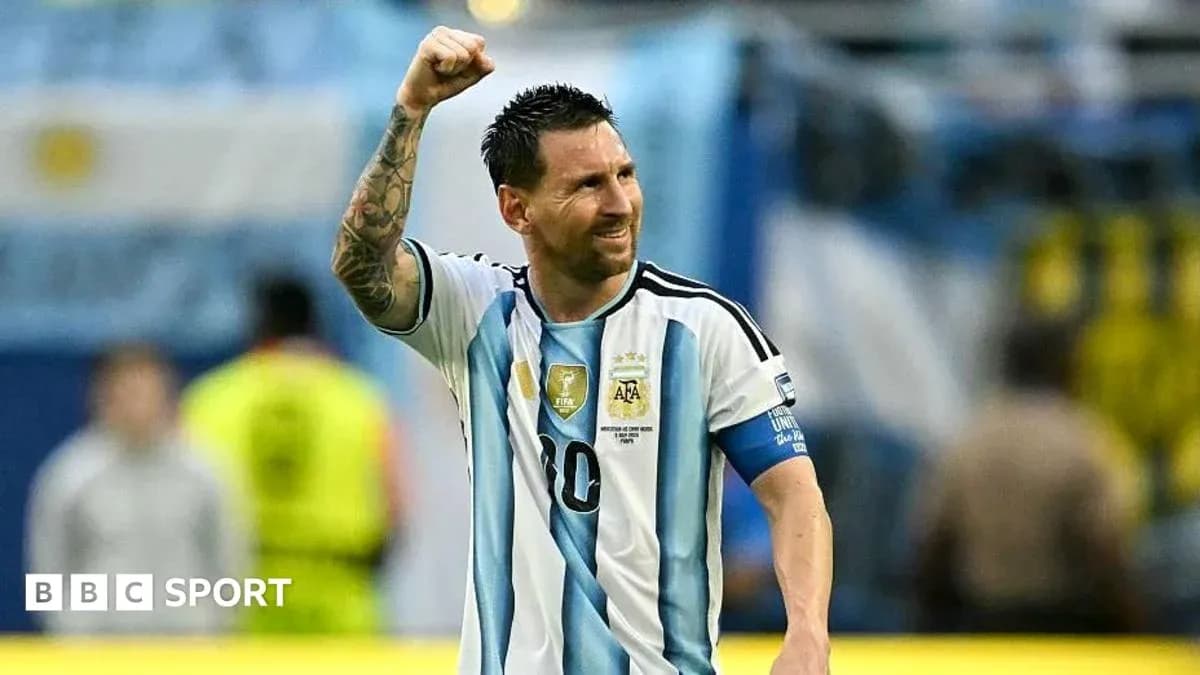
This one was his 20th goal at World Cup finals. Another line in a record book he has been casually rewriting all summer in the United States. His seventh of this tournament alone.
Miami, painted in sky blue
The story started long before the first whistle.
Miami’s streets turned into a river of sky blue and white. Drums, songs, car horns, kids on shoulders. Flags as big as billboards, draped from balconies and wrapped around shoulders, all flowing in one direction: towards a stadium that felt less like neutral ground and more like an annex of Buenos Aires.
Inside, it was the same. A sea of Argentina shirts, the number 10 stitched and printed and painted on almost every second back. Over the railings, banners cascaded down. One in particular caught the eye: Messi and Diego Maradona together, rendered almost as saints, a devotional image rather than a simple tribute.
“He’s our hero. He’s like our God,” said one fan, clutching a flag before kick-off. Another smiled and shrugged: “He has aged like fine wine. The older he gets, the better he gets.”
Talk inevitably turned to the Golden Boot. Could he win it again? The answer from the stands was simple: if Argentina reach the final, he will.
“We’ve already had so much from him,” said another supporter. “If he wins it, fantastic, but everything he’s already done for Argentina is enough. He is incredible.”
A quiet game, a loud moment
By his own impossibly high standards, this was not Messi at his most dominant. Cape Verde refused to be intimidated by the shirts, the noise or the rankings. Argentina sit second in the world; Cape Verde are outside the top 60. You wouldn’t have guessed it from long spells of this match.
They were organised, brave on the ball, and stubborn without it. Argentina huffed, probed, grew impatient. The tension in the stands crept up a notch with every misplaced pass.
Then came the familiar twist.
He had drifted, walked, watched. Barely a sprint. Then Lisandro Martínez spotted what only a few on the pitch had seen: Messi ghosting beyond the back line, timing his run with the precision of someone who has been reading this game for two decades.
The pass slid through. Messi’s first touch took it in stride, as if the ball had always belonged to him. His second touch lifted it over the advancing goalkeeper, a gentle scoop that seemed to hang in the Miami night for a heartbeat before dropping into the net.
One chance. One goal. Argentina’s nerves eased, if only for a while.
On BBC Radio 5 Live, James McFadden could barely contain his admiration. The former Scotland forward called it “just incredible”, picking out the run, the timing, the weight of the pass, and that first touch he described as “exquisite”. On ITV, Ally McCoist simply labelled it “genius at work” and shook his head at “one record after another”.
Records that keep falling
The numbers are starting to feel surreal.
Messi is now the first player, male or female, to reach 20 career World Cup goals. No one else has ever done it. He has scored in eight consecutive World Cup appearances, another mark no player has hit before.
Seven goals at this World Cup. Seven at the 2022 edition. No one had ever scored seven or more at two separate World Cups until he did.
Put his current tally in historical context and it becomes even more absurd. Since 1978 there have been 13 World Cups. In 11 of them, seven goals would have been enough to win the Golden Boot outright. Messi is playing at a level that, in most eras, would have crowned him the tournament’s top scorer by now.
What separates him is no longer acceleration or relentless running. Those days have faded. What remains is more dangerous: an almost unmatched grasp of space, rhythm and timing.
While others chase the ball, Messi scans. While defenders sweat and scramble, he strolls, head up, cataloguing patterns and weaknesses. At 39, that economy of movement is not a luxury; it is the secret to why he still scores at this rate.
He waits. He studies. He strikes.
McFadden pointed to a subtle evolution. The walking, the studying, that has always been there. But in this tournament, he has also been seen tracking back, dipping into midfield to nick the ball, stepping forward to lead the press. Not a manic, all‑action press, but a trigger. When he goes, others follow.
The capital of Messi mania
If there is a city outside Argentina that has fully surrendered to Messi mania, it is Miami.
Since his arrival at Inter Miami in 2023, the city has wrapped itself around him. His face is splashed across murals on street corners and high-rises. His shirt hangs in shop windows. Flags bearing his name flutter from balconies. On the beaches, children in Argentina’s number 10 jersey play barefoot football until the sun disappears.
Even the food tells the story. Argentine restaurants proudly serve milanesa – the breaded beef or chicken dish he is known to love – and some have gone a step further, putting his name on the menu. Order a meal, get a piece of the myth.
On match nights, the obsession condenses into a single, frantic space: the press zone.
Once the final whistle goes, reporters cram into a narrow corridor, cameras hoisted, microphones stretched, voices raised. The chatter dies the moment he appears. A brief hush, then a scramble as television crews jostle for a clear shot, hoping for a sentence or two before he vanishes again down the tunnel.
Around him, an entire media ecosystem has grown. Digital platforms, social channels, dedicated outlets track his every movement: training clips, tunnel walks, warm‑up routines, another angle of another goal. Every gesture becomes content, every match another chapter in a career that refuses to slow down.
This World Cup, then, is doing two things at once. It is a tournament Argentina are desperate to win. It is also a travelling exhibition of one of football’s greatest ever players, still bending games to his will, still dragging records into a new shape.
In Miami, under the glare and the noise and the flags, Lionel Messi added one more goal and a handful of new milestones. The question now is not whether there is anything left for him to achieve.
It is how much longer he can keep redefining what “enough” really means.