Lech Poznan's Tactical Domination Over FC Thun
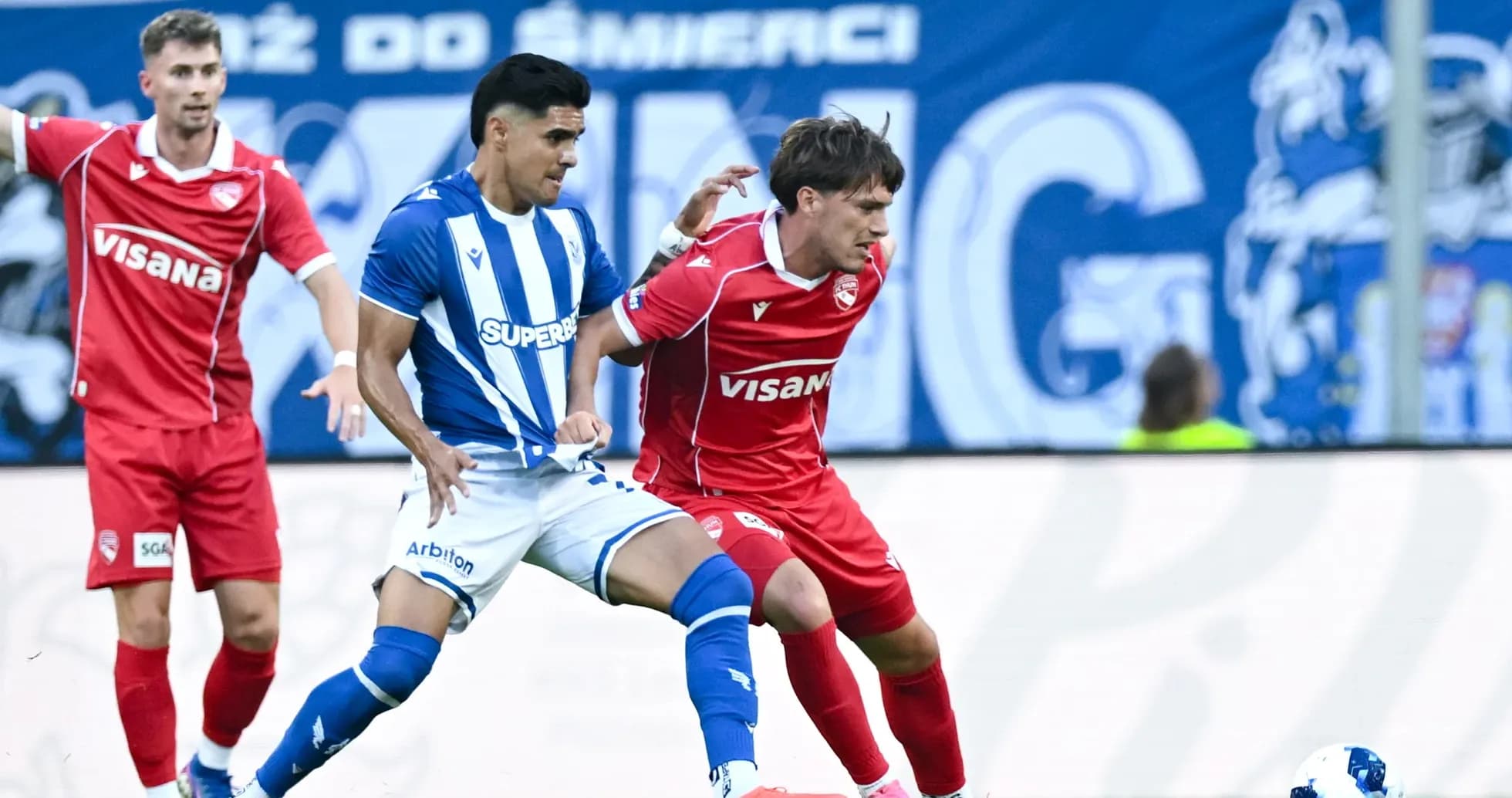
Lech Poznan’s 7-0 dismantling of FC Thun at Enea Poznań was a tactical rout built on structural superiority and ruthless execution rather than simply a bad night for the visitors. With 56% possession and an 11–4 advantage in shots on goal, Niels Frederiksen’s 4-2-3-1 systematically overloaded every line of Thun’s 4-4-2, turning the Play-offs tie into a one-sided demonstration of spacing, rotations and pressing triggers.
Lech’s base shape was a classic 4-2-3-1, but functionally it behaved like a 2-3-5 in settled possession. Full-backs J. Pereira and M. Gurgul pushed high and wide, pinning Thun’s wide midfielders. The double pivot of A. Kozubal and R. Murawski stayed staggered: Murawski slightly deeper to connect with the centre-backs, Kozubal higher to break lines and support circulation on the right. Ahead of them, P. Rodriguez as a central playmaker and the dual tens L. Palma (from the left) and P. Walemark (from the right) constantly rotated inside, leaving the flanks to the advancing full-backs.
The early goals reflected this structure. At 10', Walemark’s opener came from Lech’s ability to isolate him between Thun’s full-back and wide midfielder, a direct consequence of the wide occupation by Gurgul and Palma on that side. Thun’s 4-4-2 line could not shift quickly enough horizontally, and the first line of two forwards offered little protection to the double pivot, leaving passing lanes open from the back into the half-spaces.
At 20', A. Sayyadmanesh’s strike, assisted by Rodriguez, highlighted Lech’s vertical threat. With Thun’s midfield stretched laterally, Rodriguez received between the lines, turned under minimal pressure and fed Sayyadmanesh making a curved run off the shoulder of the centre-backs. The 4-4-2’s flatness was exposed: no holding midfielder dropped in to track the runner, and the centre-backs were forced to defend both depth and ball-carrier simultaneously.
The 25' and 31' goals underlined how Lech weaponised set and second-phase situations with their structure. Walemark’s second, assisted by Gurgul, again came from right-side overloads: the full-back’s advanced position created a simple passing triangle that Thun’s wide midfielder could not cover alone. When M. Skrzypczak scored at 31' from Kozubal’s assist, it followed another spell where Thun’s block was pinned deep, unable to push out because Lech’s rest defence—Skrzypczak and W. Monka behind Murawski—was well positioned to control any clearance.
The fifth goal, by Murawski at 45' from another Rodriguez assist, captured Lech’s dominance in central corridors. With Thun already mentally in survival mode, Murawski stepped higher from the pivot line into the edge of the box, untracked by either forward or midfield line. Rodriguez again occupied the pocket between Thun’s midfield and defence, drawing markers and laying off into Murawski’s stride. The 5-0 half-time scoreline matched the territorial reality: Lech’s 56% possession understated how often they had the ball in advanced zones, while Thun’s 16 fouls showed a side constantly arriving late to duels.
After the break, substitutions did little to alter the pattern. D. Hakans’ introduction for Walemark at 37' gave Lech fresh legs in the right half-space; he needed only two minutes of second-half play to score at 47', assisted by Sayyadmanesh. Again, it came from a right-side overload: Sayyadmanesh drifting wide, Hakans underlapping into the box, and Thun’s back four torn between tracking runners and holding the line.
Thun’s triple substitution wave around half-time—F. Dursun for M. Gutbub at 45+1', then T. Strannegård for M. Heule and F. Saiz for N. Zoukit at 46'—was an attempt to inject energy and add ball progression from deeper areas. Structurally, though, the 4-4-2 remained vulnerable. The brief attacking spark they did find was snuffed out when a potential goal by Dursun was disallowed by VAR at 66', a rare moment when Lech’s rest defence was stretched and Thun attacked with depth.
As the game moved into the final quarter, Frederiksen rotated intelligently without breaking the structure. R. Gumny for Rodriguez and G. Berggren for Palma at 64' shifted Lech closer to a 4-3-3 in possession, with Berggren playing more as a third midfielder and Gumny reinforcing the right flank. The sixth goal at 79', scored by Gumny from another Gurgul assist, reflected this: Gumny arriving from deep on the right, exploiting a tired Thun left side that had been chasing overloads all evening.
Further changes—K. Delikat for Kozubal and W. Szymczak for Sayyadmanesh at 80'—maintained intensity in the middle and up front, ensuring Lech’s pressing and counter-pressing didn’t drop. Even at 6-0, they continued to lock Thun into their own half after turnovers, with Murawski still stepping aggressively to close second balls despite his late yellow card at 87'.
From a defensive perspective, Lech’s control was as much about structure as about individual duels. With FC Thun limited to 4 shots on goal and 3 off target, the home side’s compactness between lines and aggressive counter-pressing meant M. Lis (Lech Poznan) was rarely exposed to high-quality chances. The double pivot always ensured one player screened passes into the Thun forwards, while the centre-backs held a relatively high line, compressing the space in which Thun’s midfield could operate. Thun’s 3 corner kicks were largely their only route to sustained attacking positions.
Thun’s 16 fouls and 2 yellow cards contrasted sharply with Lech’s 8 fouls and single booking, underlining the different defensive realities. Thun’s back four and midfield line were repeatedly forced into reactive defending—late tackles, pulls and blocks—because their first pressing line in the 4-4-2 failed to slow Lech’s build-up. The absence of any recorded goalkeeper saves for either side in the statistics, combined with Lech’s 11 shots on goal, suggests that many of Lech’s efforts were either extremely clear-cut or finished from positions where the goalkeeper had little realistic chance, reinforcing the impression of a structural mismatch rather than a mere finishing hot streak.
In sum, Lech Poznan’s 7-0 win was the product of a clear tactical plan: wide full-backs, rotating tens, a disciplined double pivot and relentless pressing. FC Thun’s 4-4-2 never solved the problem of protecting the half-spaces or controlling Rodriguez and the wide playmakers, and the statistical profile—possession edge, heavy shot advantage, and a stark foul disparity—mirrored the tactical gulf on the pitch.