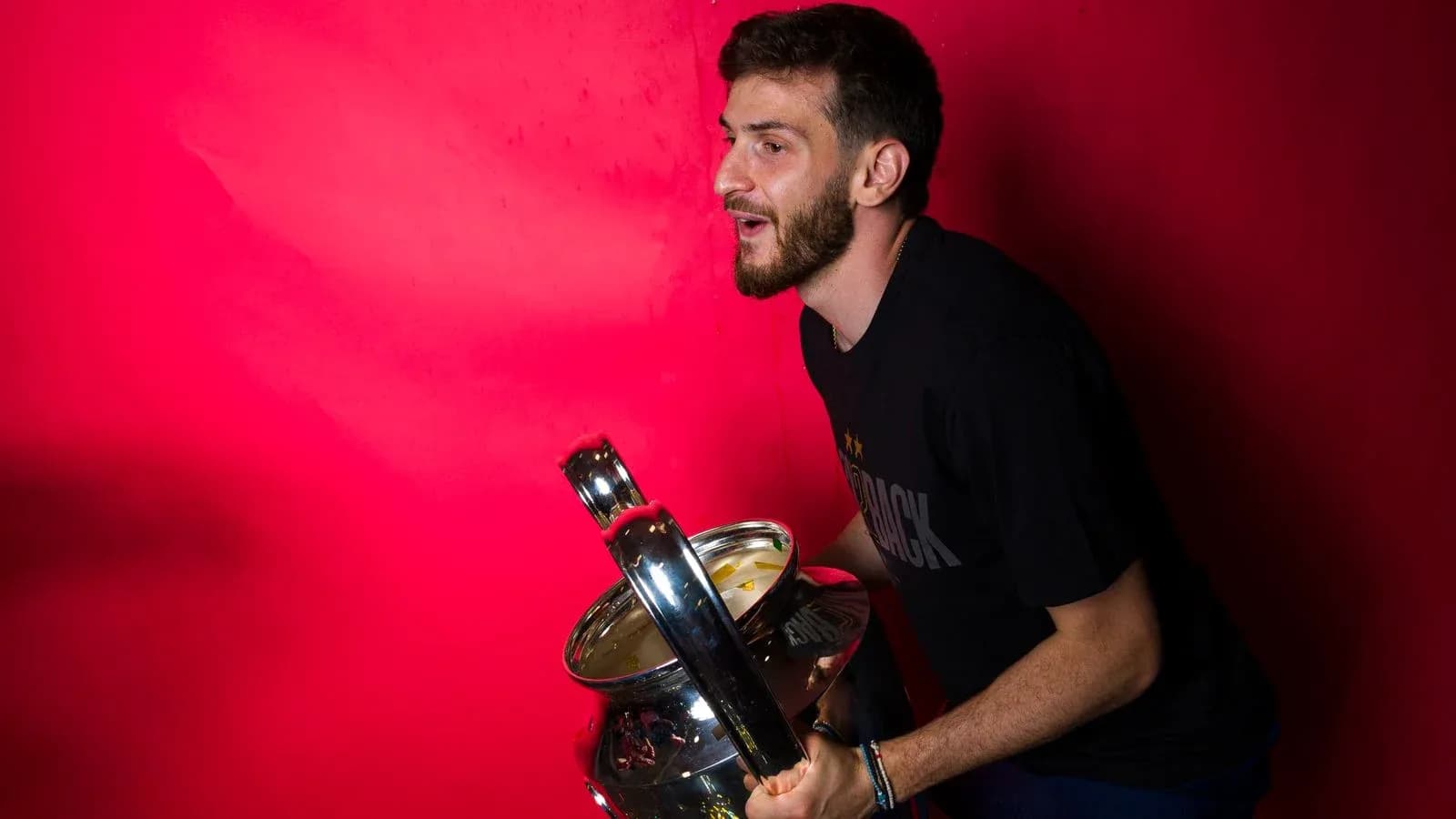
Khvicha Kvaratskhelia: PSG’s Champions League Star
The World Cup was sold as a festival for the biggest names on the planet. They delivered. The stars shone, the narratives wrote themselves, and the global stage felt full.
But as the club game returns with the UEFA Super Cup in Salzburg, the spotlight swings back to a man who watched that tournament from home. Khvicha Kvaratskhelia is walking back into the light.
The 25-year-old arrives not as a supporting act, but as the reigning Champions League player of the season, the driving force behind Paris Saint-Germain’s successful title defence in May. He comes into August eyeing a threepeat in Europe’s premier competition, determined to remind everyone that one of the continent’s outstanding footballers never set foot at the World Cup.
The catalyst of a new PSG
PSG’s recent era has no shortage of headline names. Marquinhos has twice lifted the Champions League trophy in their colours. Desire Doue and Vitinha collected man-of-the-match awards in the finals in Munich and Budapest. Ousmane Dembele climbed all the way to the Ballon d'Or on the back of that first historic triumph.
Yet the hinge moment, the shift from nearly-men to a snarling, relentless European force, arrived with one transfer: Kvaratskhelia from Napoli in January last year.
Before he landed in Paris, PSG’s European campaigns felt strangely flat. The talent was there, the results sometimes too, but there was an absence of edge, of chaos, of something that could tilt a tie on its axis.
That gap closed the moment Kvaratskhelia pulled on the shirt.
He turned PSG into a pressing machine. His ferocious work without the ball and his constant willingness to drive at defenders meshed perfectly with Luis Enrique’s demands. It did more than that. It dragged standards up around him, particularly in the forward line, where coasting suddenly became impossible.
Aston Villa, waiting for them in this season’s UEFA Super Cup, have already felt the full force. In the first leg of last season’s 2025 quarter-final, it was Kvaratskhelia’s dancing feet that left Axel Disasi twisted and tormented. Over two legs, that tie was arguably PSG’s sternest test in the knockout rounds. He treated it like a stage.
Last season, he went up another gear when it mattered most. From the play-off round onwards, no player scored more Champions League goals. He also produced more assists from open play than anyone else in the competition. When the tournament narrowed and the pressure rose, he kept deciding games.
The body of work is starting to look imposing.
From ‘Kvaradona’ to Paris
Long before Paris, Kvaratskhelia had already rewritten history in Naples. He was the man who helped drag Napoli to the Serie A title, ending a wait so long it had become mythologised around one name: Diego Maradona. That is where the ‘Kvaradona’ nickname came from, a nod to the idea that only a once-in-a-generation talent could do it again.
But the comparison, flattering as it is, does not quite capture what makes him so compelling.
Part of the fascination is that he feels like a genuine one-off. In an era of academy-polished forwards and data-model prototypes, Kvaratskhelia looks and plays like an outlier. There is no obvious twin for him in world football, either in style or in story.
Many of his PSG team-mates are products of a system. France churns out talent through a refined development model, a conveyor belt that keeps feeding elite clubs. England’s overhaul of its academy structure, combined with the financial and competitive power of the Premier League, has produced its own wave of stars, honed in pristine environments.
Kvaratskhelia came through a different route.
Leonid Slutsky, his coach at Rubin Kazan, captured that in 2023. “Nobody knew about him before he came to Italy and that is understandable,” he said at the time, before delivering the line that still echoes around Naples: “I congratulate Napoli because they won the lottery.”
Slutsky spoke of his “abnormal thinking” on a football pitch, his instinct to see and attempt things others would not consider. That thread runs through the accounts of those who saw him early.
Xisco Munoz, who played and coached at Dinamo Tbilisi, believes the answer lies in where Kvaratskhelia learned the game. “In Spain, we stop and pass, maybe learning on a training ground or at school,” he told Sky Sports. “In Georgia, it is street talent. In Georgia, they play their football on the street. They have to fight and have the contact. It is difficult to teach this in school.”
The street is in his game: the feints that feel improvised, the touches that wrong-foot defenders who thought they had read the pattern.
David Webb, who worked with him in the Georgia national-team set-up, remembers something else – an obsession. Kvaratskhelia was a nightmare to get off the training ground. Webb describes him as “very process-driven”, a player who repeats and refines rather than performing tricks for effect. This is not a YouTube winger. This is a craftsman.
A World Cup absence and a Ballon d'Or problem
Against that backdrop, Georgia’s failure to qualify for the World Cup this summer cuts both ways for him.
On the one hand, it finally gave him something he had not had for years: a break. He had dragged his country to Euro 2024. He had gone deep into the Club World Cup last year. Every summer seemed to bleed into the next. This was his first real chance to refresh body and mind.
On the other hand, the decision-makers for the Ballon d'Or tend to look first at the biggest international stage. Kevin Keegan once won the award in a World Cup year without playing in the tournament because England had not qualified, but that was a different era, when only European players were eligible and Argentina had just lifted the trophy.
Now, Kvaratskhelia is fighting a different tide. The 2026 World Cup created a cluster of Spanish world champions. Kylian Mbappe and Harry Kane have stacked up extraordinary scoring numbers for club and country. The narrative weight leans heavily towards them.
That is where nights like the UEFA Super Cup come in.
This is not just a curtain-raiser in Salzburg. For Kvaratskhelia, it is a platform to reassert himself, to remind voters and viewers that the most consistently decisive player in Europe’s toughest club competition wears PSG colours and plays off the flank like a man permanently on fast-forward.
His individual brilliance still decorates PSG’s play – the step-overs, the sudden gear changes, the passes nobody else sees. But it also drives them, sets the tone for the team currently operating at the highest level in Europe.
Khvicha Kvaratskhelia, last season’s outstanding Champions League performer and Paris Saint-Germain’s warrior winger, steps into another campaign with the same intent: to bend the biggest nights to his will, and to drag the conversation back to his name.