Kairat Almaty vs Anderlecht Tactical Analysis: A 0-3 Defeat
Kairat Almaty’s 4-4-1-1 at Central Stadium was structurally conservative but quickly came under severe stress, and the tactical narrative of the 0-3 defeat to Anderlecht was essentially decided in the opening half-hour. Anderlecht’s 4-3-3, built on a dominant midfield three and high territorial control, turned 67% possession into early scoreboard pressure and forced Kairat into reactive defending long before the red card made the task impossible.
From the outset, Kairat’s shape was clear: a back four of E. Tapalov, A. Shirobokov, Lucas Africo and L. Mata, screened by a flat midfield line including A. Mrynskiy, J. Oksanen, G. Mendonsa and O. Jukkola, with M. Gual supporting Edmilson. The idea was to have Oksanen and Mendonsa as central pivots, Jukkola tucking in from the flank, and Gual linking play between the lines. However, Anderlecht’s structure directly targeted this central block. With L. Ambros and E. Llansana operating as advanced midfielders ahead of M. Kana, and full-backs L. Augustinsson and A. Maamar pushing high, the visitors consistently created overloads in the half-spaces.
The second-minute own goal from J. Oksanen was emblematic of the pressure Kairat were under in their own box. Even without detailed shot maps, the contrast in blocked shots (Kairat 1, Anderlecht 5) underlines how often Anderlecht were able to shoot from threatening zones and how much of Kairat’s defending was last-ditch. Anderlecht’s front three of M. Cvetkovic, D. Sikan and J. Nga Kana stretched the Kairat back line horizontally, while Ambros and Llansana arrived late into central pockets, forcing Kairat’s wide midfielders to collapse inside and leaving the flanks exposed.
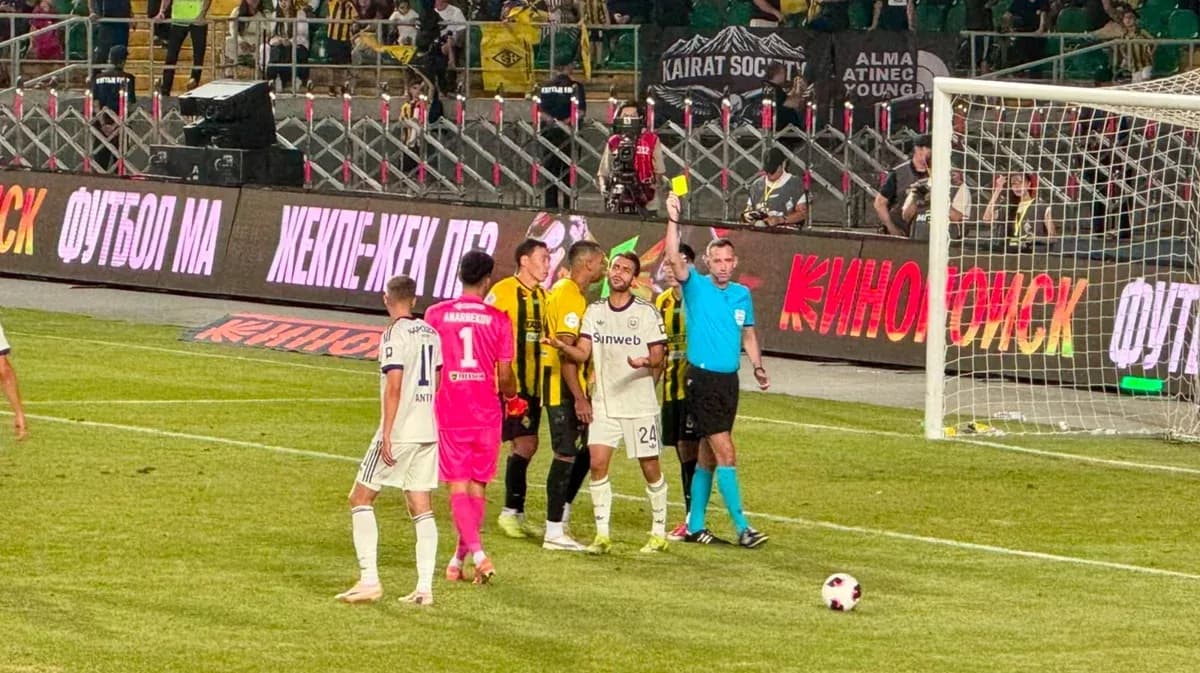
The 24th-minute goal by L. Ambros came as a direct reward for that positional superiority. With Kairat already sinking deeper, Ambros was able to find room between the lines, and the lack of pressure on the ball from Kairat’s midfield allowed Anderlecht to progress cleanly through central channels. The red card for A. Shirobokov at 39 minutes then broke what was left of Kairat’s defensive cohesion. Reduced to ten, Kairat could no longer maintain compact horizontal distances; the back four became a back three in many sequences, with full-backs forced to narrow in and concede even more territory out wide.
Anderlecht’s third, from D. Sikan at 45 minutes, assisted by Ambros, was the tactical kill shot: a classic exploitation of a short-handed and mentally shaken defensive unit. Ambros’ influence as both scorer and provider underlined how central his advanced midfield role was to Anderlecht’s game plan. By half-time, the 0-3 scoreline matched the tactical reality: Kairat’s 33% possession and only 2 shots on goal reflected a side unable to build any sustained attacking structure.
Second Half Adjustments
In the second half, both coaches adjusted, but from very different starting points. Rafael Urazbakhtin’s changes for Kairat — O. Baybek (IN) came on for A. Mrynskiy (OUT) at 46', A. Tuyakbaev (IN) for M. Gual (OUT) and I. Bekbolat (IN) for Edmilson (OUT) at 60', then L. Kurgin (IN) for L. Mata (OUT) and A. Sadybekov (IN) for J. Oksanen (OUT) at 72' — were largely about energy and damage limitation rather than a radical structural shift. Down a man and three goals, Kairat tried to refresh the wide areas and midfield legs, but the base 4-4-1-0/4-4-1 remained, with increasingly sporadic counter-attacks.
Vitor Bruno’s Anderlecht, by contrast, used their substitutions to manage the tempo and protect the advantage without sacrificing control. T. Degreef (IN) for M. Cvetkovic (OUT) at 46' and O. Antman (IN) for J. Nga Kana (OUT) at 63' allowed rotation in the front line and wide channels, while M. Winkler (IN) for A. Maamar (OUT) at 74' and N. Ojea (IN) for E. Llansana (OUT) at 84' freshened the midfield and full-back zones. A. Bertaccini (IN) for D. Sikan (OUT) at 84' was a classic late-game substitution: protecting the primary striker and maintaining pressing intensity from the front.
Discipline subtly shaped the match flow. Anderlecht accumulated 4 yellow cards, Kairat 1 yellow and 1 red, and the foul count (Kairat 11, Anderlecht 17) suggests that while Anderlecht were more aggressive in duels, Kairat’s infractions were fewer but more costly, with Shirobokov’s dismissal fundamentally altering their defensive platform. The lack of recorded reasons in the data prevents deeper categorization of these cards, but the distribution aligns with a pattern of Anderlecht making more tactical fouls high up the pitch, while Kairat’s crucial error came in a deeper, more dangerous zone.
Statistically, Anderlecht’s 4 shots on goal to Kairat’s 2 and their 8 corner kicks to Kairat’s 2 underscore the territorial dominance that the possession numbers already imply. Kairat’s inability to generate volume — with Total Shots and expected goals not specified — still emerges clearly from the context: few attempts, little sustained pressure, and a structure that was always more concerned with containment than creation, especially after going down to ten men.
In summary, this was a match where Anderlecht’s 4-3-3 imposed itself both with and without the ball. Their midfield triangle, led by an influential L. Ambros, consistently outnumbered and outmaneuvered Kairat’s central line, forcing errors and creating high-quality opportunities. Kairat’s 4-4-1-1, already stretched by Anderlecht’s width and rotations, collapsed once A. Shirobokov was sent off, turning the final 50 minutes into an exercise in survival rather than a realistic comeback attempt. The 0-3 scoreline, the possession split, and the shot profile together paint a coherent tactical picture of Anderlecht’s controlled, structurally sound away performance.