José Mourinho Returns to Real Madrid: A Familiar Yet Different Era
José Mourinho is back at Real Madrid, and somehow the story feels both familiar and utterly different.
Fourteen years ago, he arrived to break Barcelona’s spell over Spain, fresh from watching a Barça core deliver the World Cup to Spain. Back then, a Barça player decided the final in extra time against a 10-man opponent who had tried to kick them into submission. Now, again, he walks into a league ruled by a Barcelona side chasing a third straight title. Again, he has a squad stacked with stars. The names have changed; the mission has not.
One constant towers above all: Florentino Pérez. The president who hired Mourinho the first time has effectively bet his late-era legacy on him the second. After last summer’s failed push for Xabi Alonso – driven largely by chief executive José Ángel Sánchez – Pérez has taken personal control. He went to elections in June with a promise: re-elect me and Mourinho returns. The announcement landed with typical Pérez theatre, dropped on the opening day of the World Cup.
From the outside, it looks like a throwback. Inside Spanish football, many insist it isn’t.
“Almost 15 years have passed: football is no longer the same, society is not the same, Florentino is no longer the same, and Mourinho certainly won’t be either,” Jorge Valdano told A Bola.
Valdano, who worked upstairs during Mourinho’s first spell, has seen enough to know that time changes everyone – even those who pretend it doesn’t.
What hasn’t changed is Madrid’s appetite for a disciplinarian when the club descends into chaos. Mourinho has returned as the law-and-order candidate.
Last season disintegrated. Alonso’s sacking in January didn’t steady the ship; Álvaro Arbeloa’s promotion only underlined how messy things had become. In May, Federico Valverde ended up in hospital needing stitches after a bust-up with Aurélien Tchouaméni. Days later, Madrid surrendered the league in the clásico and finished the campaign without a trophy. Off the pitch, an online petition demanding Kylian Mbappé’s departure spiralled to 30 million signatures. Vinícius Júnior, down to the final year of his contract, lived under a constant fog of speculation.
This summer has felt different. Not perfect, but calmer.
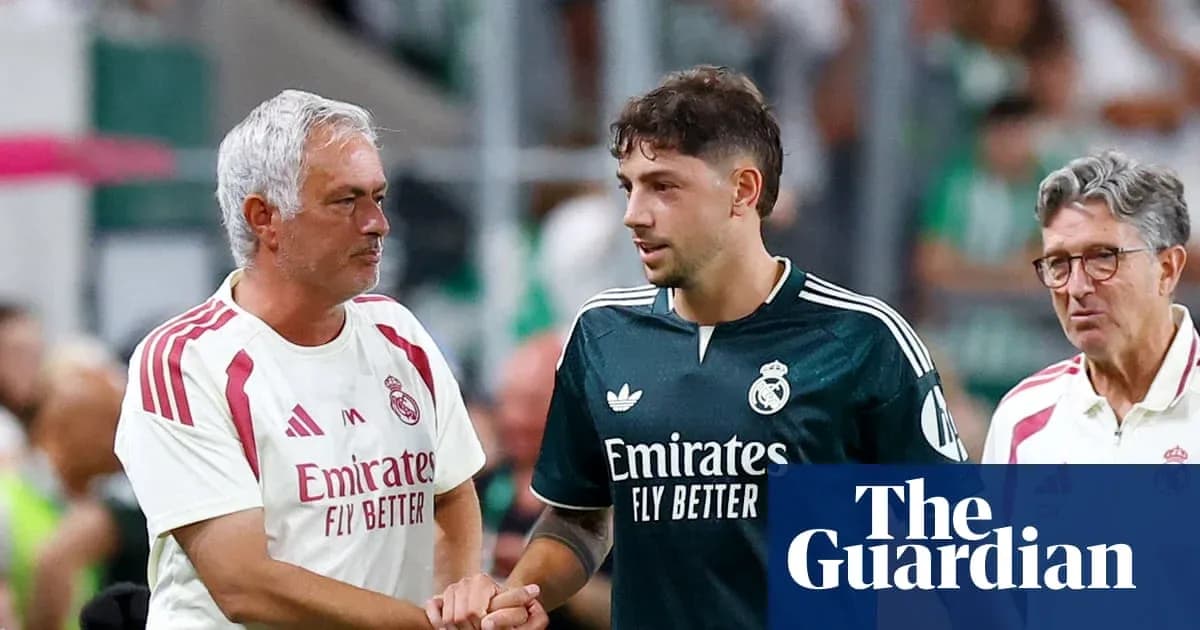
A £129m bid for Julián Álvarez was knocked back by Atlético Madrid. Barcelona look better placed to land Rodri from Manchester City. Those blows would once have triggered a public storm around the Bernabéu. Instead, Madrid have gone quiet. No glossy unveiling for Mourinho, no grand press conference. He started work a month before his contract officially kicked in and limited his words to a terse in-house interview at the start of pre-season.
“It’s not about working at Real Madrid, it is working for Real Madrid,” he said, jaw set, in a clip that lasted seconds.
The rest of the Mourinho content has been outsourced to his Netflix documentary. The club have skipped the usual global summer circus, settling for low-key friendlies around Europe.
The single most important piece of business came on the left wing. After months of Arsenal chatter, Vinícius signed a new six-year deal.
“Vinícius has become one of the most important players in one of the most successful periods in our history,” the club declared.
Now Mourinho must solve the tactical puzzle that defines Madrid’s season: how to fit Vinícius, Mbappé and Jude Bellingham into a coherent system while making room for the new galáctico, Yan Diomandé.
Diomandé is the wild card in all of this. Twelve months ago, he was playing for Leganés B in Spain’s fifth tier. Madrid have just paid £115m for him.
His first encounter with the Bernabéu came in March 2025, when he made his Leganés debut there at 18. “Who makes their debut at 18 against Real Madrid? It was a dream. And then it was a nightmare,” he wrote in the Players’ Tribune this summer, during a breakout World Cup with Côte d’Ivoire. The piece, raw and unvarnished, was dedicated to his sister Roxane, who died aged 15 after her drink was spiked at a party, only weeks after his La Liga debut. That grief, he said, never really left him.
Now he returns to that stadium in white.
Down his flank, he and Vinícius will have a familiar foil. Marc Cucurella has arrived to patrol the left side, a signing whose energy and tactical discipline look tailor-made for Mourinho. So do Bernardo Silva, Ibrahima Konaté, Denzel Dumfries and the 6ft 4in striker Carlos Espí. It is a squad built with clear lines in mind, players who can take instruction and repeat it at high speed.
Yet for all the new faces, the main attraction is still the man on the touchline.
Mourinho’s reappointment is a comeback few expected after his Premier League decline and a European tour that delivered flashes of the old brilliance alongside long, flat stretches. His name roared back into the headlines last season when he masterminded Benfica’s astonishing Champions League escape against Madrid, capped by goalkeeper Anatoliy Trubin scoring late. That night felt like classic Mourinho: siege mentality, chaos, and then a punchline.
The aftermath was less flattering. When Vinícius accused Benfica’s Gianluca Prestianni of racist abuse, Mourinho’s comments disappointed many. Prestianni was eventually banned by Uefa for “homophobic conduct”, but Kick It Out condemned Mourinho’s reaction as “a form of gaslighting”. Arbeloa, asked about the controversy, shrugged: “Mourinho is Mourinho.”
Vinícius has chosen to move on. Back at Valdebebas for pre-season, he sounded relaxed.
“It has gone very well, getting to know the new coach … Mourinho wants me to be as I have always been: happy, cheerful and playing my football,” he said.
There has been no public hint of lingering tension.
La Liga itself is also rediscovering some old faces.
Racing Santander return to the top flight for the first time since 2012 and have brought home one of their own. Sergio Canales, now 35, left Racing at 19 to join Mourinho’s Madrid in that feverish summer of 2010. “I’m still struggling to believe this is real,” he admitted last month as he pulled on the green and white again.
Deportivo and Málaga are back too, both climbing from the depths of the third tier to reclaim their seats at the top table for the first time since 2018. Deportivo’s marquee signing is a familiar name with a different pace: 37-year-old Pierre-Emerick Aubameyang.
The dugouts tell their own story. Diego Simeone, starting his 15th full season with Atlético Madrid, will renew old hostilities with Mourinho in a Madrid derby that suddenly feels like a throwback to another era. Atlético have stepped into life after Antoine Griezmann by spending decisively, signing Lee Kang-in from Paris Saint-Germain and handing him Griezmann’s No 7 shirt.
At Real Betis, Manuel Pellegrini – the man Mourinho once replaced at the Bernabéu – continues to quietly build. Villarreal, the fifth Spanish side in this season’s Champions League, have turned to Iñigo Pérez after his impressive work at Rayo Vallecano.
Up in San Sebastián, Pellegrino Matarazzo, the American in charge of Real Sociedad, has a different kind of problem: how to follow a Copa del Rey triumph in April. Across the Basque divide, Athletic Club have gone German for the first time since Jupp Heynckes in 2003. Heynckes offered a simple piece of advice to the new man, Edin Terzic, before he took the job.
“Athletic is the only club where a handshake is more important than a signature,” he told him.
And then there is Barcelona, the team Mourinho has always been measured against in Spain.
They start the season as favourites again, even after Robert Lewandowski’s move to Major League Soccer. His exit has left a gap at centre-forward, and Atlético’s refusal to budge on Álvarez keeps it open. Anthony Gordon has come in to replace Marcus Rashford on the left, where he will scrap with the fragile brilliance of Raphinha. On the opposite flank, with respect to Karim Adeyemi, there is no real debate.
That side belongs to Lamine Yamal.
He did not light up the World Cup in the way many expected, but he came back from America as a world champion and, crucially, still only 19. If Hansi Flick is to emulate Pep Guardiola and deliver three consecutive league titles, Yamal will almost certainly be the ringleader again.
The first clásico arrives at the Camp Nou at the end of October. By then, Spain will know whether Mourinho’s second act in Madrid is a nostalgic rerun or the start of something sharper, harder and new.