José Mourinho’s Return to Real Madrid: A Dramatic Victory
José Mourinho stayed in his seat.
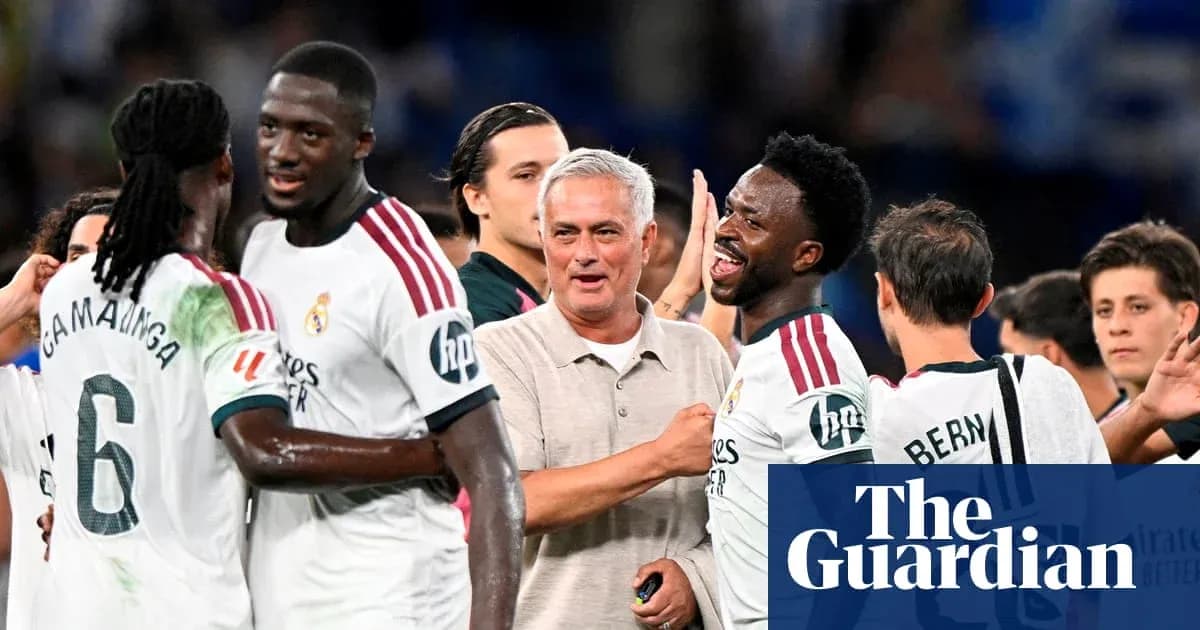
As the Real Madrid bench exploded past him, substitutes and staff sprinting down the touchline to throw themselves at Carlos Espí in the corner, the new coach rose slowly, clenched his fists and walked, not ran, towards the chaos. He watched the pile-on, shouted towards his young striker, then dragged his captain Fede Valverde in for a quiet word.
Ninety minutes into his first game back in charge of Madrid after 4,380 days away, the winning goal had finally arrived. The feeling, you sensed, was simple enough: relief.
Mourinho’s second coming, decided by a kid
For all the noise around this Madrid – the supernova front line of Kylian Mbappé, Vinícius Júnior and Jude Bellingham, the record signing of Yan Diomande – it was a 21-year-old who barely registered on the wider radar six months ago who decided it.
Espí, plucked from Levante after his goals kept them in the division last season, was brought in to be exactly this: an old-fashioned No 9, a body in the box, a striker who lives between the posts. He is still living at Valdebebas, like his manager, sharing breakfast with Mourinho every morning. On this night, he paid for the room.
When a scruffy, broken move in the 90th minute ended with Mbappé losing control of the ball inside the area, Espí was there, exactly where a classic centre-forward should be, to force it over the line. A poacher’s finish, a huge question attached: is this just the emergency option, or a profile Madrid might actually need more often?
On this occasion, at least, his presence changed everything.
The circus returns, reality bites
Mourinho’s first match on the Madrid bench since a 4-2 win over Osasuna in May 2013 began as you would expect. Photographers abandoned their positions behind the goals to swarm around him. The attraction was obvious.
It ended very differently: Mourinho embracing Espanyol coach Manolo González, high-fiving the referee and disappearing down the tunnel with three points in his pocket and a few truths in his head. Between those two moments, the gloss peeled back a little.
He had warned that Espanyol were a good side. At times, they proved it. Madrid created more, but Manolo’s team restricted them enough to keep the Bernabéu giants uneasy. On a night when some of Madrid’s old flaws resurfaced, doubts remained. It is the opening day, but the questions are familiar.
There will be tougher opponents than Espanyol. There will also be tougher nights for Mourinho’s self-proclaimed calmer temperament.
Nostalgia, power and a president who never let go
When Madrid met Benfica in the spring, Mourinho had described his first spell in Spain as “three hard, intense, sometimes violent years”. Time has a way of softening the edges. The fights fade; the trophies stay.
Mourinho insists he is not a man who “misses anything”, that he lives without regrets. Others missed him enough for both. Florentino Pérez most of all. In a world where coaches are often treated as a necessary evil, the Portuguese remains the one manager the president genuinely liked.
Some inside the club had longed for that same intensity again, even the “violence” of it: a hard man to drag them forward, to fight their rivals, to impose his personality on a squad they felt had grown too comfortable. However messy the end had been last time, Pérez never entirely shook the idea that the six Champions League titles Madrid won after Mourinho left still belonged partly to him. In his mind, Mourinho had lit the path.
On the eve of this game, Mourinho told a story. After every trophy Madrid won, Pérez called him. “I always said no, no, no, it was nothing to do with me,” Mourinho smiled – a neat way of saying it had a bit to do with him. Pérez has said much the same.
It took 13 years for the president to finally give in to that urge. Mourinho was back.
Why not? The last great returnees – Zinedine Zidane and Carlo Ancelotti – had delivered. The others had not. When Mourinho finished that story, he pointed out that the trophies belonged to Zidane and Ancelotti, then almost innocently checked that no one else had won anything. The diagnosis of Madrid’s current malaise, he implied, needed his surgery too.
Just as in 2010, Madrid had slipped behind Barcelona. No major title for two years, a slide that spoke of culture as much as tactics.
Non‑negotiables and a squad on notice
Effort alone will not fix this Madrid, but for Mourinho it is the first line in the prescription.
“We have to try not to negotiate things that are non-negotiable,” he said. “Commitment can’t be missing.”
He has the authority to demand that. Or so the theory goes. Training habits have been challenged, standards raised. Sessions have sharpened up – or at least the players’ attitude to them has. Diomande declared he was ready to “die” for his coach. Mourinho dismissed it as just a phrase, but he did not exactly hate hearing it.
There were other reasons for optimism. Vinícius’s future is finally settled, the internal tension over status and role eased. The World Cup is done, no looming distraction.
Mourinho pointed out that Brazil, France and England had all found a way to get the best from Vinícius, Mbappé and Bellingham individually. Doing it with all three together is something else entirely. “I don’t think they’re incompatible,” he insisted. Last season, at times, it looked like they were, Bellingham himself admitting they drifted into the same spaces too often.
Here, all three started. Bellingham as a classic No 10, Vinícius pinned wide.
“For me this is his [Jude’s] position,” Mourinho said. “The connection with the forwards, he can score goals. He has to play close to the goal. Playing at 6 or 8 we’re losing his closeness to the goal.”
A perfect start, then a sudden drop
The new era’s first goal arrived early. Nine minutes in, Vinícius was fouled on the left – already a theme. Alex Calatrava had earlier raked his studs down Vinícius’s back, drawing an exasperated arm raise from Mourinho. This time, the punishment came.
Arda Güler whipped in a superb free-kick. Bellingham rose above everyone and buried his header past Marko Dimitrovic.
Mourinho, stationed on the far left of the bench, barely reacted. He stood, hands in pockets, and strolled down the touchline to the far side, where the overflow of his sizable staff were perched in the stand. There he shook hands with Sami Khedira, the in-house assistant provided by Madrid, and analyst Roberto Merella.
For a moment, it felt like the script would write itself. Madrid pressed high, Espanyol struggled to escape. The gulf between the sides looked vast. This, they might have thought, was the glimpse of the future.
Then the intensity leaked away. Espanyol saw the invitation and stepped in.
When Dean Huijsen needed treatment for a cut, Madrid’s players drifted towards Mourinho for instructions. The game, though, drifted away from them. Espanyol edged higher, and soon they were level.
Thibaut Courtois saved from Riedel, but Roberto Fernández could not keep the rebound down. The loose ball was recycled, Tuy Dolan and Javi Hernández combined neatly, and Calatrava arrived to finish. Mourinho sat almost motionless.
Espanyol threaten the upset
Mbappé burst free twice before the break, one chance from each side of the box, drawing sharp saves from Dimitrovic. Yet Espanyol created the moment that should have turned the match on its head.
Again they worked the ball into a crossing position on the right. Omar El Hilali delivered a brilliant ball across the six-yard box. Dolan stretched but could not quite reach it, and Fernández, arriving behind him, could only head the ball down into his own feet when the net beckoned.
Madrid escaped to half-time level, but not in control.
Just after the restart, Mbappé somehow failed to restore their lead. From a Güler corner, Bellingham’s header was tipped onto the bar by Dimitrovic. The ball dropped at Mbappé’s feet at the back post. He was almost on the line. He still put it wide.
Valverde hit the post. Mbappé shot wide. The chances stacked up, the goal refused to come. On the touchline, Mourinho turned to the cavalry: Marc Cucurella, Diomande, Eduardo Camavinga, Trent Alexander-Arnold, Espí. One by one, they joined the fight.
And then, right at the end, Espí tore past him to become the hero.
A win, with a warning attached
“I think we deserved to win, but Espanyol didn’t deserve to lose,” Mourinho said afterwards, a rare soft edge to his verdict.
Madrid had their late release, their storybook winner for the coach’s return. The president got his man back, the man got his victory, the kid from Levante got his moment.
The performance, though, told its own story. The surgery Mourinho promised has only just begun.