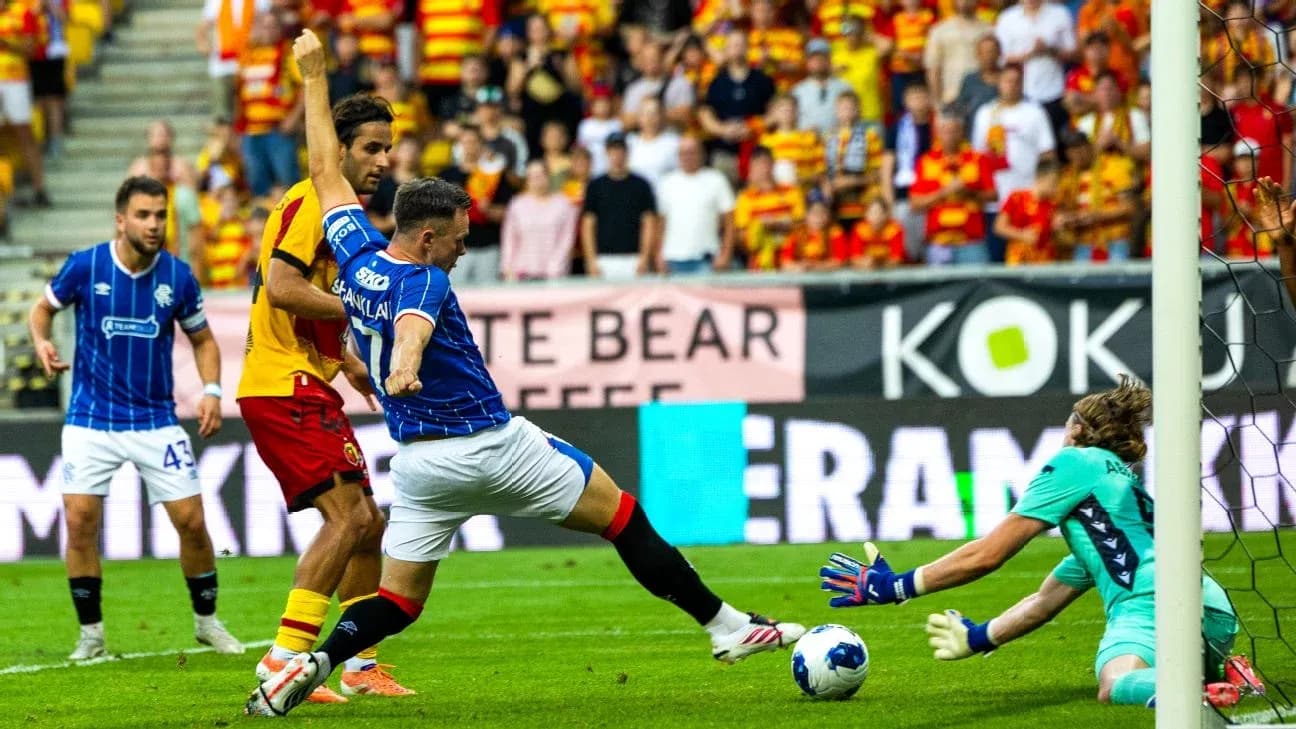
Jagiellonia’s Tactical Masterclass in 2-1 Win Over Rangers
Jagiellonia’s 2-1 win over Rangers at Chorten Arena was built on structural clarity and early-game aggression within Adrian Siemieniec’s 4-3-3, then protected by compactness without the ball. Rangers, in a 4-2-3-1 under Derek McInnes, carried more threat from wide and set plays but never fully solved the home side’s midfield block, despite a second-half substitution wave designed to tilt the game.
Jagiellonia’s shape was textbook: S. Abramowicz in goal behind a back four of G. Montoia, Y. Kobayashi, A. Konstantopoulos and N. Wojtuszek. In front, T. Romanczuk anchored as the central pivot, with S. Lozano and R. Conceicao initially giving a hybrid of a single pivot plus two shuttlers. Ahead of them, K. Szmyt and J. Imaz supported lone forward N. Prelec in a narrow front three that constantly looked to occupy the half-spaces rather than hugging the touchline.
That structure underpinned the home side’s slight edge in possession (52%) and, more importantly, their superior shot quality profile. Jagiellonia produced 7 shots on goal from relatively limited overall volume (with 3 shots off goal and no blocked efforts recorded), an indicator of clean chance creation rather than speculative shooting. Much of that came from quick vertical progressions once the first Rangers line was broken, using Romanczuk’s positioning to recycle second balls and allow Lozano and Imaz to receive between Rangers’ midfield and defence.
Second Half Changes
The turning point in game management came early in the second half. With Rangers chasing, McInnes triggered a triple substitution at 46': C. Devlin (IN) came on for T. Chukwuani (OUT), N. Raskin (IN) came on for D. Neil (OUT), and F. Curtis (IN) came on for D. Yokota (OUT). On paper, this refreshed the double pivot and attacking midfield lines, adding more energy and ball progression from deep. In practice, it shifted Rangers towards a more assertive central presence, with Raskin and Devlin trying to step higher to lock Jagiellonia into their own half.
Siemieniec’s response at 65' was decisive and conservative in equal measure. J. Agbonifo (IN) came on for R. Conceicao (OUT) and A. Klynge (IN) came on for S. Lozano (OUT), effectively injecting fresh legs into the midfield band while preserving the 4-3-3 structure. Agbonifo’s role was primarily defensive: tucking inside to form a narrow three in front of the back four, reducing the channels Rangers’ No. 10 and wide attackers could exploit. Klynge, meanwhile, offered work rate and simple ball circulation rather than high-risk progression, reflecting a shift from proactive to protective possession.
Rangers’ main route back into the match increasingly came from width and set plays. Their 5 corner kicks to Jagiellonia’s single corner underline how often they forced the ball into advanced wide zones and the box. Yet they managed only 3 shots on goal and 4 shots off goal, with just 1 blocked shot, suggesting that while they reached crossing positions, Jagiellonia’s central defenders, especially Konstantopoulos and Kobayashi, protected the zone in front of Abramowicz effectively and limited clear shooting lanes.
McInnes continued to chase the game with further changes: at 76', V. Dragojevic (IN) came on for T. Aasgaard (OUT), adding a different profile between the lines, and at 85' L. Shankland (IN) came on for R. McCrorie (OUT), a move that tilted Rangers towards a more direct, striker-heavy approach. This late structural tweak pushed Rangers closer to a 4-2-4 in possession, with Chermiti and Shankland offering dual penalty-box targets. However, without a sustained supply of quality deliveries, the numerical increase up front did not translate into a corresponding rise in high-quality chances.
Jagiellonia’s late substitutions at 80' further underlined their game-state management. D. Drachal (IN) came on for J. Imaz (OUT) and Y. Sylla (IN) came on for N. Prelec (OUT). Removing Imaz and Prelec, two of their more creative and forward-oriented players, signalled a clear priority: defensive solidity and transitional threat over sustained attacking. Drachal added fresh pressing energy from midfield, while Sylla provided a running outlet to stretch Rangers on the counter, forcing their back line to respect depth even as they pushed numbers forward.
Discipline also shaped the rhythm. Rangers committed 15 fouls to Jagiellonia’s 11, with three yellow cards to the visitors and one to the hosts. The accumulation of Rangers fouls reflected their need to break up transitions once they lost the ball in advanced areas, particularly after they committed more men forward in the second half. Jagiellonia’s single yellow suggested a more controlled defensive approach, relying on positional play and compactness rather than repeated tactical fouling.
Statistically, the balance of play supports the tactical narrative. Jagiellonia’s 52% possession was not about sterile circulation; it was a platform to engineer 7 shots on goal from relatively few total attempts, implying that when they reached the final third, they did so with structure and clarity. Rangers, with 48% possession, leaned on territorial pressure and set pieces, as shown by their 5 corners, but their 3 shots on goal underscored the home side’s success in protecting the central channel and limiting clear looks at goal.
In sum, Jagiellonia’s victory in this UEFA Europa League 3rd Qualifying Round tie was the product of a well-drilled 4-3-3 that maximized shot quality, then intelligently shifted into a more conservative, substitution-driven block once ahead. Rangers’ 4-2-3-1 and later attacking reshapes generated pressure and corners but lacked the precision and central penetration needed to overturn the deficit against a disciplined, structurally coherent home side.