Hradec Králové vs Beşiktaş Tactical Analysis: Structure and Control
Hradec Králové’s 3-4-2-1 and Beşiktaş’s 4-1-4-1 produced a match defined less by volume of chances and more by structure and game-state control, especially once the visitors were reduced to ten men. At Malsovicka arena, the Czech side tried to leverage width and vertical running from their midfield box, while Beşiktaş relied on a compact back four, a single pivot, and a fluid band of four attacking midfielders behind Oh Hyeon-Gyu.
Without the ball, Hradec Králové’s back three of F. Cech, F. Cihak and J. Uhrincat aimed to hold a relatively high line, trusting the double pivot of V. Darida and S. Dancak to screen central spaces. Wing-backs J. Kucera and D. Horak were essential to their pressing triggers: when Beşiktaş tried to progress via full-backs, Hradec Králové jumped aggressively, often pushing into a 5-2-3 or even a 3-2-5 in possession. That aggressive posture is reflected in their 10 fouls and early yellow card for Mick van Buren at 2', underlining a willingness to disrupt Beşiktaş’s build-up before it reached the final third.
In possession, the hosts sought to overload the half-spaces with M. van Buren and T. Sloncik (before his substitution) operating off O. Mihalik. The 3-4-2-1 morphed into a narrow front three, trying to pin the Beşiktaş centre-backs and full-backs simultaneously. The result was a healthy attacking output: 9 shots on goal from Hradec Králové, supported by 8 corner kicks. Those numbers show that they consistently reached finishing zones and forced Beşiktaş to defend deep, especially in the second half. However, the absence of any recorded total shots and xG data makes it impossible to quantify shot quality; what is clear is that Beşiktaş’s defensive line, despite conceding volume, limited clear-cut conversions.
Beşiktaş’s 4-1-4-1 was built around S. Ozcan as the single pivot, with V. Cerny, J. Olaitan, O. Kokcu and I. Fakili forming a flexible line of four. Early on, they accepted a slightly lower share of possession (they finished with 52% to Hradec Králové’s 48%), preferring to control central lanes and spring forward through the half-spaces. Their shot profile — 5 shots on goal but 11 shots off goal, plus 6 blocked shots — indicates a side that reached shooting positions frequently but often from less-than-ideal angles or under pressure. The 6 blocked shots, in particular, speak to Hradec Králové’s willingness to throw bodies in front of efforts around the box, with the back three stepping out aggressively.
Disciplinary Sequence
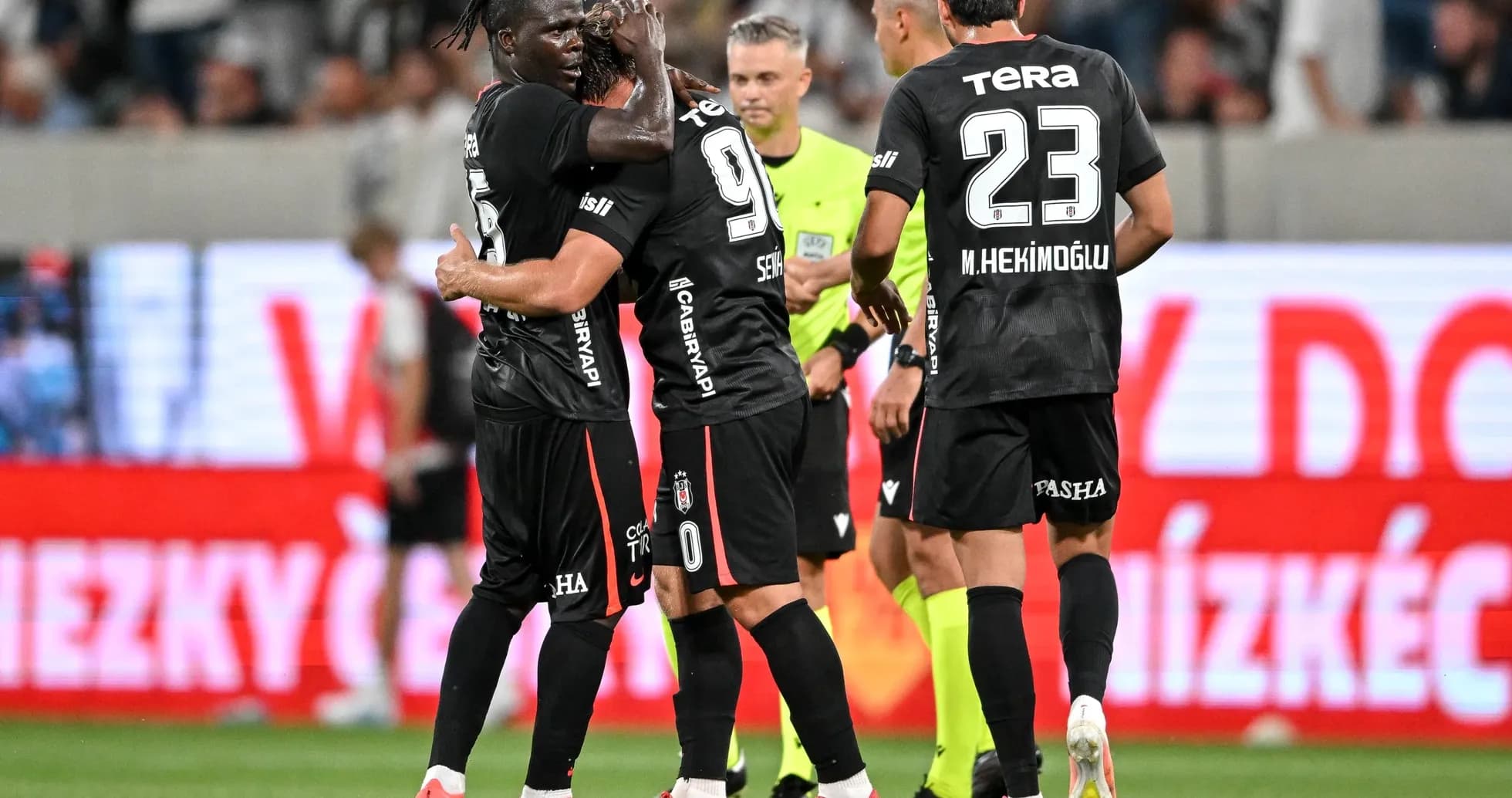
The disciplinary sequence significantly shaped the tactical landscape. Beşiktaş accumulated 3 yellow cards and 1 red, all concentrated on their defensive unit and centre-forward: V. Cerny was booked at 37', Kassoum Ouattara collected yellows at 65' and 71' and was then sent off with a red at 71', and Hyeon-gyu Oh received a yellow at 83'. Even though the card reasons are not specified, the pattern suggests repeated defensive interventions on Hradec Králové’s left flank, where Ouattara was tasked with dealing with Kucera and the left-sided forward. His dismissal forced Beşiktaş to re-balance their shape, likely tucking a wide midfielder into the back line and flattening the 4-1-4-1 into a deeper 4-4-1 block.
Remarkably, Beşiktaş’s attacking efficiency improved after the red card in terms of outcome, if not volume. With fewer players, they focused on direct transitions and selective pressing. The decisive goal from S. Kilicsoy at 80' came in this phase, when Hradec Králové had tilted the field and committed numbers forward. Beşiktaş’s substitutions at 76' — W. Ndidi (IN) for O. Kokcu (OUT), R. Yilmaz (IN) for I. Fakili (OUT), and S. Kilicsoy (IN) for V. Cerny (OUT) — signalled a shift toward defensive solidity in midfield and fresh legs up front to exploit space. Ndidi’s introduction, in particular, would have reinforced the central shield in front of the back four, allowing Beşiktaş to protect the box more aggressively while leaving Kilicsoy as the primary outlet.
On the Hradec Králové side, substitutions were aimed at sustaining tempo and adding attacking thrust: D. Ludvicek (IN) for J. Kucera (OUT) at 42' and M. Valenta (IN) for S. Dancak (OUT) at 59' refreshed the midfield and wing-back roles, while A. Umar (IN) for M. van Buren (OUT) at 59' and D. Trubac (IN) for T. Sloncik (OUT) at 81' were clear attempts to inject new movement between the lines and in the box. The hosts maintained pressure, as shown by their 8 corners to Beşiktaş’s 5, but could not translate territorial dominance into a breakthrough.
From a territorial and control perspective, the marginal possession edge for Beşiktaş (52%) combined with their lower foul count (6 to Hradec Králové’s 10) suggests a side comfortable defending in structure rather than constantly chasing. Hradec Králové’s higher number of shots on goal reflects their more direct, vertical approach once they entered the attacking third, but Beşiktaş’s compactness and box defence — highlighted by 6 blocked shots — were decisive in preserving the 0-1 scoreline.
With goalkeeper saves and passing data unavailable, the fine detail of build-up efficiency and shot-stopping cannot be assessed numerically. Nonetheless, the broad statistical picture aligns with the tactical narrative: Hradec Králové generated more on-target attempts and set-piece pressure, Beşiktaş generated more overall shooting volume and defensive interventions in their own box, and the visitors’ game management — even after going down to ten men — allowed them to extract a narrow but tactically coherent away win in this 3rd Qualifying Round tie.