HNK Hajduk Split Triumphs 2-0 Over Pafos in UEFA Europa League Qualifier
HNK Hajduk Split’s 2-0 win over Pafos at Stadion Poljud in the UEFA Europa League 2nd Qualifying Round was a classic example of controlled pragmatism overcoming territorial inferiority. Despite conceding 55% possession and facing more total shots (8 vs 14), Hajduk built a structurally sound 4-2-3-1 that limited Pafos to largely sterile dominance and then struck twice in an 8‑minute second-half surge to settle the tie.
Pafos, set up in a 3-4-3 by Albert Celades, tried to dictate with an extra man in the first line of build-up and a four-man midfield band. They generated more volume in attack (14 total shots, 11 off target, 3 on goal) and held the ball longer, but their shot profile betrayed imprecision and difficulty in accessing truly dangerous zones. The three centre-backs and double pivot were often circulating in front of Hajduk’s block rather than splitting it.
Gonzalo Garcia’s 4-2-3-1 for HNK Hajduk Split was built on compactness between the lines. The back four of S. Hrgovic, A. Van Hoorenbeeck, D. Maresic and M. Acapandie stayed narrow, with full-backs timing their advances rather than pushing simultaneously. In front, the double pivot of R. Pukstas and Adrion Pajaziti provided horizontal coverage, shuttling into wide channels when Pafos tried to overload with wing-backs Jaja and Nikolas Ioannou. This allowed the wide players D. Melnjak and R. Brajkovic to hold slightly higher starting positions, ready to spring transitions.
The statistical split of shots is revealing. Hajduk took only 8 total attempts, with 6 off target and 2 on goal, but both efforts on target ended in goals. That 100% conversion of shots on goal underlines a game plan that prioritised shot quality over volume. Pafos, conversely, fired 14 times but hit the target just 3 times; with 11 shots off goal and 0 blocked, they were frequently forced into lower-percentage efforts from suboptimal positions, a credit to Hajduk’s block defending and lane protection rather than last-ditch blocks.
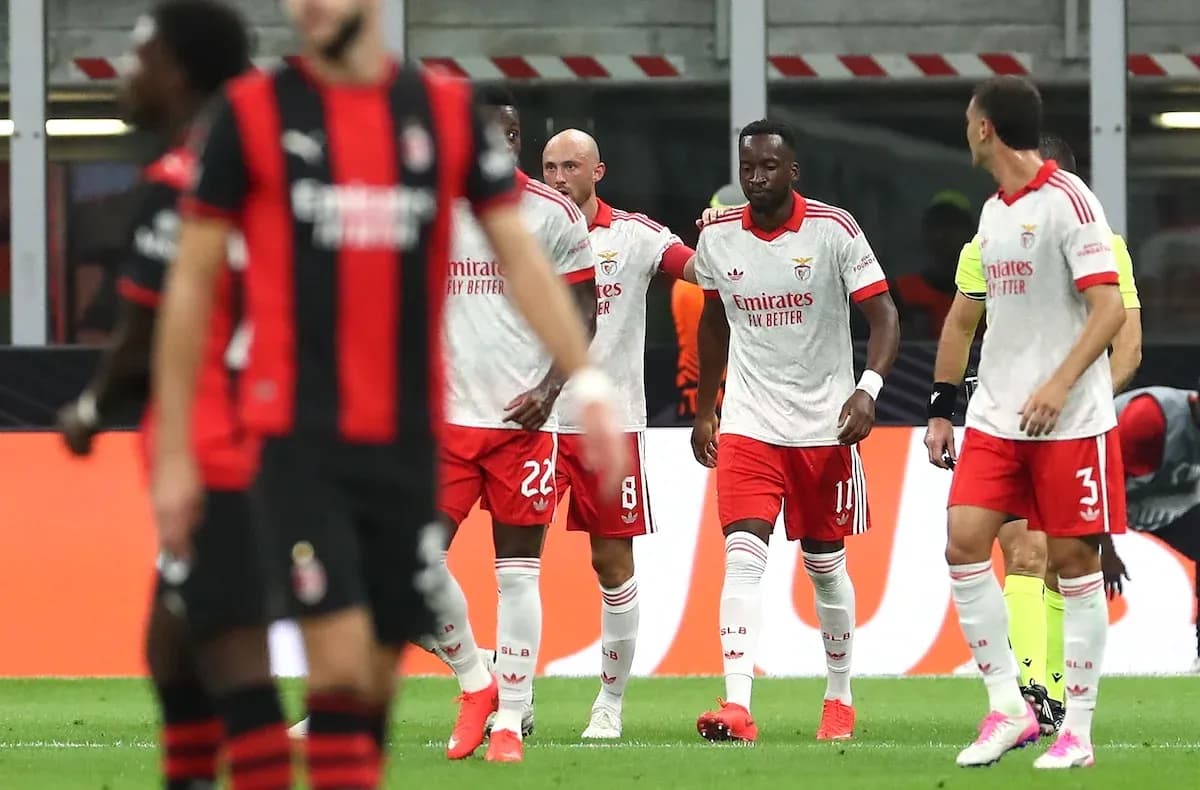
The turning point came in the second half, once Hajduk began to exploit the structural weaknesses of Pafos’s 3-4-3 in defensive transition. At 56', M. Sego struck the opener for HNK Hajduk Split, capitalising on the spaces that appeared when Pafos’s wing-backs and midfield stepped high in search of control. That goal flipped the dynamic: Pafos now had to chase the game, further stretching their shape and exposing the half-spaces behind their advanced midfield line.
Just eight minutes later, at 64', D. Melnjak doubled the lead, assisted by M. Acapandie. The involvement of the right-back in the assist underscores how Hajduk began to target the flanks more aggressively once ahead, using full-back underlaps and overlaps against Pafos’s wide defenders, who were already burdened by both defensive and build-up responsibilities. The 2-0 scoreline at that point reflected a ruthless exploitation of key moments rather than territorial dominance.
Substitutions then became a tactical lever for both sides. Celades reacted first on 63', with Bruno (IN) coming on for D. Goldar (OUT), and A. Brito (IN) for Pepe (OUT), signalling a desire for more dynamism in the back line and midfield. However, Brito was booked almost immediately at 64' for a “Professional foul”, an indication that Pafos were forced into riskier counter-pressing to prevent Hajduk transitions after turnovers.
On 74', D. Quina (IN) came on for V. Dragomir (OUT) and Guga (IN) for I. Sunjic (OUT), further refreshing the midfield and trying to inject vertical passing and late runs. Yet, despite these changes, the shot pattern did not improve in accuracy; the structure still struggled to break down Hajduk’s disciplined 4-2-3-1 block.
Garcia’s in-game management was oriented around game control and energy preservation once the lead was established. On 77', M. Livaja (IN) replaced goalscorer M. Sego (OUT), adding a forward capable of holding the ball and drawing fouls to slow the tempo. Simultaneously, A. del Moral (IN) came on for D. de Almeida (OUT), adding fresh legs and defensive work in the attacking midfield band, and M. Skelin (IN) replaced centre-back D. Maresic (OUT), a like-for-like change that maintained the back-four structure while refreshing concentration levels.
On 83', A. Guram (IN) came on for D. Melnjak (OUT), protecting the goalscoring wide player and adding a more conservative profile to see out the game. Finally, at 90+2', R. Raci (IN) replaced S. Hrgovic (OUT), another defensive substitution aimed at locking down the flanks in the closing moments.
Discipline played a subtle tactical role. The card sequence began early: at 4', Adrion Pajaziti (HNK Hajduk Split) received a yellow card — “Foul” — which could have constrained his aggression in the pivot, but he managed his risk well thereafter. In the second half, at 55', Nikolas Ioannou (Pafos) was booked for “Foul”, reflecting Pafos’s increasing need to halt Hajduk’s counters. The 64' yellow for Alexandre Brito (Pafos) — “Professional foul” — further underlined that pattern: tactical fouls to stop transitions once Hajduk had found their rhythm.
Late on, Hajduk’s substitutes also entered the disciplinary picture. At 87', Adam Huram (HNK Hajduk Split) was shown a yellow card — “Foul” — and at 88', Alberto del Moral (HNK Hajduk Split) was booked for a “Professional foul”. Both cards illustrate a deliberate choice to break up play and protect the two-goal cushion rather than allow Pafos to build sustained pressure in the final minutes. The final card tally was HNK Hajduk Split: 3, Pafos: 2, Total: 5.
Statistically, the match reads as a controlled underdog performance in terms of possession, but not in terms of tactical clarity. Pafos’s 55% ball possession and 14 total shots suggest initiative, yet their 3 shots on goal and 11 off target highlight inefficiency and an inability to convert territory into clear chances. Hajduk, with 45% possession, 8 total shots and just 2 on goal, maximised their limited attacking entries with clinical finishing.
Set-piece and wide dynamics were relatively balanced: Hajduk earned 8 corner kicks to Pafos’s 7, indicating that both sides managed to reach the final third with some frequency. However, with 0 blocked shots for both teams, the defensive work was more about forcing poor shooting angles and distances than about last-second interventions.
In the context of a two-legged European qualifier, this 2-0 home win gives HNK Hajduk Split a structurally solid platform: a clean sheet, efficient use of chances, and a defensive scheme that successfully turned Pafos’s possession into low-yield shooting. Pafos leave with the sense of having controlled large stretches of the ball but without the penetration or precision required to trouble a well-organised 4-2-3-1.