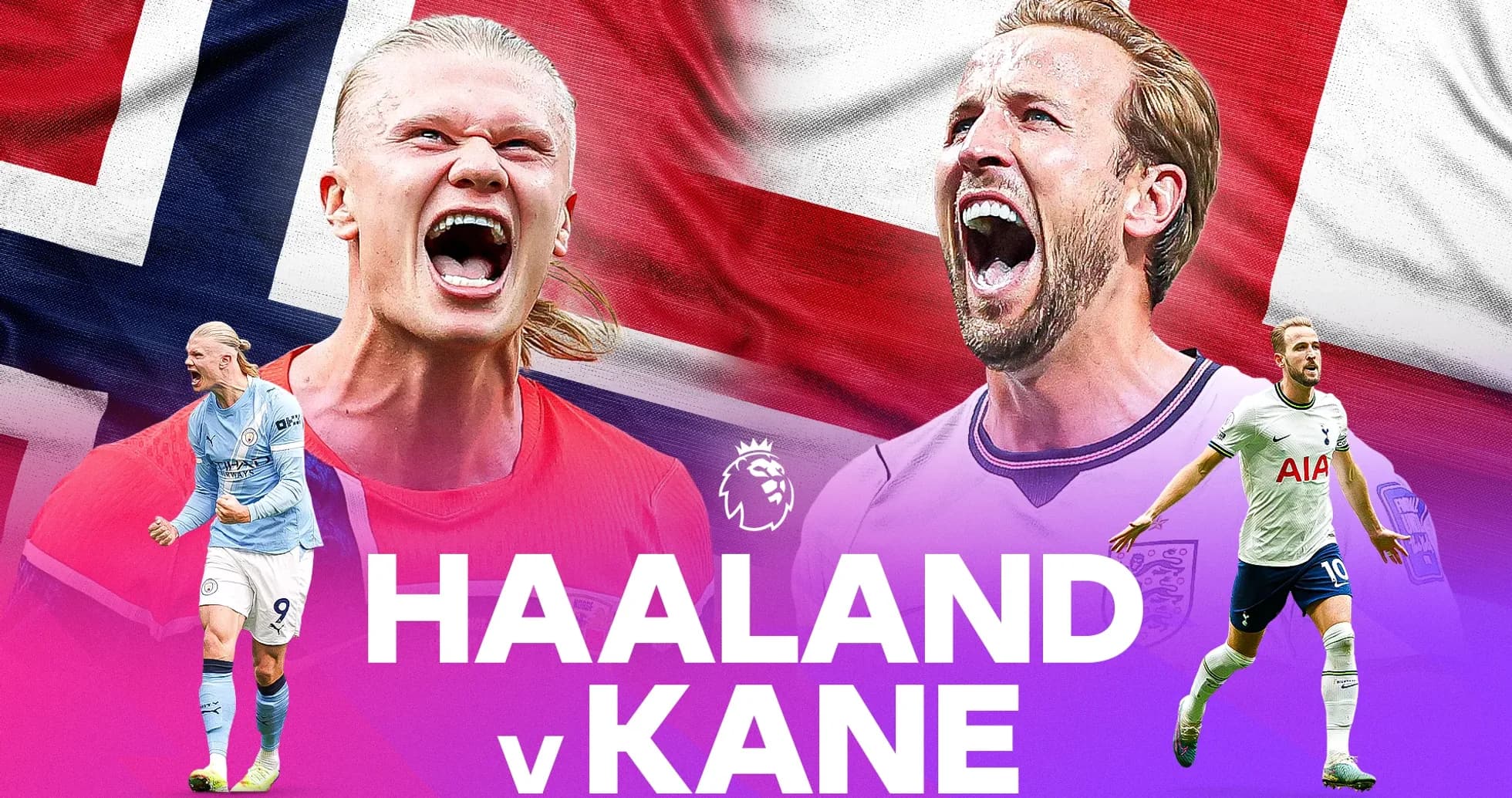
Harry Kane vs Erling Haaland: The Definitive No 9 Debate
Harry Kane and Erling Haaland are bound together by numbers that barely look real. Goal after goal, record after record, season after season. Two giants of the modern game, standing on either side of the same argument: who is the definitive No 9 of this era?
Strip it back and they could not be more different.
Haaland is the pure finisher, a striker built for the penalty area and the history books. He stalks the line, disappears from games, then rips them open in a heartbeat. Cold, ruthless, efficient. A collector of medals and milestones.
Kane is the conductor. The No 9 who always thought like a No 10, who literally wore that shirt at Tottenham Hotspur to show it. He drops off, dictates, threads passes that would make a playmaker proud – and still scores in every conceivable way. He is the system as much as he is the spear.
For years their rivalry felt theoretical. Parallel careers, barely crossing. They shared just one Premier League season, 2022/23, before Kane left for Bayern Munich. Now the duel turns concrete and brutal: England v Norway, World Cup quarter-final, 2026. Kane against Haaland with a place in the last four on the line.
Before that first duel on the biggest international stage, the numbers tell their own story.
Haaland’s historic pace, Kane’s towering total
In Premier League terms, both already live in rarefied air.
Kane sits on 213 Premier League goals, second only to Alan Shearer’s 260. He is just 47 short of the all-time record, and at his familiar 25-goal-a-season rhythm he would need roughly 18 more months back in England to stand alone at the top. Nine seasons as a first-team regular at Spurs have built that mountain of goals.
Haaland, though, has changed the conversation with sheer velocity. Four seasons, 112 goals. A goals-per-90 rate of 0.91 – the best in Premier League history. No one has ever scored as frequently.
At that rate, he needs only 113 more league games – roughly four campaigns at his current average of 33 matches a season – to overtake Kane’s tally and move into second place all-time. Give him another 52 matches and, in theory, he climbs beyond Shearer as well.
He has eight years left on his current contract. He needs about half of that to chase down Kane, and a little more to hunt down Shearer. If he stays, time and mathematics point one way: Haaland as the most prolific scorer the competition has ever seen.
For now, though, Kane’s sheer volume keeps him ahead in the Premier League record books.
Records, awards – and a different kind of dominance
Their entries in the record columns read like two sides of the same coin.
Haaland owns the fastest sprint to 100 Premier League goals. He holds the single-season record with that astonishing 36-goal debut campaign in 2022/23. He boasts the best per-90 scoring ratio the league has ever seen.
Kane counters with longevity-based landmarks. Most goals for a single Premier League club: 213 for Spurs. Most goals in London derbies: 51. And crucially, more seasons among the elite single-year hauls.
Look at their top scoring Premier League seasons and Kane’s consistency comes into focus. Haaland’s 36 in 2022/23 tops the list. But Kane’s 30 in that same season, plus 30 in 2017/18 and 29 in 2016/17, give him more entries in the single-season top five than his Norwegian rival. Haaland’s next-best return is 27 in 2025/26.
Context matters. Kane’s Premier League rise was gradual. He was 21 before exploding under Mauricio Pochettino in 2014/15. Haaland arrived like a meteor, smashing records from day one. Every Kane “win” in these comparisons needs the same caveat: Haaland has simply not had the same time in the division.
Individual honours underline how close they already are.
Haaland has five Golden Boots – three in the Premier League, two in the Champions League – plus three Player of the Year awards (one each in the Premier League, Bundesliga and UEFA competitions) and a European Golden Shoe. Kane has nine Golden Boots spread across competitions – three in the Premier League, three in the Bundesliga, one each in the Champions League, World Cup and European Championship – along with a Bundesliga Player of the Year and two European Golden Shoes.
The Englishman leads the tally right now, but Haaland is seven years younger. The gap feels temporary, not permanent.
Where Haaland does pull clear is in team silverware. League titles: two Premier Leagues and an Austrian Bundesliga to Kane’s two Bundesligas. European titles: Haaland has a Champions League; Kane is still searching for one. Domestic cups: Haaland has five – two FA Cups, an EFL Cup, a DFB-Pokal and an Austrian Cup. Kane’s cabinet holds a single DFB-Pokal.
Some will argue that Kane’s numbers, built largely outside serial title-winning environments, are even more remarkable because of that. Others will simply point to the medals.
Both can be right.
Kane’s Bayern explosion and Haaland’s international storm
If anyone wants to know what Kane might have done in a side like Pep Guardiola’s Manchester City, Bayern Munich have provided a pretty vivid hint.
Ninety-eight goals in 94 Bundesliga matches. That is the territory usually reserved for Lionel Messi and Cristiano Ronaldo. The kind of output that makes you wonder what the Premier League record book would look like if Kane had spent his peak years in a team that monopolised the ball and the chances.
Haaland answers that question from a different angle – with his country.
Norway are not England. They do not dominate tournaments, they do not routinely play deep into major competitions. Yet Haaland has 62 goals in 54 caps, scoring at a rate of 1.26 per 90 minutes and finding the net in each of his last 14 internationals. It is a staggering return, especially in a side that does not live in the final third.
Kane’s England record is outstanding in its own right: 85 goals in 119 caps, at 0.83 per 90, and he stands as his country’s all-time leading scorer. But in this particular column, Haaland’s ratio is on another level.
So where does it all land?
On almost every metric, the two are separated by context and time. Kane leads many categories because he has been around longer. Haaland has more trophies because he has spent more of his career inside dominant teams. The numbers wrestle each other to a near stalemate.
Then the 2025/26 season crashes into the debate.
Across all club competitions in Europe, nobody touched Kane. Not Haaland. Not Kylian Mbappé. No one. Kane finished with 61 goals in all competitions, towering over Mbappé’s 42 and Haaland’s 38.
At this moment, in July 2026, that matters. Form matters. Output matters. The here and now matters.
Right now, Kane is the best striker in the world.
On Saturday, Haaland gets 90 minutes – maybe more – to argue otherwise, on the biggest stage there is.