Gianni Infantino Under Siege: The World Cup Controversy
“Tom, can you get me off the hook? For old times’ sake?”
“Sorry. Can’t do it.”
The old Godfather lines used to feel like cinema. This week, around Gianni Infantino, they sound closer to documentary.
For almost six weeks the Fifa president has lived under a cloud – and not the usual low-lying fog that hangs over Zurich whenever world football’s governing body drifts into scandal. This time the allegation is starker: that he drove a covert plan to sell off football’s greatest shared asset, the World Cup, on the cheap, with the structure of the deal leaving him in line for a vast personal payday.
He is under siege. Again. Only this time, something in the air has changed.
The man who sold the world – twice
Infantino has survived plenty. Since he walked into power on a wave of post-Blatter reform rhetoric, he has turned Fifa into his personal stage show, selling himself as the bald-headed evangelist of growth, equality and “fiscal stimuli”, arms windmilling at the lectern as though he might conjure integrity out of thin air.
He has already sold the World Cup once, in spirit if not in name, to the highest bidders and the deepest pockets. Then came the second sale – the now-infamous Trump-era plan, with World Cup rights and global football assets bundled into a mega-commercial vehicle, the sort of thing that just happened, by a remarkable quirk of fate, to bring him into the orbit of the president of the United States and his circle of donors and dealmakers.
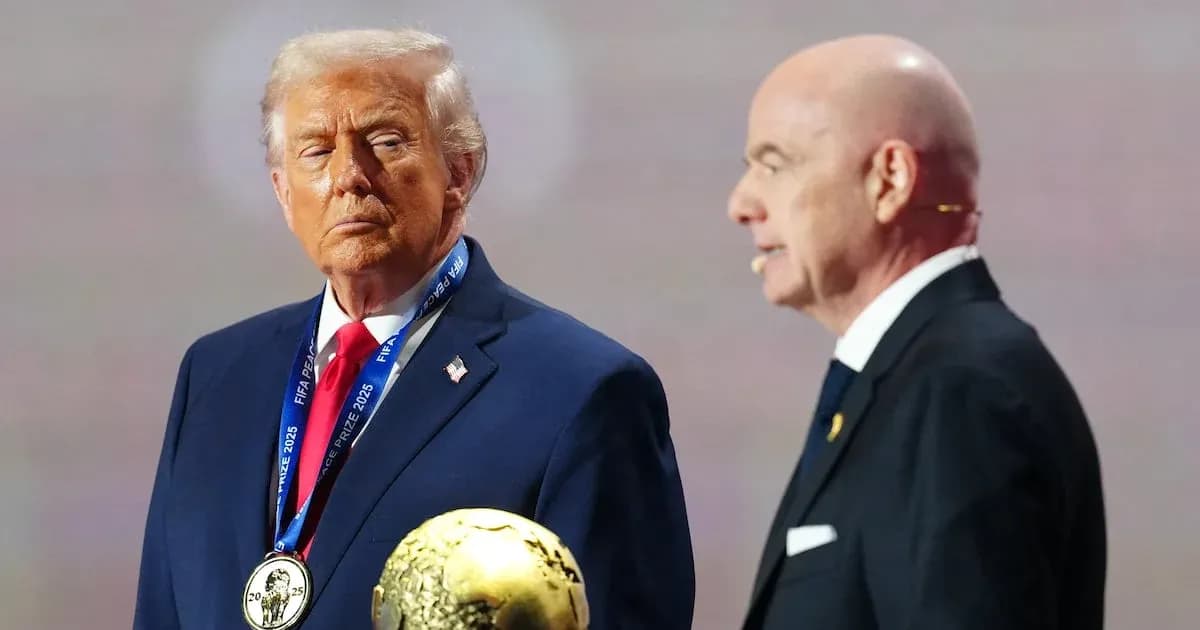
Infantino has long traded on proximity to power. Donald Trump, in particular, offered a kind of political force field. The image lingers: the two of them grinning together like catalogue models in a Brooks Brothers knitwear spread, the Fifa president preening as the “very tall, very handsome man”, Trump looming beside him like a walking, honey-glazed buffet item squeezed into a suit.
But that kind of protection is brittle. And this week, the shell started to crack.
Uefa’s legal gambit and the terror of discovery
The catalyst is not another angry column or a former Manchester United squad player weighing in from the sidelines. Infantino can live with gnats at his ankles. What he fears is hard power.
That now comes in the form of Uefa’s lawsuit in a New York court, which accuses Fifa and its president of “criminal mismanagement” over the proposed sale of World Cup rights to a consortium fronted by Thrive Capital. At the heart of it lies a simple question: was the World Cup deliberately undervalued, to the benefit of the buyers and, indirectly, to Infantino himself via a huge potential salary?
Uefa may not expect to win outright. It may not need to. The real weapon here is discovery – the legal process that forces both sides to hand over internal documents, emails, memos, WhatsApp messages from the golf course, all the paper trails of power.
Nobody on Infantino’s side wants that.
Fifa’s own counterfiling this week brands the whole thing a “smear campaign”, then immediately gives the game away by stressing how fiercely it intends to resist discovery. That is the quiet part said out loud. When an organisation fights that hard to stop people looking in the box, you start to wonder what’s rattling around inside.
Kushner steps back, the apron strings loosen
The first major tremor came from Florida, where Josh Kushner – the investor whose firm Thrive Capital was central to the Fifa Forward deal – was named as a party to discovery.
Kushner, brother of Jared, the president’s son-in-law, issued a statement saying he “would not have gotten involved” had he known the full picture. He called the whole episode “regrettable”.
On the surface, those are mild words. Between the lines, they read like a man stepping carefully away from the blast zone. Kushner has also hired Alex Spiro, a high-end, high-conflict lawyer who has defended Elon Musk over the “pedo guy” tweet and Alec Baldwin over an accidental on-set shooting. You don’t bring in Spiro for a gentle misunderstanding. You bring him in when you expect the knives to come out.
That move, coupled with Fifa’s panic over discovery, hints at something deeper: the protective apron of Trump-world starting to fray.
Trump himself weighed in on Truth Social in early August, warning that removing Infantino would be “really bad” – but only “if for any reason” Fifa chose to do so. Even then, the support felt conditional, hedged. Since then: silence.
From a man whose politics is built on a stark matrix of winners and losers, silence is never a good sign.
The Trump pattern
Trumpian loyalty is transactional. He will walk you in, beam for the cameras, repeat your name, sell you as a winner. But once you look like a loser, history shows what tends to follow.
Michael Cohen once said he would “take a bullet” for Trump. He ended up disbarred, imprisoned, exiled from the inner circle. Jeff Sessions, the former US attorney general who hailed Trumpism as “a movement”, was later described by Trump as weak, confused, dumb, an idiot, a disgrace, even “mentally retarded”.
There is a pattern. When you are useful, you are cherished. When you become a liability, the floor disappears beneath your feet.
Infantino has basked in that glow, the global sports bureaucrat granted intoxicating access to the White House, to donors, to dealmakers such as Greg Maffei, the Trump ally and adviser tied to the World Cup rights plan. Now those same corridors of power are where Uefa wants discovery to roam.
Fifa, Thrive Capital, Maffei – all sit in the crosshairs of the court’s document demands. Every email, every side note, every late-night draft could, in theory, be pulled into the light.
You can picture the Club World Cup trophy here: all jagged edges and hidden angles, like something with a secret drawer full of human toenails. Do you really want to know what’s inside? Is it safe to look?
No safe rooms left
This is why the atmosphere around Infantino feels different. The sabre-rattling continues – the tours of the outer provinces, the handshakes, the declarations of unity. Saudi Arabia has offered support “at this time …”, a phrase that lands with a distinct chill. There is a Fifa congress in November. The usual levers of patronage and vote-gathering will be pulled.
But power senses vulnerability. The corridors that once teemed with fixers and enforcers now feel oddly empty. The image is of a ward with no nurses, no cops at the door, the old man upstairs suddenly unguarded.
Discovery is the key. If the court allows it, Uefa gets to start raking through the coals. Even if the case ultimately fails, the process itself can be lethal. That is how it ended for Sepp Blatter and Michel Platini, brought down by a single “disloyal payment” that seemed to fall from a clear blue sky.
Legal challenges often fizzle out. Files are sealed. Deals are cut. But once lawyers start asking for emails and contracts from the Trump era, from the Thrive negotiations, from the inner sanctum of Fifa House, control begins to slip.
Infantino knows this. So, too, do those around him – and those who once stood behind him.
Uefa doesn’t need a knockout blow. It just has to keep jabbing, keep forcing Fifa to fight on ground it does not control. Keep pressing, and you never quite know what – or who – will fall.
“Today I settle all family business,” Michael Corleone says. “So don’t tell me you’re innocent.”
Somewhere in Zurich, with the walls inching closer and the lawyers circling, Gianni Infantino will be hoping football’s justice system is kinder than that.