
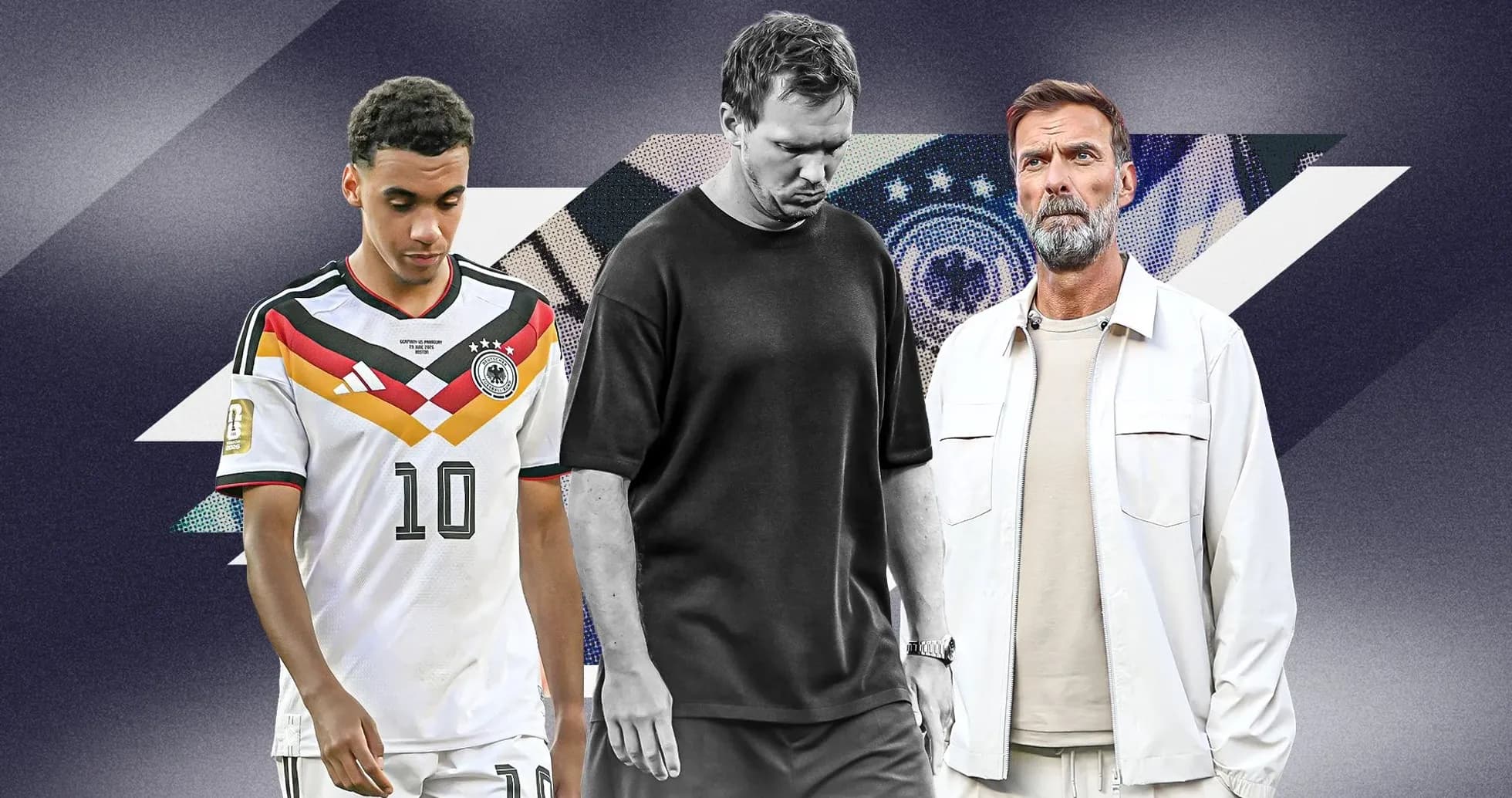
Germany's World Cup Struggles: From Hope to Decline
Germany have been here before. That is precisely the problem.
When the world champions crashed out of the 2018 World Cup in the group stage, undone by Mexico and South Korea, the inquest was brutal but the conclusion was soft. Joachim Löw, the man who had taken Germany to the summit in 2014, survived what looked like a natural end point. His credit in the bank bought him three more years and one more tournament. The team never truly recovered.
Euro 2021 confirmed what many had suspected since Russia: the magic had gone. Germany stumbled to the last 16, were outclassed by England at Wembley, and Löw finally walked away. The overdue break came too late to prevent the stagnation.
Hansi Flick arrived as the fresh start. He rode a wave of optimism into Qatar in 2022, but the pattern repeated. Another group-stage exit, this time after a calamitous defeat to Japan despite taking the lead. Again, the expectation was ruthless clarity from the DFB. Again, they hesitated. Flick clung on until autumn 2023, when a string of poor results eventually forced the federation’s hand and opened the door for Julian Nagelsmann.
From golden hope to Foxborough nadir
Nagelsmann’s appointment in September 2023 felt like a generational reset. Young, tactically sharp, and unafraid of bold selections, he quickly convinced a sceptical public that he could drag Die Mannschaft back to the elite.
Euro 2024 on home soil seemed to confirm that narrative. Germany played with purpose, reconnected with their fans, and, for the first time in eight years, navigated a major tournament with something resembling conviction. A quarter-final defeat to eventual champions Spain hurt, but it also carried a sense of near-miss rather than collapse. Nagelsmann spoke openly, almost immediately, about targeting the 2026 World Cup. At that moment, he was the most popular national coach since peak Löw.
That feels like a long time ago now.
Over the past two years, Nagelsmann has squandered his public capital with remarkable speed. The nadir arrived in Foxborough on Monday, the World Cup exit to Paraguay the latest chapter in a decline that has become impossible to ignore. The DFB have already made the mistake of waiting too long twice. They cannot afford a third.
A coach who wouldn’t stop talking
What has grated most is not only the football, but the noise around it. Nagelsmann used his regular media appearances as a stage for detailed, often cutting, critiques of his own players. Every few weeks, another name, another pointed analysis, another public rebuke.
It looked less like clear communication and more like a craving for attention. Some of his statements were unfortunate, others simply untrue. He promised certain players defined roles, then quietly rowed back. When challenged, he too often lost his composure and slipped into a patronising tone, a pattern that repeated itself throughout this World Cup.
On the pitch, the contradictions continued. Toni Kroos’ return for Euro 2024 had been an unqualified success, a rare example of a big call paying off. Nagelsmann then went back to the well, dragging Manuel Neuer out of international retirement at 40 for this World Cup, despite repeatedly insisting he would not do so.
The human cost was obvious. Oliver Baumann, exemplary throughout qualifying, was shunted aside. The sporting gain was negligible. Neuer did nothing in this tournament that Baumann could not have delivered. The whole episode was mishandled and unnecessary, and it underlined a coach losing his feel for the dressing room.
Then came the Joshua Kimmich saga. Germany’s captain became a symbol of Nagelsmann’s positional tinkering, shuttling between right-back and central midfield, even within the same match. The defeat to Paraguay showcased that confusion in stark detail, Kimmich’s role morphing as the game slipped away.
A campaign that went backwards
Germany’s World Cup display was not a one-off bad night. It was the logical endpoint of a team that had stopped progressing after the Euros.
Apart from a brief second-half surge against minnows Curaçao, Nagelsmann’s side underperformed across the tournament. The attack lacked imagination, the defence looked brittle, and ordinary opponents sensed opportunity. Ivory Coast, Ecuador, Paraguay – none of them are superpowers. All of them made Germany look vulnerable.
In cold sporting terms, this World Cup may be even more damning than 2022. At least in Qatar, Germany salvaged a draw against Spain and showed flashes of high-level football. This time, there was no such anchor. Just a flat, predictable team, drifting.
To their credit, the players did not hide. They took collective responsibility after the exit and went out of their way to absolve Nagelsmann of blame in public. But international football is unforgiving. It is the coach’s job to give structure, to provide a plan that amplifies individual talent. With a squad rich in quality, Nagelsmann failed to do that.
His in-game management only deepened the doubts. The substitutions against Ecuador raised eyebrows; the decision to start super-sub Undav against Paraguay, stripping him of the very impact that made him valuable, looked like overthinking for its own sake.
Klopp in the studio, Klopp in the air
As Germany unravelled, one man sat in a television studio and dissected it all with clinical clarity: Jürgen Klopp.
On Magenta TV, the former Liverpool and Borussia Dortmund coach laid out what he had seen.
"You have to attack down the wings. There's no alternative," he said after the elimination. "We all know how well these guys can play, but they didn't bring that to the pitch. In three months, we'll be raving about [Florian] Wirtz and [Jamal] Musiala again about how great they are, but not now.
"Paraguay had the opportunity to achieve something, Germany was under pressure to achieve something. Everyone in the stadium thought: Now they'll turn it around! But we didn't. We let them off the hook... We can talk about the DFB. We absolutely have to change a few things."
It was not just analysis. It sounded like an audition.
For many fans, the solution is obvious. Klopp currently works as Red Bull’s head of soccer, but the idea of him leading Germany into Euro 2028 and the 2030 World Cup has ignited imaginations across the country. His arrival would trigger an eruption of euphoria German football has not felt in years.
Klopp, though, stayed on the fence when asked in Boston.
"I haven't thought about that yet. I understand that when the national coach position is discussed, my name is mentioned in some form. But it's not the moment to really talk about it. There's nothing to say about it. I have a job that I enjoy very much. As far as I know, it's not a part-time job."
The decision the DFB can’t duck
Publicly, Nagelsmann still has backing. The players have lined up behind him. Sporting director Rudi Völler has offered support. On paper, continuity has its arguments.
Reality points elsewhere.
Germany have now lived through three cycles of hesitation. Löw stayed too long. Flick stayed too long. The warning lights around Nagelsmann are flashing just as brightly, and the performances on the pitch leave little room for sentiment.
If the DFB truly believe change is needed, they must move quickly. Not because Klopp is a magic wand, but because opportunities like this do not linger. A coach of his stature will not wait forever for a phone call that may never come.
Germany’s future is on hold. The question is whether the federation finally has the courage to break the pattern – or whether they will watch, again, as another era drifts past its expiry date.





