Gabriel's Tug-of-War: Manchester United's Fragile Future
Real Madrid want him. Barcelona want him. Paris Saint-Germain and Bayern Munich are circling too.
Manchester United, though, are refusing to budge. Not yet. Not on this kid.
Gabriel, the 15-year-old forward many inside Carrington see as a once-in-a-generation talent, is at the centre of a storm that cuts right to the heart of what United are – and what they risk becoming.
Sir Jim Ratcliffe has already felt the heat since stepping in as the public face of United’s football operation. Unpopular calls, fan protests, a club still searching for its identity. Letting Gabriel slip away now, before he has even turned 16, would be a fresh open wound. One that would follow him for years.
The problem? United don’t really hold the cards.
Gabriel is contracted until next summer, but he isn’t a full-time scholar and doesn’t sit under the usual academy model. When he turns 16 on October 16, he could, in theory, walk away for nothing – as long as he has a European passport.
United are scrambling to understand exactly where they stand. His father, Joe O’Cearuill, played twice for Ireland; his mother has Greek Cypriot roots. Under post-Brexit rules, that heritage could allow Gabriel, as a dual national, to move to an EU club before he turns 18. That’s the escape hatch the European giants are banking on.
United already beat Manchester City to his signature once. This time, the fight feels different. Colder. More distant.
Signs of a split are already on show. Gabriel was due to train with the first team on Saturday. He didn’t turn up. He hasn’t been seen at Carrington all week.
For Michael Carrick, that no-show carries a heavy cost. The head coach had pencilled Gabriel into his squad for Wednesday night’s Carabao Cup third-round tie against Brighton at Old Trafford. Had he stepped onto the pitch, Gabriel would have become the youngest player in United’s history. That chapter has been ripped out, for now.
A prodigy in fast-forward
United’s academy has waited a long time for another genuine superstar to emerge. Since Marcus Rashford burst onto the scene, the conveyor belt has produced good players, promising players – but not that one, era-defining name.
Gabriel looked like the answer.
He joined United at 11 and immediately stood out. A two-footed forward, slippery in tight spaces, able to twist away from defenders and finish with a calm that belongs to someone far older.
People around him whisper the usual names. Messi. Neymar. The Messi talk is lazy, unhelpful. The Neymar comparison is closer to the mark: low centre of gravity, flair, that stop-start dribble defenders hate. He even wears the same Nike boot model as the Brazilian, having signed a lucrative extension with the brand in March 2025.
The numbers back up the hype.
At 14, Gabriel jumped into United’s Under-18s – a record in itself – and ripped the league apart: 20 goals in 21 games. That haul earned him the first-ever Premier League U18s Player of the Year award and United’s Jimmy Murphy Young Player of the Year, making him the youngest winner in the club’s history.
This August, he went again. Promoted to the U21s, he lit up his debut against Ipswich: two assists and a delicate chip in a 5-0 rout. A week later, he scored again as United hammered Leicester 4-1.
Everything about his rise screams fast-track. No wonder fans are desperate to see him in a first-team shirt when the senior side are crying out for inspiration in the final third.
And they only have to look at Arsenal to see what happens when a club leans into the chaos.
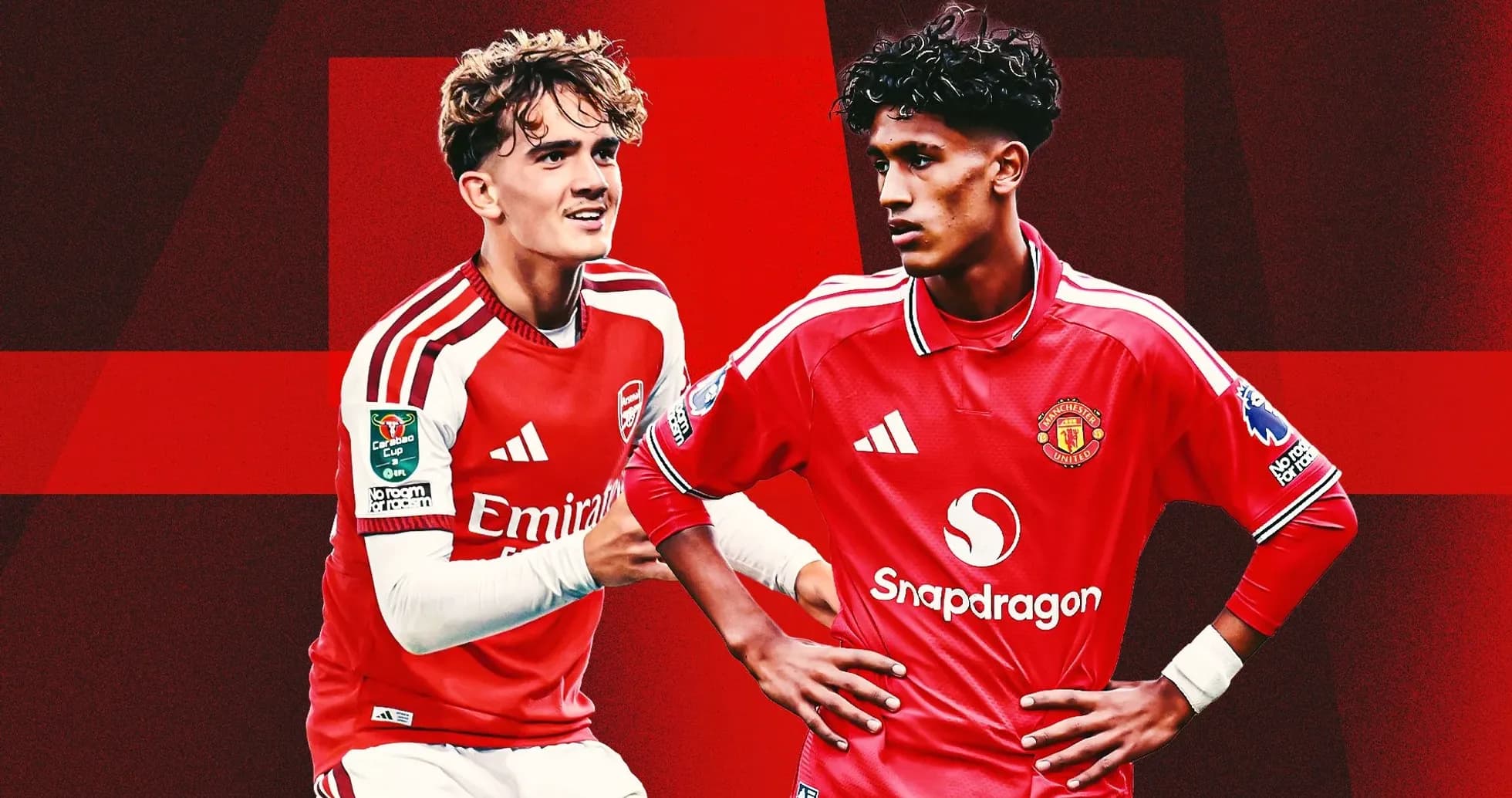
Dowman, Nwaneri and the age of the teenage star
Ethan Nwaneri set the tone back in September 2022, becoming the youngest player in Premier League history at 15 years and 181 days when he came on for Arsenal at Brentford. His path has not been smooth – loans to Marseille and Borussia Dortmund, dips and doubts – but he already has more than 50 senior appearances and is still only 19.
Then came Max Dowman.
Arsenal doubled down on the old line: if you’re good enough, you’re old enough. Dowman became the second-youngest Premier League player ever when Mikel Arteta threw him on against Leeds in August 2025. He didn’t just appear; he rewrote the records.
In March, Dowman produced a stunning solo goal against Everton to become the league’s youngest scorer at 16 years and 139 days, taking James Vaughan’s long-standing record. In May, he became the youngest title winner in Premier League history. This week, he joined Wayne Rooney in a tiny club: the only 16-year-olds to score a brace for a Premier League side in a major competition, leading Arsenal to a 4-2 Carabao Cup win over Ipswich.
Fourteen senior appearances already. Flair, strength, maturity. Arteta can’t ignore him, and doesn’t try to. He just chooses his moments.
The Arsenal boss has even allowed Messi’s name to brush against Dowman’s in public, while still preaching caution.
“We have to look after him. He’s 16 years old. You don't see that in this league,” Arteta said after the Ipswich game. “In this league, with the demands that the league has, the players and everything put on you, we really need to make sure every time we throw him in, he's in the right context with the right preparation. That's what we are trying to do.”
That’s the luxury of a functioning, confident team. Arsenal win, rotate, and win again. They can protect their kids.
United can’t say the same.
Why Carrick is holding the line
Gabriel doesn’t have Dowman’s frame. He’s slight, often the smallest player on the pitch. His courage and determination make up for plenty, but the Premier League is unforgiving. Throwing him into that storm too early could break more than it builds – especially if he starts brilliantly.
Imagine the scenario. Gabriel comes in, dazzles, scores. The clamour goes through the roof. Carrick would be hounded to start him every week, whether his body is ready or not. United don’t have the depth Arsenal enjoy; they can’t shuffle the pack with the same ease.
Drop him after a few games? Carrick gets branded too cautious while the team struggle. Keep playing him through dips? Gabriel is suddenly “overhyped”, “not that good”, another wonderkid chewed up by expectation.
That’s why Carrick’s caution has been praised by those who know the pathway best.
Danny Simpson, a United academy graduate who broke through under Sir Alex Ferguson, sees the difference clearly. Speaking to GOAL via Free Bets, he drew a sharp contrast between Dowman’s environment and the one Gabriel would walk into at Old Trafford.
Simpson pointed out that he could ease his way into a dominant United side, often coming on at 2-0 or 3-0 up, surrounded by a “second XI who could win the Premier League”. Dowman, he argued, has something similar at Arsenal – a team “flying in confidence, full of top, top talent, winning games”.
United now? Not that. Not close.
“I know we all want to see Gabriel play and it's exciting, but it's just a very different situation to Max Dowman at Arsenal,” Simpson said. His message was simple: trust Carrick. Let Gabriel train, be around the group, and wait for the right moment.
The problem is, waiting is getting harder for the boy himself.
Yamal, La Liga and the lure of the fast track
Across Europe, teenagers are not just dipping their toes in senior football; they’re diving in.
Lamine Yamal did it at Barcelona in 2023, debuting at 15 years, nine months and 16 days. Like Gabriel, he was skinny, light, easy to target. He survived – and thrived – because of his speed, intelligence and the rhythm of La Liga, a league that prizes tactical structure and possession over relentless physical duels.
In Spain, a young technician can breathe. In the Premier League, the ball burns.
Gabriel will be watching Yamal’s trajectory closely. It’s easy to see why Barcelona or Real Madrid might look like the shortcut to stardom. Different league, different demands, different spotlight.
But timing is everything. When Yamal broke through, Barca were on their way to the title under Xavi but out of the Champions League in the group stage. Raphinha, Ousmane Dembele and Ferran Torres weren’t at today’s levels. There was room to disrupt the hierarchy.
Look at Barca now: Yamal established, Raphinha at his peak, Anthony Gordon, Karim Adeyemi and Gabriel Jesus all in the mix. Real Madrid, under Jose Mourinho, boast Kylian Mbappe, Vinicius Junior, Jude Bellingham and Yan Diomande.
At either club, Gabriel would still be a long way from guaranteed minutes. The badge is bigger, the queue is longer.
At United, the path is clearer. If he stays.
Entitlement, standards and a line in the sand
For all the noise around his potential, one fact remains: Gabriel is still a child, 18 months away from sitting his GCSEs. United cannot allow a teenager, however talented, to dictate the terms of their project.
The club’s history is built on homegrown players who earned everything the hard way. George Best, Sir Bobby Charlton, Ryan Giggs, David Beckham, Paul Scholes, Gary Neville – none of them were handed anything. They fought through setbacks, criticism, and brutal internal standards.
Former manager Ruben Amorim, sacked in January after a troubled spell, saw a worrying shift before he left.
“There is a feeling of entitlement we have in our club,” he said in one of his final press conferences. “Sometimes, difficult moments is not a bad thing for the kids. We don't always need accolades in everything. We are not helping.
“Nowadays, they speak and go against the club because they feel entitled. Let's stay. Let's fight. Let's overcome. That is the way we can solve things.”
He got a lot wrong. On this, he was right.
Right now, Gabriel is acting like someone who wants everything, everywhere, all at once. Surrounded, perhaps, by people telling him he’s already made it. The risk for United is obvious. So is the risk for him.
If he stays, accepts the grind and trusts the process, he could become the face of a rebuilt United attack, with a club structured around his growth. If he forces a move now, he joins a long list of prodigies who chased the biggest badge and found only a bigger bench.
United, for their part, must be clear-eyed. They can fight to keep him. They can promise a pathway, not a guarantee. What they cannot do is bend their entire identity around a 15-year-old.
No one is bigger than the club. If Gabriel can’t live with that, the decision almost makes itself.