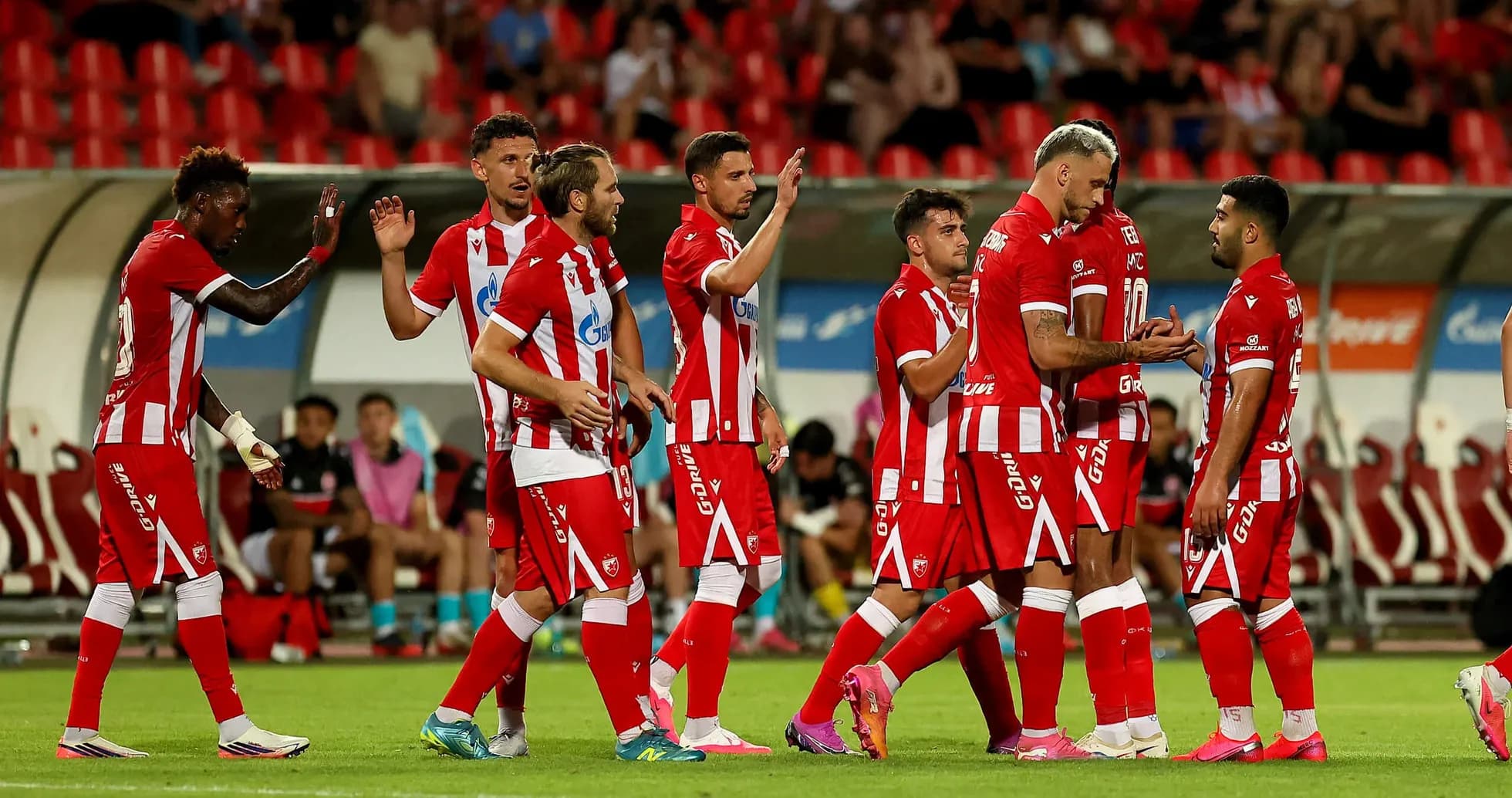
FK Crvena Zvezda's Dominant 3-0 Victory Over Plzen
FK Crvena Zvezda’s 3-0 win over Plzen at Stadium Rajko Mitić was a controlled, structurally coherent European home performance built off a clear 4-3-3 framework against a 4-4-1-1 that never quite settled. With both sides splitting possession at 50%-50%, the difference lay not in ball share but in how effectively each team converted their structure into territory and threat.
First Half
Albert Riera’s 4-3-3 was front-footed from the outset. The back four of Seol Young-Woo, D. Luckassen, M. Veljkovic and T. Elsnik had a dual role: provide early progression and lock down Plzen’s transitions. Elsnik, nominally a midfielder by profile, started as the left-back in the line, which immediately hinted at an asymmetric build-up. In practice, he often stepped inside, creating a situational three-man first line with Krunic dropping close to the centre-backs, while Seol pushed slightly higher on the right to offer width.
Ahead of them, the midfield triangle of R. Krunic, M. Ivanic and V. Kostov gave Zvezda a strong central spine. Krunic acted as the primary organiser, staying close to the centre-backs in early phases and then stepping into the right half-space. Ivanic and Kostov alternated between receiving between the lines and making late penalty-area runs. This staggering was decisive: Ivanic’s timing from midfield underpinned both of his open-play goals, each arriving from combinations with Elsnik, who advanced from his nominal left-back slot to assist twice.
The front three of O. Bukari, M. Arnautovic and M. Cham were set up to stretch Plzen horizontally. Bukari and Cham started wide, pinning full-backs and opening the half-spaces for Ivanic and Kostov. Arnautovic operated as a classic reference point, occupying centre-backs and providing lay-offs rather than constant depth runs. Even without detailed passing data, the shot profile is telling: Zvezda produced 7 shots on goal from a relatively modest total volume (with 5 shots off target and 1 blocked), indicating that their attacks were well-prepared and reaching high-quality finishing zones rather than relying on volume.
Plzen's Response
Plzen’s 4-4-1-1 under Martin Hysky was more reactive. The back four of M. Doski, D. Krcik, S. Dweh and F. Prebsl (before his substitution) often found themselves compressed deep, with wide midfielders T. Ladra and C. Souare (later replaced by C. Kabongo) forced into long defensive shifts. In theory, the line of four behind P. Adu should have allowed for compact central protection and counter-attacking outlets. In practice, the distances between Adu, the midfield line, and the back four were inconsistent, especially once Zvezda established a lead.
Plzen did manage 5 shots on goal and 1 off target, plus 2 blocked, which shows they found moments to test the hosts. But their attacks were more sporadic and less controlled, often coming from direct play or broken phases rather than sustained positional pressure. The 2 corner kicks to Zvezda’s 1 underline that Plzen did reach the final third, yet lacked the layering and second-ball structure to pin Zvezda back for long periods.
Discipline and Defensive Behaviour
Discipline and defensive behaviour further exposed the tactical contrast. Zvezda committed only 5 fouls and took 2 yellow cards, suggesting a largely controlled defensive display where their structure did the bulk of the work. Plzen, by contrast, recorded 6 fouls but picked up 4 yellow cards. That ratio hints at a side repeatedly forced into emergency or poorly-timed interventions, especially as the game state worsened at 2-0 and then 3-0.
The card timings support this narrative. Early on, Seol Young-Woo’s caution at 31' for Zvezda did not destabilise their right side; the team simply tightened their pressing triggers and ensured better cover behind him. Plzen’s cautions, however, came later and clustered (77', 84', 88'), aligning with a phase in which Zvezda were protecting a lead and Plzen were chasing, increasingly late to duels and transitions.
Substitutions
In terms of substitutions, Riera’s changes were game-state management rather than structural gambles. At 72', J. Enem (IN) came on for M. Arnautovic (OUT), and A. Katai (IN) replaced the already-influential M. Ivanic (OUT). The first change refreshed the central attacking reference, maintaining the same 4-3-3 structure with fresh legs to press and run channels. The second introduced a technically secure ball-carrier in Katai to help manage possession and exploit tired legs between lines, which he crowned with the late penalty conversion.
Later, M. Bajo (IN) for V. Kostov (OUT) at 84' and F. Tebo Uchenna (IN) for D. Luckassen (OUT) at 85' were conservative, protective moves. Zvezda effectively locked the result by reinforcing energy in midfield and at the back, without altering the basic shape. L. Loizou (IN) for O. Bukari (OUT) at 90' was a final rotation to see out the match.
Hysky’s substitutions for Plzen were more about searching for solutions. C. Kabongo (IN) for C. Souare (OUT) at 46' was an early second-half adjustment, presumably to add more direct threat and running from wide areas. At 61', S. Pirgic (IN) for T. Ladra (OUT) further refreshed the flanks, again hinting at a desire to attack down the sides of Zvezda’s shape. The double change at 73' — D. Visinsky (IN) for F. Prebsl (OUT) and M. Vydra (IN) for P. Adu (OUT) — reconfigured the attacking structure, effectively moving towards a more aggressive front with Vydra as a focal point. Finally, K. Spacil (IN) for D. Krcik (OUT) at 86' added fresh legs in the back line, but by then the tactical damage was done.
Statistical Overview
Statistically, the match was closer on paper than the 3-0 scoreline suggests. Both teams shared possession at 50%-50%, and Plzen actually matched Zvezda in shots on goal (5 to Zvezda’s 7 is competitive in context). But the hosts’ efficiency — 3 goals from their 7 efforts on target — reflects a side whose positional play consistently created clean looks, particularly through the left-sided Elsnik–Ivanic axis and the late-game composure of Katai from the spot.
Without explicit xG values, the pattern of shots and the nature of the goals point to Zvezda generating higher-quality opportunities. Defensively, their ability to restrict Plzen to a small number of shots on goal, despite the visitors’ multiple attacking substitutions, underlines a solid collective block rather than reliance on last-ditch interventions.
The disciplinary split — FK Crvena Zvezda: 2 yellow cards, Plzen: 4, Total: 6 — encapsulates the tactical story. Zvezda’s structure allowed them to defend largely on their own terms, while Plzen’s late, card-heavy chasing phase revealed the strain of trying to break down a well-organised 4-3-3 that had already done the decisive damage.