The Journey of an English Defender: From Back-Garden Dreams to Helsinki
He started where so many English football stories begin – in a back garden, a ball, and a kid who wouldn’t stop playing.
“I started playing at like eight-ish, nine years old,” he recalls. The first badge on his chest was Senrab, that famous East London nursery of talent. From there it was Buckhurst Hill at nine – the same grassroots club where David Beckham once pulled on a shirt – and then into Leyton Orient’s development setup from 11 to around 13 or 14.
The path looked familiar. The reality was anything but straightforward.
Chelsea, Talent… and a Closed Door
At 14, everything changed. He began working with Lester Thomas, a well-known grassroots coach and Chelsea scout in his area. Sessions took place near West Ham train station, a world away from the polished academy pitches but run with the same intensity.
“He did a fantastic job with grassroots and he's got a lot of players that have made it in professional football – some of them are in the Prem and playing football now,” he says. Thomas trained a group of ambitious boys “the same way that they were training in academies,” and used his connections to get them seen. Trials at Manchester United, Blackburn, West Brom followed. At 16, the big one: Chelsea.
He walked into Cobham and straight into one of the most talent-stacked youth environments in Europe.
Nathaniel Chalobah was there, flitting between reserves and first team. John Swift, Lewis Baker, Adam Nditi, Charlie Colkett. Ola Aina and Jeremie Boga were younger but already training up. Ruben Loftus-Cheek too. This was the era when Chelsea hoarded some of the best teenagers in the country.
“It was really good,” he says. “At that time at Chelsea, the calibre of player, a lot of the players from 15 already signed scholarships.” He sensed the respect for his ability but not the same long-term belief. Then came the moment that effectively shut the door.
A month or two after he signed, Chelsea brought in Nathan Aké.
“It was just unfortunate that at the time I signed and a month, two months later, they signed Nathan Ake and the space for me getting a scholarship was taken.”
Centre-back spots were already stacked: Alex Davey, Dion Conroy, Jordan Houghton. Two of them had been tied down on two-year scholarships and two-year pro deals. They had grown up in the system since the age of eight. He was the talented late arrival.
“I came in late as a 16-year-old, they were quite surprised by the ability that I had,” he says. But loyalty, long relationships and a big-name signing squeezed him out. “Signing Nathan Ake just kind of ruined my chances there. So I had to move on and went to Sheffield Wednesday.”
A Career Built on Adaptation
From there, the journey turned nomadic. Sheffield Wednesday from 16 to 19. Charlton from 20 to 21. Then the National League at 21. Looking back now at 32, he’s blunt about that turning point.
“I would say, I should have gone to Finland or Sweden. I went to the National League, but I should have just gone straight to Scotland then.”
He did eventually head north and spent three to four years in Scotland. The aim was always the same: play, develop, earn a route back into the English game, ideally in the Championship.
It never quite opened up. “I wanted to try and get myself back into the English game in terms of playing in the Championship or something. I didn't get the chance, different interests were there, I was outpriced and all that stuff.”
So when a message came through while he was on holiday for a friend’s wedding, the next twist arrived fast.
China: Promise, Chaos and a Club Wiped Out
He signed an 18‑month deal in the Chinese Super League, arriving in June 2024. The move was as much about life as football.
“I thought, you know what, it's something I've always wanted to do in my career, play abroad,” he says. He’d already proved he could live away from home. “I've been playing away from home, I've adapted quickly and I'm that kind of person, I can adapt quickly and I like learning other cultures.”
He liked the idea of China, the culture, the food. He wanted an experience as well as a contract. “Hopefully it goes well and then I can just carry on my career there,” he thought.
On the pitch, he got paid. Off it, the warning signs were flashing. “In China, there's complications with payments, et cetera, et cetera,” he explains. Late wages hit local players hardest. Frustration spilled onto Chinese social media – their own platforms, not Instagram or Twitter – and the Chinese Football Association noticed.
China has a strict system: at the end of each season, clubs must sign a document confirming players have been paid and send it to the CFA. Only then are they approved to compete in the CSL the following year. His club did that. Then those posts surfaced.
The CFA demanded proof. Bank statements. Evidence that matched the claims. Players were added into a group chat for the next season while lawyers joined to explain what was happening.
The club leaned heavily on government funding, like many in China. That money was due by Boxing Day. It arrived on the 27th.
One day late. One day that killed a club.
“So now they've said, ‘OK, you're a day late’. Basically, you've got to disband, they say.” Protests went nowhere. The CSL wanted to make a point. “They told our team they can't play in the CSL or play in the Chinese Football League ever again – they've got to disband or declare bankruptcy.”
This wasn’t an isolated warning. Guangzhou, one of the country’s most successful clubs, stacked with titles and once home to Paulinho, also collapsed under the same hardline stance.
“I think they were putting a statement out to the teams that, ‘look, if you don't go by the rules, you're not going to play football ever again, your team's done’,” he says. Points deductions across the division this year underline that the clampdown is real.
For him, it was brutal timing. The decision came at the start of January, long after most clubs had finalised their five foreign-player spots for the new season.
“So by then, it was hard to transfer to another team,” he says. Offers came in from other countries and from China’s second tier. He turned down the drop. “I didn't really want to go down a level, because going down a level in those areas, if I was to go down, it's very hard to go back up.”
He waited on another move abroad while still technically under contract. Both options collapsed. By then, the window had shut and squads were set.
“I was out the window and all the teams had signed the players they really wanted. I had to just sit out for four or five months.”
Finland: A Small City, a Big Reset
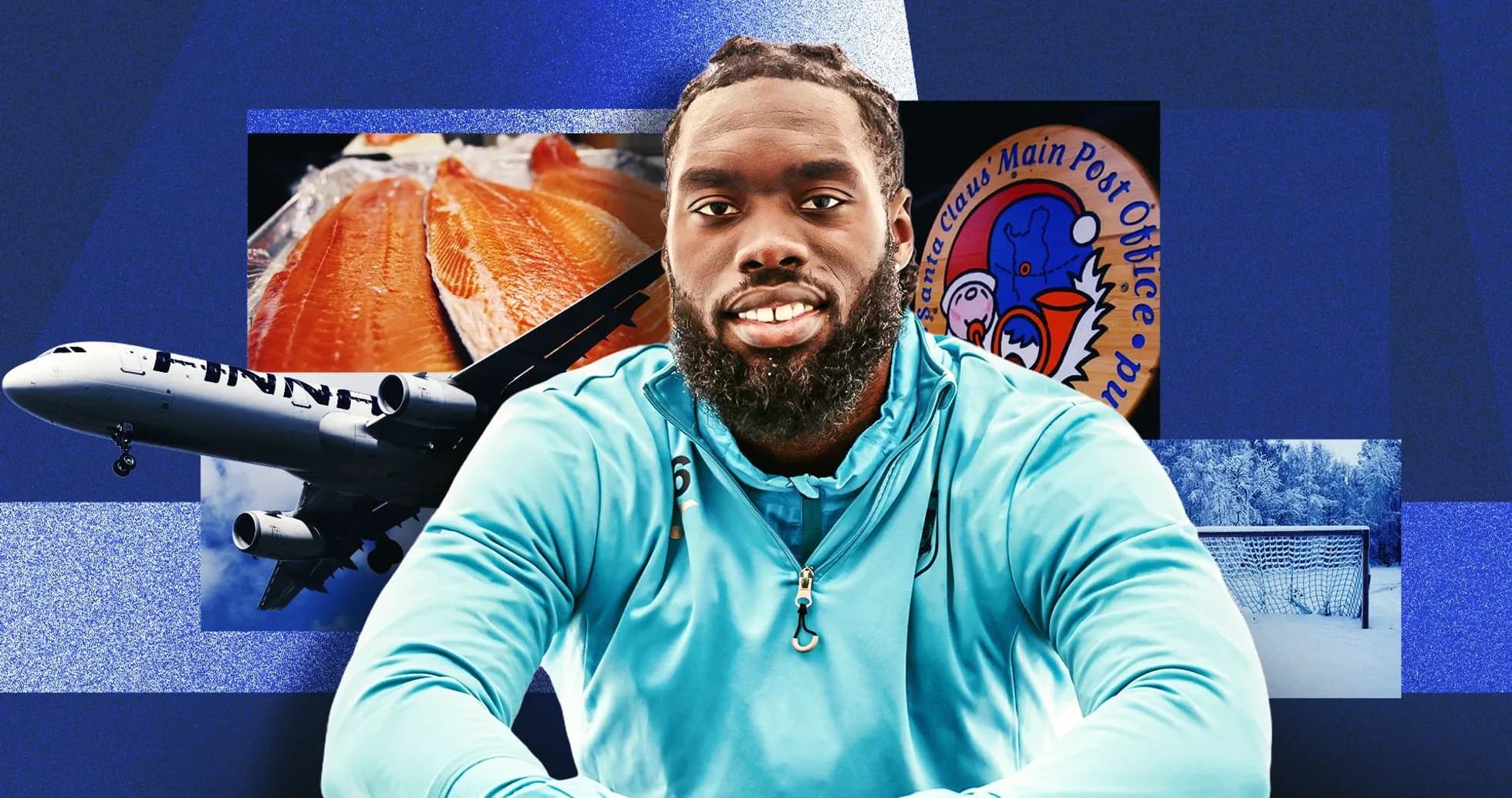
In May, a lifeline arrived from an unexpected place: Finland.
He first landed in Seinajoki, a modest city with a tight-knit feel. “Many people may not have heard of it,” he says. “It's not a bad city. It's quite small, there's not much to do.”
He reaches for a London comparison. “The centre is literally about the size of Westfield, of Stratford Westfield or Shepherd's Bridge Westfield. That's the size of the actual city centre. It's quite small. So everyone kind of knows each other a little bit.”
It didn’t matter. After five months without competitive football, the priority was minutes, not nightlife.
“In my mind, I didn't think, ‘oh, I need this city to be lavish or anything like that’,” he says. “I just needed to, in my mind, get myself back playing. I've been out for five months, I need to get myself back playing. This team's in Europe, I want to play. I've always wanted to play European football.”
Data, visibility, rhythm – that was the plan. Use Finland as a platform. Perform in European competition. Build a case for the next move.
Now he’s in Helsinki, the capital. Bigger city, brighter lights, a different pace. “Being from London, I went to a city called Seinajoki… But now being in Helsinki, it's a lot better. It's the capital city of the country.”
A Message to Young English Players: Look Outwards
His story has zigzagged through academies, the EFL, Scotland, China and Scandinavia. The lesson he draws from it is clear and aimed directly at the next generation stuck in under-21 squads and on benches across England.
“I feel like for young players, if they're not making their way in England, there's life outside of England,” he says. The Premier League and EFL dominate the horizon, but they also distort it. “I know England is a big pinnacle, the big league. I know in England, they say to you, ‘you need to stay here’ and stuff like that. You kind of get a little bit brainwashed.”
Scandinavia, he believes, offers something different: opportunity, intensity, and a pathway back.
“One good reason why I came here is because I know that there's a lot of young players playing in the Scandinavian league. So sharpness-wise, I get that back quickly,” he explains. “A lot of the players here are under the age of 25, 23. Coming here, building your career here, in England you would have something and in the Scandinavian market you would have something.”
Perform in Finland or Sweden and doors open. “If you're doing well in the Scandinavian market, you can easily move on to another country or even back to England in a better league.”
He’s seen too many young players feel trapped, their heads “buried playing in the 21s or not getting a chance” and convinced their careers are stalling.
His message is simple, and it comes from experience in back gardens, at Cobham, in Scotland, in the chaos of the CSL and now under the northern lights.
“If they're not making their way in England or they're not getting their chances in England, look outside. The life is a lot easier as well… There's always light on the outside.”