England's World Cup Win Sparks Drink-Drive Warnings
The morning after England’s breathless 4-2 win over Croatia, the party met the pavement.
On the edge of Durham city centre, rush-hour drivers were being waved into lay-bys and side streets, engines ticking as officers leaned in with breathalysers. No swerving, no suspicious weaving. Just random stops, blue lights cutting through the drizzle and the school-run traffic.
The message was blunt: last night’s beers can still cost lives.
Durham Constabulary launched a targeted drink‑drive operation off the back of England’s World Cup opener, armed with a statistic that should jolt any fan out of their hangover – collisions rise by around 20% on England match days.
With this World Cup staged in North America, kick-offs land late in the evening for fans in the UK. That means longer nights, later rounds, and a very real risk that the alcohol is still in the system when the alarm goes off.
None of the drivers stopped while media watched actually failed the test. One, though, discovered they were uncomfortably close to the limit. A near miss, in legal terms. In real life, it could have been far worse.
Sergeant Sarah Manser, overseeing the checks, spelt it out as cars rolled through the checkpoint.
“We come out this morning to give that message that alcohol still might be in your system the next morning,” she said. “We’ve had a couple this morning already who haven’t blown over the limit, but they have had alcohol in the system. Please just don’t and drink-and-drive, it’s just as simple as that.”
No lecture, no jargon. Just a line in the sand.
Among those pulled over was driver Louis Renwick. His test flashed clear – no alcohol detected – and he had no complaints about the stop. Quite the opposite.
“There’s too many deaths on the roads through drink-driving,” he said, backing the campaign as he headed back into the traffic.
His words sat in stark contrast to the scenes 4,700 miles away in Dallas, where England’s win had fuelled a very different kind of statistic.
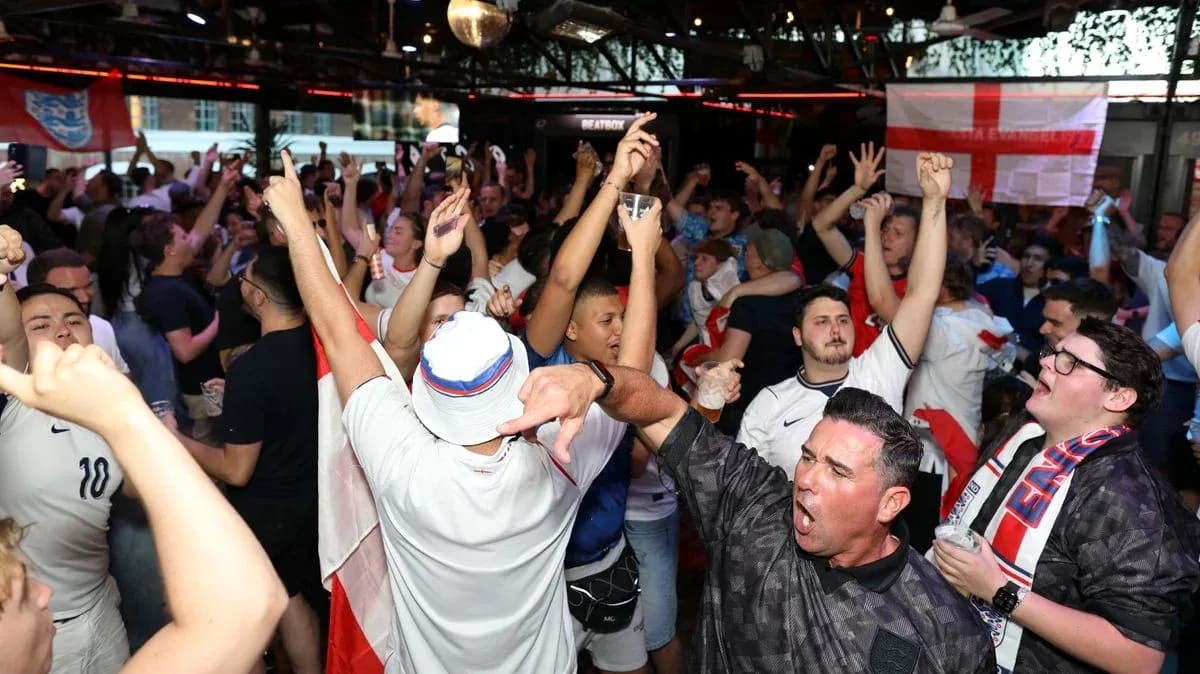
At the Londoner Pub in Dallas – quickly christened a “Palace in Dallas” by those swept up in the occasion – hundreds of England fans turned a World Cup group game into a marathon drinking session. The numbers were staggering. Around 2,352 bottles of beer sold. More than 5,000 beers drunk in total. Over £30,000 taken in a single night.
The pub had pushed a later closing time, and fans poured in, drawn by the promise of a long night with the Three Lions. The crush grew so intense that police moved in, videos showing officers ordering supporters out even as they belted out the national anthem. The venue had hit maximum capacity, with just two security guards trying to manage a crowd that simply kept coming.
The Londoner later revealed that the financial headlines told only half the story. The mayhem brought damage to property and landscaping, and the fire marshal eventually ordered the bar to close for the rest of the day.
“We are closed for the rest of the day, on order of the fire marshal,” the pub said in a statement. “The sales are overinflated in reports and do not account for the destruction of our property and landscaping. We are incredibly grateful for the business and have done our absolute best to manage it.”
It was a snapshot of England’s travelling circus: unfiltered, emotional, and occasionally overwhelming for the places that host it.
Inside the stadium in Dallas, the spectacle took on a different shape. At times the match felt like a scrappy FA Cup third‑round tie, all chaos and loose ends. Then it shifted into something else entirely – a Super Bowl‑style showpiece, noise ricocheting around the stands, a sense that this was not just a game but an event.
By the final whistle, with Marcus Rashford’s 85th‑minute strike sealing a 4-2 victory, it sounded like a karaoke night. “Hey Jude” rolled into “Wonderwall”, then “Sweet Caroline”. When Rashford’s goal hit the net, the tension that had gripped the stadium broke into a booming, defiant chorus of “Football’s Coming Home”.
The World Cup, for a few delirious hours, belonged to England.
Among the crowd was American fan Jessica Long, buzzing at the thought of the tournament coming to her home city. A former London Marathon runner, she’d once pounded past the flats of English fans on the streets of the capital. Now, in Dallas, she was shaking hands and talking about how this global circus was landing on her doorstep.
“This is brilliant, what an amazing day,” she said. “The World Cup is fantastic – look at everyone coming together.”
On the pitch, Thomas Tuchel’s England had delivered a performance to match the noise – eventually.
Twice pegged back in a wild first half, they went in at the break at 2-2. The second half, though, was a different game. A different team.
Tuchel’s changes and tweaks bit immediately, the German coach showing the in‑game decisiveness that Kyle Walker later admitted had not always been a strength of Gareth Southgate. Writing in The Sun, Walker contrasted Tuchel’s willingness to act with Southgate’s loyalty to his trusted core.
“Against Croatia, Tuchel made substitutions at the correct time and brought fresh legs on,” Walker wrote. “Gareth tended to stick with the XI he trusted in and only made a few changes here and there. I was part of that XI so it benefited me, but sometimes when you’re on the field, you’re thinking ‘go on, make a change, do something’ and Thomas got that right. If you’ve got Saka, Rogers and Rashford coming on when they did with about 20 minutes left, it would scare any team in the world.”
Tuchel’s half‑time message, as relayed by Harry Kane, was as bold as his bench.
“He told us to take the shackles off, calm down and let’s go,” the England captain revealed. “He said what’s the worst that can happen? Show the world who we can be.
“We came out in the second half full gas and they couldn’t live with it, and that’s the level we have to set in every game. The way we controlled the game once we went ahead, we never really looked like we were in danger and then scored on the counterattack.”
Kane had already done serious damage before the interval. His first‑half brace not only set the tone but pulled him level with Gary Lineker’s 10‑goal record as England’s top scorer at World Cups.
Watching Kylian Mbappe and Erling Haaland open their own campaigns with braces the previous day clearly lit a fire.
“Obviously I saw the guys scoring their goals,” Kane said. “I don’t like to concentrate on other people, but it is natural as a sportsman and athlete to want to reach the highest level. Those guys started in a great way.
“As a striker myself, I just want to get on the scoresheet as quickly as possible. In the back of my mind that competition helps me to push my levels. That is what the World Cup is for, to push myself at the highest level, so it is nice to get a couple.”
Tuchel went further, calling Kane the “full package” and pointing to a late defensive block in extra time as the perfect symbol of his captain’s commitment.
“If you see the commitment of our captain, of our number nine, in the extra time to block a crucial shot after a set piece with all his body and his commitment to buy into a defensive action like this, then you know everything about his performance today,” Tuchel said. “Complete performance, absolute leader and he is all in – he’s all in physically, he’s all in mentally, and he’s all in.”
Kane wasn’t the only one under the spotlight.
Jude Bellingham, back in the England fold after missing the September and October camps, arrived in Dallas with questions swirling around his relationship with Tuchel and his role in the squad. There had been talk of friction, of whether he fully embraced the “brotherhood” demanded by his manager. Tuchel’s mother had even been dragged into the debate, her view of Bellingham’s past behaviour described as “repulsive”.
Bellingham’s answer came with the ball at his feet.
He struck England’s third just two minutes into the second half, a goal that swung the night and symbolised the shift in control. Later, he spoke openly about using the noise around him as fuel.
“For me personally, it was nice to put some of the noise aside and just show my country and my team-mates how committed I am to help us try to win football matches,” he told BBC Sport. “Second half, we got things right, first half we got the intensity right, but not quite with the ball and second half we put it all together nicely.
“To contribute, to help my team and help my country is one of the biggest honours and regardless of the noise outside, that honour doesn’t change for me at all.
“It has been a tough season for me but I am feeling fresh and sharp and stronger. I have got a little bit of a chip on my shoulder. That helps me a lot to find that focus early in the game and to find that intensity. I know that it’s part of being a footballer and I don’t hold a grudge against anyone who says bad things about me because sometimes I do deserve it. Today, it was nice to try to show people and remind people what I’m about.”
His performance also prompted a public rethink from one of his more sceptical observers. Dietmar Hamann, who had been critical of aspects of Bellingham’s behaviour during his time at Borussia Dortmund, admitted on RTE that the midfielder had won him over with his evolution at Real Madrid and his team‑first display against Croatia.
“I saw him for Dortmund for a couple of seasons, and some of the things he did I didn’t like at all,” Hamann said. But he pointed to Bellingham’s Champions League triumph in his debut season in Spain, and the way he played within Tuchel’s structure in Dallas, as proof of a player who has grown under intense pressure.
“I wasn’t sure about him going to Madrid, but I have got to say the way he made the transition to Madrid and winning the Champions League in his first year, there is huge pressure to perform, and tonight he looked like a team player. When he does play for the team, when he does work for his team-mates, we know he’s an excellent player.”
Tuchel echoed that sentiment, stressing that Bellingham’s place in the XI is something he must keep earning, with Morgan Rogers pushing hard for the same role.
“A very good player, he deserved to start, and that’s what he needs to do to fight for his place,” the England boss said.
The wider football world kept spinning around them. In Mexico, the South Korean national team saw a drone brought down by the military near their training camp ahead of their clash with the hosts, an “unregistered” device that coach Hong Myung‑bo called “unfortunate” timing, even if it came just before they began working on tactical drills.
In another corner of the tournament, Cristiano Ronaldo’s sixth World Cup began with frustration rather than fireworks. He laboured through Portugal’s draw with the Democratic Republic of Congo, missing two half‑chances and drawing sharp criticism from Chris Sutton on 5 Live, who accused coach Roberto Martinez of being “scared” to take him off.
Back in the betting markets, England’s statement win did not go unnoticed. From 8/1 outsiders, they were cut to 13/2 to win the World Cup.
“After a shaky end to the first half, England were excellent in the second 45, and that was a real statement win from Thomas Tuchel’s men,” said Betway spokesperson Lewis Knowles. “They undoubtedly answered a lot of critics last night, and although there hadn’t been much confidence in them in the market at 8/1 going into the game, the Three Lions are now 13/2 to go all the way, and there seems to be a real belief that football might actually come home this summer.”
Belief is one thing. Responsibility is another.
As the songs fade and the odds shorten, the reality of a World Cup played in late‑night time zones will keep colliding with everyday life in places like Durham. Fans will still crowd into pubs, in Dallas and beyond, ordering one more round as Kane chases the Golden Boot and Bellingham drives from midfield with that chip on his shoulder.
The question is what happens the morning after, when the streets fill, the traffic builds, and the blue lights appear in the rear‑view mirror.