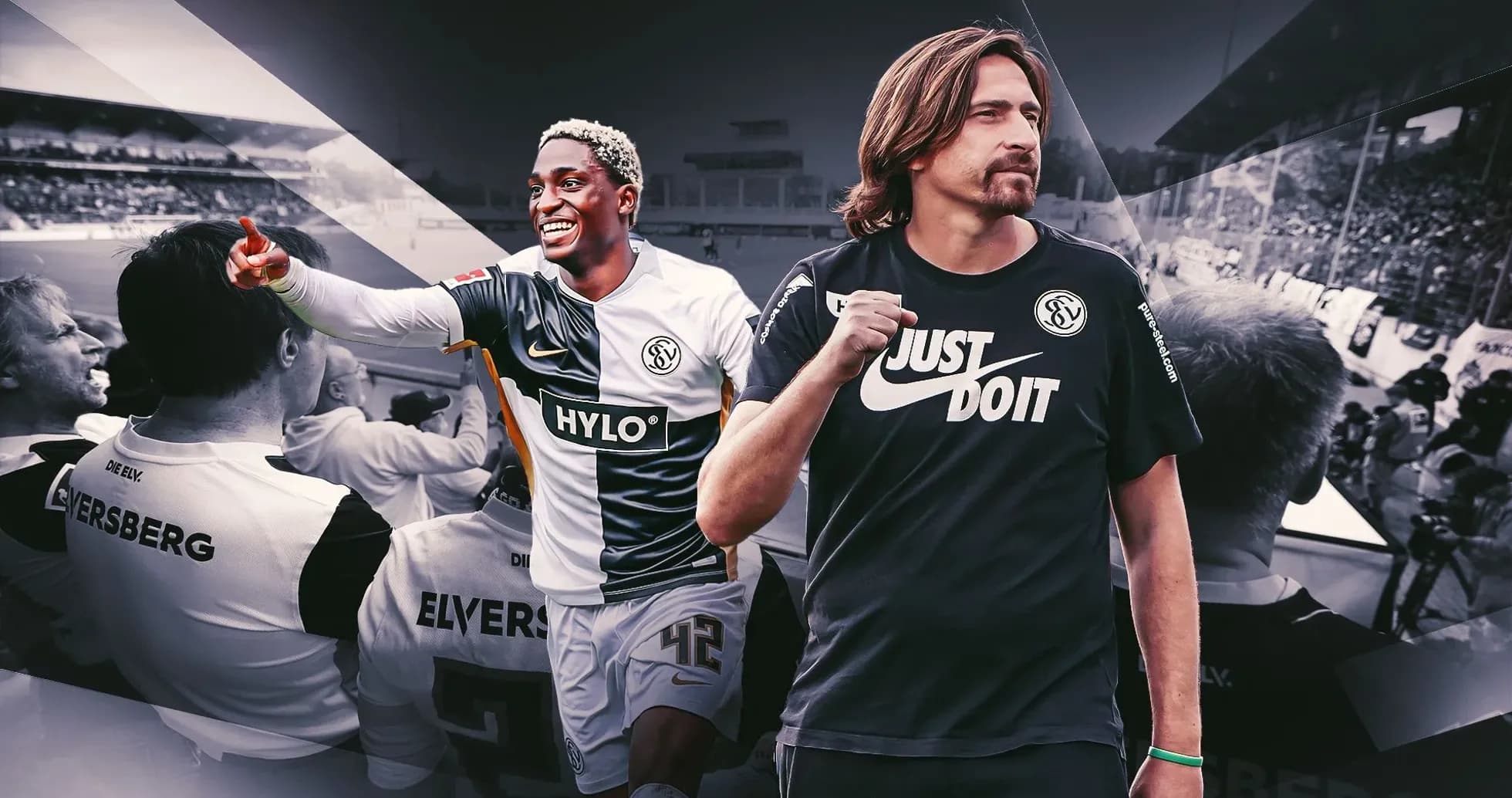
Elversberg: From Village Club to Bundesliga Contender
In Elversberg, they still call it a village.
No train station. No community hall. Just 13,000 people and a club that has somehow muscled its way into the Bundesliga, turning a quiet Saarland backwater into the most unlikely address in German elite football. The locals long ago embraced the nickname: Dorfverein. The village club.
From village pitch to professional dream
Elversberg first came into being in 1907, disappeared during the First World War, and resurfaced in 1918. For decades, it drifted along as an amateur side, tucked away in regional leagues, miles from the glamour and money of the top flight.
The turning point came in the early 2000s when local pharmaceutical firm Ursapharm stepped in as main backer under club president Frank Holzer. His son Dominik took over in 2011, and the club’s ambitions hardened.
By 2013, Elversberg had fought their way into the 3. Liga, Germany’s fully professional third tier. The stay was brief; they went straight back down. But the foundations were changing. Ursapharm bought the naming rights to the stadium, rebadging it as the Ursapharm-Arena an der Kaiserlinde, in honour of a 100-year-old lime tree that had stood sentinel until it fell in 2015. Capacity crept up to 10,000. The infrastructure was growing. The footballing vision wasn’t.
That arrived in 2018, with Horst Steffen.
Steffen’s revolution
Steffen didn’t just tweak tactics. He ripped up the script. Elversberg went from plucky also-rans to a side that attacked in waves, always on the front foot, always willing to risk. He once said he preferred a spectacular win to a “measly 1-0”, and his team played like they’d taken that line as a mission statement.
The payoff came in 2021-22 with the Regionalliga Südwest title and promotion back to the 3. Liga. This time, they were ready.
The message landed early in 2022-23. In the DFB-Pokal’s first round, Elversberg stunned Leverkusen 4-3, the biggest scalp in the club’s history. Bochum stopped the cup run in the next round, but the league form barely dipped. In a ferocious promotion race, the top five clubs finished within five points. Elversberg edged Freiburg to the title.
They did it with style. Eighty goals in 38 games, the best attack in the division. Stuttgart loanee Nick Woltemade chipped in with 10, but it was the collective relentlessness that stood out. Elversberg didn’t just win; they entertained.
The first season in the 2. Bundesliga was a reality check, but not a disaster. An 11th-place finish was solid consolidation. Then came 2024-25, and with it, the first glimpse of the “Promised Land”.
Agony at the door of the Bundesliga
Elversberg finished third behind Köln and Hamburg, earning a shot at promotion through the play-off against Heidenheim. The first leg ended 2-2. The second was locked at 1-1 deep into stoppage time. Five minutes beyond the 90, Leo Scienza struck. Heidenheim stayed up. Elversberg’s dream shattered on the line.
The pain doubled when Steffen left soon after, lured by Werder Bremen. The compensation fee of €300,000 barely registered compared to the loss of the architect who had dragged the Dorfverein into the national spotlight. Steffen’s Bremen stint would last only seven months, but that was little comfort in Elversberg.
Sporting director Nils-Ole Book now had the most important decision in the club’s history. He wanted a coach who understood pressing, tempo, youth development – and, crucially, the club’s commitment to brave, attacking football. The search ended with Vincent Wagner, fresh from leading Hoffenheim’s reserves to promotion to the 3. Liga in 2024-25.
“With everything he brings to the table, he fits in very well with us,” Book said at Wagner’s unveiling. “Vincent will not only continue our current path, but also enrich and develop it with new energy.”
The words sounded bold. The reality would be even bolder.
Wagner, the doubted successor who lit the fuse
Wagner arrived with a thin résumé and a squad stripped of key pieces. Goal threats Fisnik Asllani and Muhammed Damar returned to their parent clubs. Defensive leader Robin Fellhauer left for Augsburg. Pundits saw only one direction: down the table.
Book refused to let that happen. Working with limited funds, he rebuilt on the fly. Lukasz Poreba, Bambase Conté and Jarzinho Malanga came in on loan from Bundesliga sides. Lasse Günther and Jan Gyamerah signed permanent deals to shore up the back line. The mix of hungry loanees and undervalued signings clicked faster than anyone expected.
The 2025-26 campaign exploded into life. Elversberg won seven of their first nine 2. Bundesliga matches. Form wobbled later, but they stayed with the promotion pack. Schalke eventually strode clear in first, leaving a two-way scrap for the second automatic spot between Elversberg and Paderborn.
It all came down to the final day. Elversberg, second on goal difference, at home to rock-bottom Preußen Münster. It looked straightforward on paper. It was anything but in the heads of players carrying 119 years of history on their shoulders.
They didn’t flinch. A commanding 3-0 win sealed promotion. The village club were in the Bundesliga.
“Of course, this is something special,” Wagner said. “A friend of mine said this week, ‘If Elv can get promoted, it’s like flying to the moon.’ And we managed to make the moon landing today.”
The feat was staggering given the turbulence mid-season. The league’s top scorer, Younes Ebnoutalib, had been sold to Eintracht Frankfurt in January. Book, the man behind so many smart signings, left for Borussia Dortmund two months later.
On the pitch, Lukas Petkov stepped into the scoring void, hitting six goals in the second half of the season and finishing with 11 assists across the year. Tom Zimmerschied dovetailed with him, contributing nine goals and assists combined. Elversberg finished with a league-best 64 goals and conceded only 39 – the second-tightest defence behind Schalke.
The Dorfverein were no fairytale tourists. They had earned their ticket to the top.
Building a Bundesliga club on a construction site
Promotion triggered sweeping changes. The Ursapharm-Arena had to be dragged up to Bundesliga standards. Work began on expanding capacity to 15,000 by next spring. For now, one side of the ground looks more like a building site than a stand, with a temporary steel gantry bolted in place so journalists can actually see the pitch.
Off the field, Christian Weber arrived from Fortuna Düsseldorf after 16 years as scout and sporting director. Replacing Book, a master of finding hidden gems, was a daunting task. Weber wasted no time making his mark.
He prised 21-year-old attacking midfielder Maurice Krattenmacher from Bayern for just €2m, a steal in modern terms. The loan market remained Elversberg’s hunting ground: Francis Onyeka from Bayer Leverkusen, Noah Darvich from Stuttgart, Noel Futkeu from Eintracht. Then came the headline deal – a club-record €6m for Cole Campbell from Dortmund, a move that sent a jolt of excitement through the fanbase.
Campbell is regarded as one of the United States’ brightest prospects. New technical director Josef Welzmüller made his expectations crystal clear.
“He’s a fantastic player. He’s very fast and strong with the ball and in one-on-one situations,” Welzmüller told Bulinews in August. “We are very, very sure that he will have a breakout season.”
Welzmüller also shut down any idea of Elversberg abandoning their identity now that they were rubbing shoulders with Bayern and company. Survival by sitting deep and parking the bus? Not here. Wagner, who loves his space analogies, calls that kind of cautious approach a “mission to Mars” – and not one he’s interested in.
“We won’t do anything different,” Welzmüller told BBC Sport. “The identity stays the same and it is built on three core pillars. The first is to be brave, the second is to be intense and the third is to be clever.”
Those pillars were on full display from the first whistle of the new season.
Leverkusen stunned, Bundesliga warned
On opening weekend, Elversberg hosted Carles Martínez’s Leverkusen and tore into them like seasoned Bundesliga heavyweights, not nervous newcomers. Inside 10 minutes, they were two goals up.
Petkov struck first with a deflected effort. Then Campbell announced himself properly. He pounced on a loose pass, surged towards the box with the kind of swagger that justified the hype, and unleashed a vicious drive that Mark Flekken couldn’t keep out. Ruthless, fearless, emphatic.
Any thought of a second-half wobble vanished 25 seconds after the restart. David Mokwa slid home Petkov’s low cross to make it 3-0. Leverkusen rallied through Patrick Schick and Christian Kofane, but the damage was done. Elversberg, fielding seven Bundesliga debutants, had overpowered one of Germany’s established clubs. Campbell, with just 10 previous top-flight appearances, was suddenly the “experienced” head in the matchday squad.
“We fortunately did this with our fans behind us. We’re small but mighty,” Wagner said. “We’ll have to continue to play courageous football as it’s the only way we’re going to have a chance in this league.”
The message was clear. Elversberg weren’t here to make up the numbers.
A comeback for the ages in Gladbach
Matchday two at ista-Borussia-Park delivered a different kind of test. Away to Gladbach, Elversberg were 3-1 down before the hour mark. The atmosphere was hostile, the momentum against them, and Wagner had been sent off for his protests after a throw-in decision went the wrong way in the build-up to Gladbach’s second goal.
From the stands, the coach still found a way to influence the game. His substitutions changed everything.
Krattenmacher came on and made an instant impact. Within a minute, he headed against the crossbar, then reacted first to stab in the rebound and cut the deficit. Belief flooded back. In the 80th minute, Felix Heidel stepped up and bent a stunning free-kick into the net to level the match.
The stage was set. Deep into stoppage time, Futkeu, another substitute, drove into space and picked out Krattenmacher. The youngster swept home his second of the day. 4-3 Elversberg. A newly-promoted side, 3-1 down in one of Germany’s most intimidating arenas, had turned the game on its head.
“I enjoyed the way we played football – simply a sensational team performance from everyone,” Wagner said afterwards. Club captain Lukas Pinckert summed up the mood: “We were 1-3 down in front of this crowd and turned the game around as a newly-promoted team – that’s remarkable. We’re simply a unit, we never give up.”
The Dorfverein spirit, distilled into 90 chaotic, unforgettable minutes.
Bayern next – and no fear
Now comes the biggest stage of all. Bayern on Sunday. If results elsewhere fall kindly and Elversberg pull off what would once have sounded ridiculous – beating Bayern – they could climb to the top of the Bundesliga table.
Dreamland? Of course. Impossible? That word doesn’t sit comfortably in Elversberg anymore.
Schalke have already shown this Bayern side can be frustrated, grinding out a 0-0 draw. Elversberg will not follow that blueprint. There will be no deep block, no 11 men behind the ball for 90 minutes. They will do what has brought them this far: be brave, be intense, be clever, and take the game to Harry Kane, Michael Olise and the rest.
For Welzmüller, a Munich native who grew up supporting Bayern, the fixture carries an extra charge. “It will be insane. [But] we don’t fear anybody,” he has said.
That, more than the money, more than the shiny new stands or the transfer coups, is what makes Elversberg unique. A village club with a Bundesliga badge on its chest and not a shred of fear in its eyes.
The question now is simple: how far can this Dorfverein really go?