Dynamo Kyiv vs PAOK: Tactical Analysis of UEFA Europa League Defeat
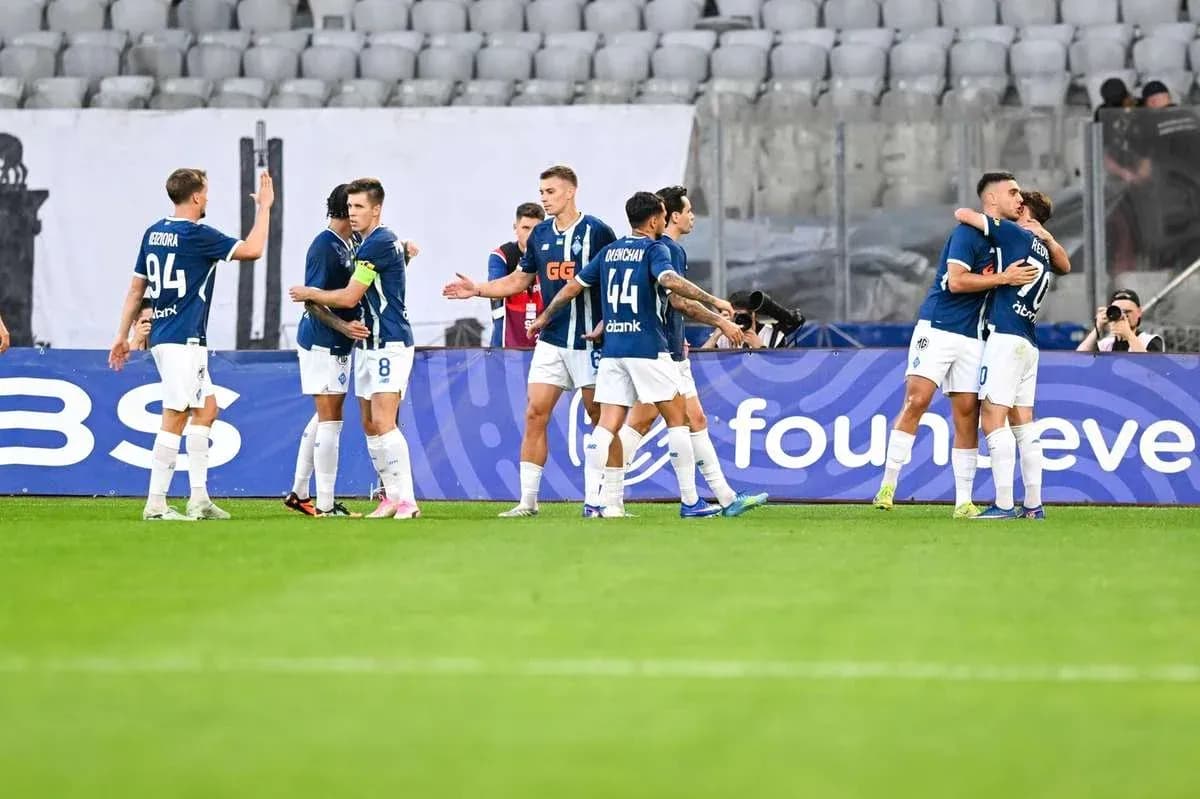
Dynamo Kyiv’s 3-2 home defeat to PAOK at Valeriy Lobanovskyi in the UEFA Europa League 2nd Qualifying Round was defined by contrasting interpretations of similar base structures. Both sides lined up in back fours, but where Dynamo’s 4-3-3 sought to dominate the ball and progress methodically, PAOK’s 4-2-3-1 was built to compress space centrally, spring in transition and attack the box with numbers. The statistical profile – 58% possession and 524 passes for Dynamo against 42% and 380 for PAOK – underlines that this was not about control of the ball, but about the efficiency of what each side did once they reached the final third.
Dynamo’s Tactical Setup
Dynamo’s 4-3-3 was oriented around a possession-first, midfield-heavy build. With T. Kedziora and V. Dubinchak as full-backs and K. Bilovar and T. Mykhavko as centre-backs, the hosts had a natural platform to circulate and step into PAOK’s half. The midfield trio of O. Pikhalyonok, V. Brazhko and M. Shaparenko provided a clear interior structure: Brazhko as the deeper controller, Pikhalyonok and Shaparenko as advanced eights connecting to the front three. That framework produced volume – 524 total passes with 456 accurate – and sustained territory, reflected in 58% ball possession.
However, the attacking pattern exposed a key imbalance. Dynamo generated 10 total shots, split 7 inside the box and 3 from range, but only 5 were on goal and just 1 was blocked. This points to a team that reached good zones but struggled to turn circulation into truly high-pressure sequences with repeated shooting lanes. The front line of N. Voloshyn, M. Ponomarenko and E. Guerrero offered width and central presence, yet PAOK’s double pivot and compact back four often forced Dynamo to recycle rather than penetrate through the half-spaces. The relatively low corner count (2) for such a possession-dominant side reinforces that they were not consistently pinning PAOK deep with waves of attacks.
PAOK’s Tactical Setup
PAOK’s 4-2-3-1, by contrast, was calibrated for verticality and penalty-box aggression. The back four of J. Kenny, P. Hatzidiakos, G. Michailidis and Jogo sat behind the double pivot of B. Santamaria and C. Zafeiris, with A. Zivkovic and T. Ali wide, G. Konstantelias as the central playmaker and A. Mythou leading the line. Despite having less of the ball, PAOK produced 14 total shots – 11 inside the box and 3 outside – and 7 on goal, with 2 blocked. The shot map implied by those numbers is clear: they consistently accessed central, high-value spaces.
The key tactical distinction lay in how each side used its midfield. Dynamo’s three tried to control rhythm, but often played in front of PAOK’s structure. PAOK’s two plus the 10, on the other hand, were constantly looking to break lines. Konstantelias, in particular, became a reference point between Dynamo’s midfield and defence, exploiting the pockets that appeared when Dynamo’s eights stepped forward to support attacks. Zafeiris and Santamaria not only shielded but also advanced at the right moments, contributing directly to the scoring output and embodying PAOK’s principle of committing midfielders into finishing zones.
Defensive Performance
Defensively, Dynamo’s numbers tell a story of relatively clean but insufficiently disruptive work. They conceded only 10 fouls and 1 offside, suggesting a side that preferred to defend positionally rather than with aggressive stepping out. Yet PAOK still carved out 7 shots on goal from 14 attempts. With just 1 blocked shot, Dynamo rarely got close enough to shooters to smother efforts before they reached the frame, leaving too much responsibility on the last line and the goalkeeper.
PAOK’s defensive approach was more interventionist. They committed 13 fouls and matched Dynamo’s offsides count at 1, indicating they were willing to break rhythm and accept defensive duels to prevent Dynamo’s midfield from dictating comfortably. Their 2 blocked shots show a slightly higher readiness to step out and close shooters. The three yellow cards for PAOK, compared to just one for Dynamo, fit this profile of a side that defended on the edge of their block, disrupting rather than merely containing.
Set-Piece and Restart Analysis
Set-piece and restart data adds another layer. Dynamo had 13 free kicks to PAOK’s 10, but PAOK’s ability to turn limited attacking platforms into clear chances was superior. Corner Kicks skewed 2-1 in Dynamo’s favour, yet PAOK were far more dangerous from open play incursions into the box, as reflected by their 11 shots inside the area. Dynamo’s territorial advantage did not translate into a sustained aerial or second-ball threat around PAOK’s goal.
Goalkeeping Performance
In goal, R. Neshcheret (Dynamo Kyiv) and J. Pavlenka (PAOK) faced different types of pressure. Dynamo’s 5 shots on goal forced J. Pavlenka (PAOK) into 3 saves, while R. Neshcheret (Dynamo Kyiv) made 4 saves against 7 shots on goal. The raw save counts underscore that PAOK created more frequent and often clearer looks at goal; Neshcheret was busier and exposed to higher-volume central finishing, a direct consequence of Dynamo’s midfield being played through and their back line being attacked in the box.
Discipline Profile
The discipline profile further illustrates the tactical trade-offs. Dynamo’s single yellow card contrasted with PAOK’s three, but that numerical cleanliness did not equate to control of dangerous zones. PAOK accepted the risk of cautions as the cost of a more aggressive, interventionist defensive plan, one that prevented Dynamo from turning their possession into a barrage of chances. Dynamo, by staying relatively passive in duels, allowed PAOK’s attacking midfielders to receive, turn and attack their box too often.
Conclusion
Overall, the statistical verdict is that Dynamo Kyiv won the structural and possession battle but lost the tactical efficiency war. Their 58% possession, 524 passes and 456 accurate passes framed the game, yet only 10 total shots and 5 on goal were not enough to match PAOK’s 14 shots, 11 from inside the box and 7 on goal. PAOK’s 42% of the ball and 380 passes were leveraged with far greater attacking precision, supported by a more disruptive defensive posture. In a two-legged European context, this match serves as a clear illustration that control of the ball must be married to protection of central spaces and a more ruthless occupation of the penalty area; on this evidence, PAOK’s 4-2-3-1 achieved that balance far better than Dynamo’s 4-3-3.