Diego Forlan: From Tennis Dream to Manchester United Hero
Diego Forlan never meant to follow his father onto a World Cup pitch. As a boy, he chased a tennis dream, not Pablo Forlan’s shadow. The switch came at 12, born out of tragedy and an act of generosity from Diego Maradona that would change the course of his life.
Maradona dipped into his own pocket to help the Forlan family pay medical bills after Diego’s sister, Alejandro, was left paralysed in a car crash that killed her boyfriend. The gesture lodged deep. Forlan decided he would be the one to support his family. Tennis was out. Football was in.
He threw himself into it. Penarol. Danubio. Then, at 16, a seven‑month trial at Nancy in France. No contract. No promises. Just a plane back to South America and another door slammed shut. Undeterred, and with the help of family contacts and manager Jose Omar Pastoriza, he landed at Independiente, one of Argentina’s ‘Big Five’, and began again.
By 18, he was in the first team. By 21, he was a problem for every defence in Argentina. Two-footed, tireless, ruthless when it clicked. Forty goals in 91 games for Independiente brought the European scouts back. In January 2002, Middlesbrough thought they had him, agreeing a £6.9 million fee for the Uruguayan forward.
Manchester United had other ideas.
Ferguson’s phone call
Forlan arrived in England expecting to sign for Middlesbrough. United moved fast. They matched the fee, offered better wages, and, crucially, Sir Alex Ferguson picked up the phone.
One call from a bathroom in England changed everything.
"I could understand English from a very early age, but I could barely understand the man on the phone," Forlan later wrote in his column for The National in 2015. The accent was thick, the words rapid, but the message was unmistakable.
"'We want you,' he said. ‘It’s not just interest, we want you. You can be a great player for us. Wait for us. You will play for Manchester United'.
United needed another No.9. Teddy Sheringham and Andy Cole had gone, and the champions-elect were retooling. Forlan arrived to fanfare, a fresh face to support Ruud van Nistelrooy and Ole Gunnar Solskjaer.
His debut came quickly, off the bench in a 4-0 win at Bolton. Fifteen minutes. A few clever runs. A blur of energy and pace. Enough to impress Van Nistelrooy.
"With Diego, we have got a very young and talented player," the Dutchman said. "He only came on for the last 15 minutes, but you could see that he has a lot of potential. He’s very, very quick, has two great feet and I think at 22 years of age, he has a great future."
The problem? That future would mostly unfold from the bench.
The drought
Forlan’s first start didn’t arrive until March, covering for an injured Solskjaer against Tottenham at Old Trafford. United cruised to another 4-0 win. Forlan buzzed around, running in behind, stretching the game. But when the chances came, his composure deserted him.
He finished the 2001-02 season with 18 appearances and not a single goal. United’s campaign unravelled too: third in the Premier League, early exits in both domestic cups, and a painful Champions League semi-final defeat to Bayer Leverkusen.
Yet Old Trafford warmed to him. They saw the running, the pressing, the refusal to hide. Uruguay took him to the 2002 World Cup, where he produced one of the goals of the tournament against Senegal – a vicious, 20-yard volley into the far corner. Confidence flickered back to life.
Back in Manchester, though, the story stayed the same. Substitute appearances, half-chances, no goals. After 26 games without scoring, the British press branded him "Forlorn". It stuck.
The dam finally burst in his 27th outing.
A penalty, a plea, and a first goal
Maccabi Haifa came to Old Trafford for United’s opening Champions League group game in September 2002. Forlan entered just before the hour with his side 4-1 up, full of industry but still without that elusive finish. He even ballooned a golden chance over the bar from a Van Nistelrooy pass.
It looked like another night of frustration until the 88th minute, when David Beckham won a penalty. Beckham, captain for the evening, picked up the ball to take it. Forlan begged.
"Please. please. Anyone with an ounce of humanity says please on his behalf," ITV commentator Peter Drury intoned as Old Trafford held its breath. Forlan’s body language screamed anxiety. His finish did not. He sent the goalkeeper the wrong way with a crisp side-foot and finally, mercifully, scored.
Beckham and his team-mates swarmed him. Relief poured off the bench. "If I'd taken it and scored, I'd have been hated by 67,000 people," Beckham said afterwards. "He's been working so hard in training and in matches, and he really deserved that."
Ferguson agreed. "Diego's movement is first-class and he deserves his goal," he said. "Even in the half-hour he was on, he created half a dozen chances. If you put that amount of effort in you should get something. Hopefully he will settle down now and get lots more. That will kick-start him I'm sure of that, he did some fantastic work."
Forlan, typically, stayed grounded. "I had to adjust myself to the Premiership and a different culture," he admitted. "Sometimes I don't play too much time and in those occasions it's more important to control the ball rather than scoring more goals. The pressure is a personal one, but I'm confident the goals will come. It would have been better to score that goal after a move but it still counts."
He was right. The goals did come – and when they did, they came with drama.
Shirt off, chaos on
The penalty didn’t unlock him immediately. Forlan went seven more games without scoring. Then Aston Villa arrived at Old Trafford on October 26.
United trailed 1-0 with 13 minutes left. Mikael Silvestre collected the ball on the far side of the box, seemingly boxed in. Somehow, he dug out a cross. Somehow, Villa left Forlan completely free.
The header was superb: angled, powerful, into the top corner beyond Peter Enckelman. Nine months after joining, Forlan finally had his first Premier League goal.
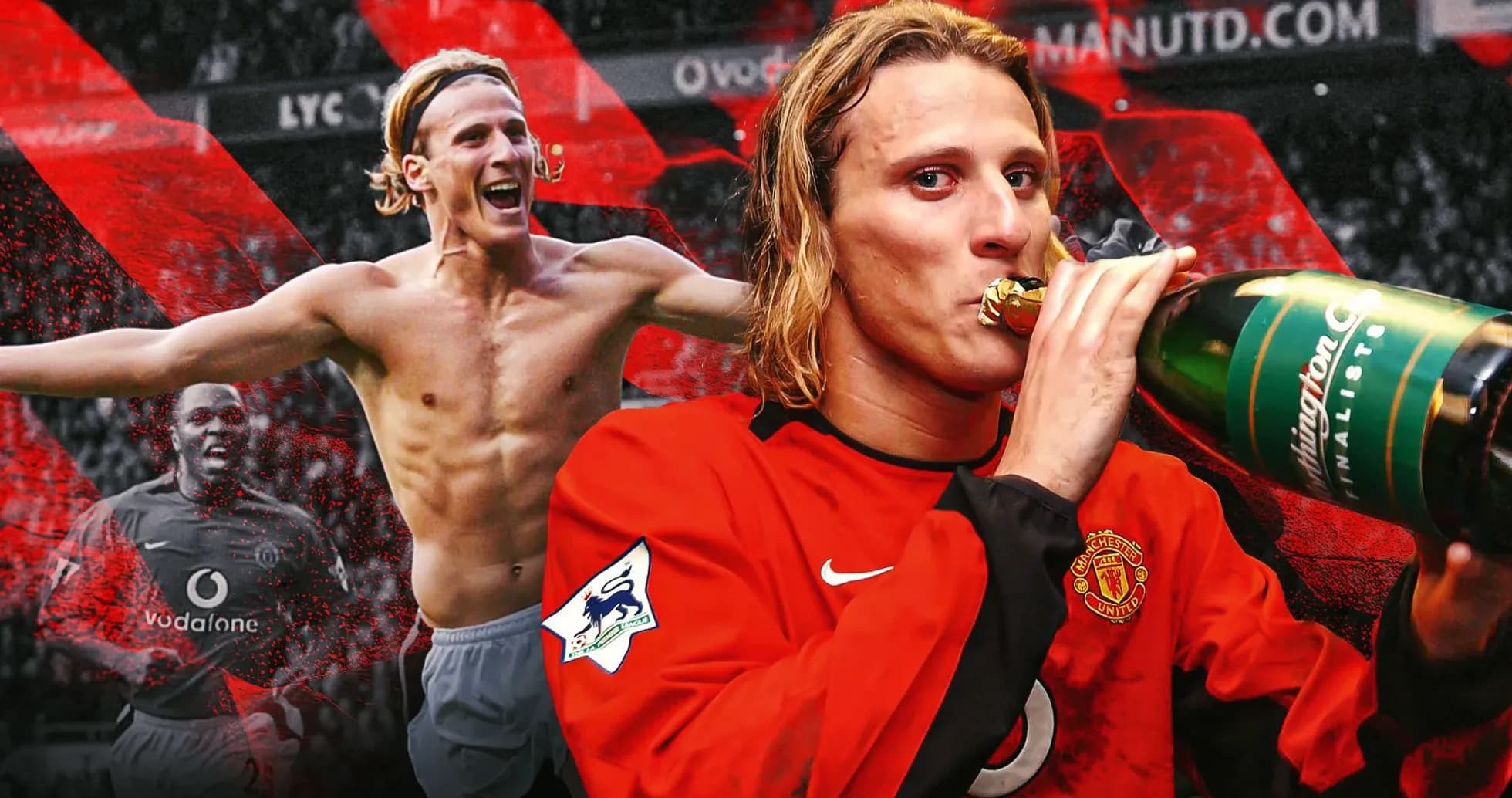
The celebration was pure release. Shirt off. Arms wide. And then, in the confusion, he sprinted towards the Villa fans instead of the Stretford End. After 23 league games without an open-play goal, no one blamed him for losing his bearings.
Southampton came to Old Trafford a week later. Forlan was back on the bench, but again he had the final word. With five minutes left and the score 1-1, Juan Sebastian Veron found him 25 yards out. Two touches to set. One ferocious strike. The ball screamed past Antti Niemi before he could move.
Same celebration. Shirt off. But this time, comedy followed the catharsis. United’s Nike dual-layer kit tangled around him as he tried to get dressed again. The game restarted with Forlan still wrestling his top, charging into a tackle while clutching it in his hands.
"I was trying to get it back on quickly, but sometimes when you are in a hurry, things tend to get worse," he said later. "I don't know if I will do it again. We'll have to see when it happens."
He was emotional, impulsive, driven by instinct. It wouldn’t be long before that instinct delivered the moment that would define his United story.
Anfield, and immortality
Forlan started in a wild 5-3 win over Newcastle, setting up two of Van Nistelrooy’s goals. It earned him another start, this time at Anfield. A scrappy, tense afternoon, where one mistake or one flash of brilliance felt destined to decide it.
The mistake came first.
Jamie Carragher headed a loose ball back towards Jerzy Dudek. Routine. Safe. Then chaos. Dudek let it slip under his legs, and Forlan reacted quickest, rolling it into the empty net.
He wheeled away, hands going to his shirt, then stopped himself just in time. Lesson learned. Goal one.
Three minutes later, the brilliance arrived. Ryan Giggs rode two tackles and slid the ball into Forlan’s path on the edge of the box. One touch, then a brutal strike at Dudek’s near post. The goalkeeper should have done better. It didn’t matter. The finish was clean, vicious, decisive.
Sami Hyypia pulled one back, Fabian Barthez made a stunning late save from Dietmar Hamann, and United held on. Forlan had broken Liverpool and, in the eyes of United fans, stepped into a different category.
"You know, the thing I remember is, of course, the goals – every time I see them on TV – but it was after the game when Gary [Neville] came to me and said you don’t know what you did. You will be remembered for years," Forlan recalled on United’s media channel in 2022.
He was right. The chant followed, to the tune of Dean Martin’s "Volare": "Diego, whoooah, Diego, whoooah, He came from Uruguay, and made the Scousers cry." It became a terrace staple, resurfacing even during a game against Sunderland in 2017, baffling Jose Mourinho on the touchline.
"I knew it was something important but, you know, I didn’t know in that moment, until now, after 20 years, they would still be singing my name. It's unbelievable," Forlan told GQ in 2019. "I get goosebumps every time I hear it. I’m not Ryan Giggs, Paul Scholes or another United legend, nor am I the only player to have scored at Anfield, so it feels a privilege to be remembered. I was getting so few minutes in the team that I didn’t even feel like I was a proper footballer until that game."
From that point, every goal he scored felt like a little piece of folklore.
December’s decisive touch
December 2002 turned into Forlan’s month of clutch moments. He finished calmly in a 2-0 League Cup win at Burnley. In the quarter-final at Chelsea, he nutmegged Carlo Cudicini to score the only goal and send United through.
Back in the league, he smashed home the opener against Birmingham City at Old Trafford, meeting a Beckham nod-back on the half volley. Still, he started only one more Premier League game that season.
His biggest league moment, though, came against Chelsea again, this time in January at Old Trafford with the title race tightening.
Arsenal had gone five points clear after beating West Ham earlier that day. Chelsea sat three further back in third. At Old Trafford, they dominated the first half and took the lead through Eidur Gudjohnsen on 30 minutes. United looked rattled until Cudicini slipped, mis-hit a pass straight to Beckham, and watched the winger cross for Paul Scholes to level.
United surged after the break. So did Cudicini, denying Van Nistelrooy with an astonishing save from a glancing header. Chelsea held out into stoppage time.
Then Forlan arrived.
On as a substitute for Van Nistelrooy, he drifted between Chelsea’s centre-backs and latched onto a perfect through-ball from Veron. One swing of his left foot, low and true, and the ball flew past Cudicini. Old Trafford exploded. This time, there was no hesitation. Shirt off. Sprint to the corner. A wall of noise.
"That's why we always put him on for the last 20 minutes. He's become a really important player this year with important goals," Ferguson told reporters afterwards.
Four months later, United were champions again. Forlan’s numbers – six goals and two assists in 25 appearances – looked modest on paper. But with only seven starts, those goals felt enormous.
The ceiling at Old Trafford
Forlan was never destined to be United’s long-term leading man. The signs came early. In a 2003-04 pre-season friendly against Juventus, he missed what was quickly labelled one of the worst sitters of the era, hitting the side netting from inside the six-yard box with the goal gaping. It set the tone for a final season that never truly ignited.
Ferguson shifted to a lone-striker system that made Van Nistelrooy even more central. Forlan’s room to breathe shrank. The flashes remained – a superb volley against Rangers in the Champions League, the winner away at Panathinaikos to secure progression, a sharp double off the bench in a 4-0 demolition of Aston Villa, and a goal on the way to lifting the FA Cup, including a strike in a 3-0 fourth-round win over Northampton.
But the misses hurt. He squandered more chances than he converted, including a penalty against Northampton, and struggled to impose himself when handed rare starts. After a particularly flat display against Leicester in April, Ferguson hauled him off after 57 minutes. Forlan stormed towards the tunnel, a rare public flash of anger.
His situation worsened when Louis Saha arrived in January 2004, and Wayne Rooney followed from Everton that summer. On the opening day of the 2004-05 Premier League season at Chelsea, Forlan came on for 17 minutes, slipped when clean through, and walked into the moment that effectively ended his United career.
"Ferguson wanted me to play with long studs, the interchangeable ones that suit wet pitches, but I feel more comfortable in short ones," Forlan has said. "I agreed to change but I didn't and wasted a chance. Afterwards, I rushed to the dressing room to change boots but Ferguson caught me. He grabbed the boots and threw them. That was my last game for United."
Days later, he was gone.
A ‘flop’ who never felt like one
Forlan left Old Trafford for Villarreal in a cut-price £2m deal, stamped in the record books as a transfer flop. The story between him and Ferguson, though, never soured.
In his autobiography, Ferguson reflected on the dynamic that had worked against Forlan. "Ruud wanted to be the No 1 finisher, that was his nature. Diego Forlan didn’t register on his radar at all, so when you put the two of them out there together, there was zero chemistry. Diego was better with a partner," he wrote. "But he scored some priceless goals. He was a good player and a terrific pro."
At Villarreal, freed from the bench and handed the lead role, Forlan exploded. The same happened at Atletico Madrid, where he forged a lethal partnership with Sergio Aguero, and on the international stage, where his understanding with Luis Suarez and Edinson Cavani became the heartbeat of Uruguay’s attack.
United never saw that full version of Forlan, the Golden Boot winner, the World Cup Golden Ball winner, the complete forward. What they saw instead was something different – and, in its own way, just as enduring.
"I remember when Diego Forlan came in, and it wasn't quite happening for him. If a player tried - and Diego did - we'd drag him with us; we'd try and help him," Roy Keane said in 2023.
United fans responded in the same way. They saw the running, the missed chances, the refusal to disappear. They saw a player who might not have been clinical enough, or consistent enough, but who never hid, never sulked, never stopped.
He made the Scousers cry, yes. But that was only part of it. His determination, his willingness to keep showing for the ball when it would have been easier to shrink, turned him into an Old Trafford cult hero.
In an era since defined by expensive signings and fleeting commitment, Forlan’s time at United poses a sharper question: if romance in football isn’t measured in numbers, but in devotion, how many modern players could stand next to him?