
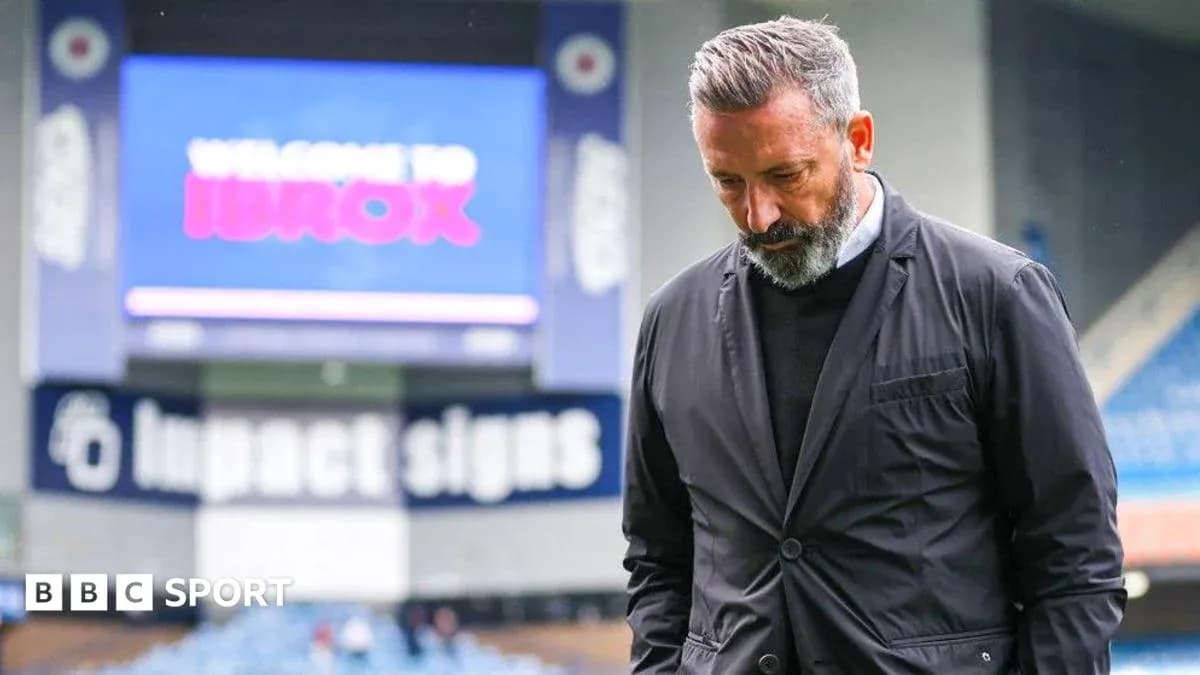
Derek McInnes Takes Charge at Rangers
Derek McInnes has never hidden what Rangers means to him. When he walked into Tynecastle last May and called Hearts “everything I wanted”, it sounded like a man finally where he felt he should have been years earlier.
Thirteen months later, he’s gone. Hearts have been traded for Ibrox. The dream job, it turns out, was always in Govan.
Hearts’ nearly man walks
The moment Rangers made their move, there was an inevitability about it. This was not a tug-of-war. It was a formality. When, not if.
You’d forgive Hearts supporters for fury, for feeling used, for railing against a manager who came within three minutes of delivering the Scottish Premiership title and then walked away. But the mood around Gorgie is more muted than that. Irritated, yes. Betrayed, not quite.
McInnes was never truly “one of them”. He was respected, admired even, for that extraordinary title push and the cascade of club records that fell in his single season. Yet he always felt like a visiting specialist rather than a long-term architect. A man passing through on the way to somewhere else. Somewhere called Ibrox.
Everyone knew, deep down, that if Rangers came calling properly, Hearts would be a stopover, not a destination.
Control, power – and a clean break from data
Part of this is about footballing culture. McInnes is a manager who craves control. At Kilmarnock and, before that, Aberdeen, he ran football operations with a firm hand. At Hearts, he had to live with a different reality.
Jamestown Analytics have real weight in the modern Tynecastle structure. Recruitment, selection, squad planning – all heavily influenced by data. McInnes adapted, he worked within it, but he never looked entirely at ease with analysts effectively having a seat at the table.
He is not a coach who wants to be told which players must play because their metrics pop on a dashboard, or which targets must be binned because the algorithm frowns. He wants football people making football calls. His calls.
At Rangers, he will get something close to that. Not absolute power – no manager truly has that now – but a far stronger version of it than he enjoyed in Edinburgh. He will have money, too. More than he has ever had to shape a squad. For a manager who almost won the league on a relative shoestring last season, that is a powerful lure.
Call it disloyal if you like. In the brutal logic of modern football, it is also a decision that makes perfect sense for McInnes.
Ibrox: his train set, his risk
Rangers’ owners have already thrown serious money at the problem in their short time in charge. They are ready to go again this summer, potentially on a scale that could reshape the squad in McInnes’ image.
This is now his train set. He will run the football department as he sees fit. No data department lobbying for “their” players to get minutes. No signings forced on him because their Jamestown scores are through the roof. No need to coach pet projects he never truly believed in.
But this freedom comes with a brutal caveat. At Ibrox, power is inseparable from pressure.
Nothing short of the Premiership title will be tolerated next season. Not a brave challenge. Not a near miss. A title.
Danny Rohl had a go and finished third. The sympathy was minimal. Philippe Clement finished second and the supporters could not wait to see the back of him. The patience has gone. The romanticism has gone. There is only an angry demand for silverware and a raw fatigue at watching someone else lift the trophy.
McInnes knows that better than anyone. His words will land well at first – he is a persuasive, clear communicator – but talk at Rangers is cheap. Only the league table counts.
The obvious choice – with a question mark
On paper, he is exactly what Rangers needed. He knows the club. He knows the league. He has out-thought them from the opposite dugout. His Hearts side caused Rangers real pain last season, tactically sharp and mentally tough.
He is no shrinking violet. His personality fills a room, and that matters at a club of this scale. Rangers demand a big presence in the technical area, someone who will not flinch under the glare. McInnes fits that profile.
His record in big domestic occasions is extensive. With Aberdeen, he turned Hampden into a second home: League Cup finals in 2013-14, 2016-17, 2018-19, and a Scottish Cup final in 2016-17. Celtic repeatedly stood between him and glory, and few would criticise him for losing to that powerhouse.
But the story is not only about running into Celtic. There were painful cup exits to Dundee United, Hibs, St Johnstone, Dundee, Hearts, Motherwell, Hearts again, St Mirren, Motherwell again and United again. On the honours board, a lot of other names have appeared since he last lifted a trophy with a Premiership club: St Johnstone, Inverness, Hibs, St Johnstone again, Aberdeen in the Scottish Cup; Ross County, St Johnstone and St Mirren in the League Cup.
Managers outside the Old Firm have broken through – Tommy Wright, John Hughes, Alan Stubbs, Callum Davidson twice, Jimmy Thelin, Jim McIntyre, Stephen Robinson. McInnes, for all his consistency and longevity, still carries the label of the nearly man.
Rangers are betting that, with their resources and his authority, “nearly” becomes “actually”.
From stepping stone to judgement day
Hearts, in the end, were a bridge. The job he wanted then, not the one he has wanted all his life. In Edinburgh, he came close to writing himself into club folklore with that agonisingly narrow title miss. At Ibrox, the stakes are higher and the margin for error smaller.
He now has the chance he has waited for, the one that has hovered over his career for years. No more stepping stones. No more what-ifs.
Just one brutal, simple question: can Derek McInnes finally turn promise into titles at the club that matters most to him?





