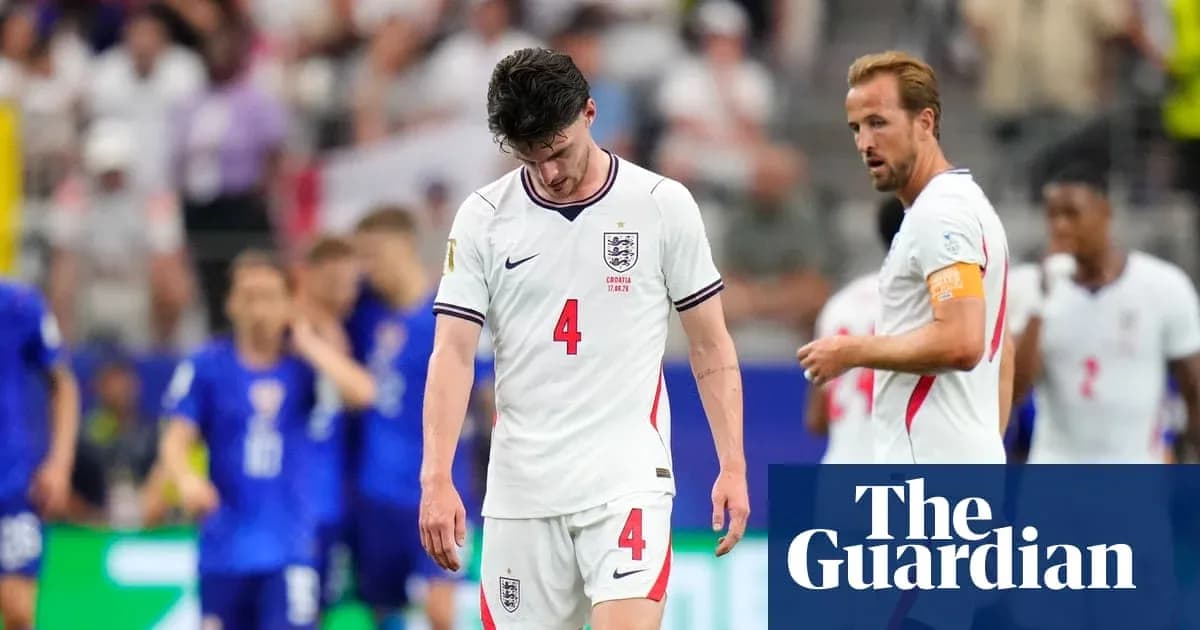
Declan Rice: A Unique Talent in England's Midfield
Aaron Cresswell calls Declan Rice “a freak of nature”. It sounds like a throwaway line from an old team‑mate, the sort of praise players trade all the time. It is not. Not when you look at the numbers.
Since the start of the 2020-21 season, Rice has played 360 games for club and country. Three hundred and sixty. West Ham’s European runs, England duty under Gareth Southgate, a record move to Arsenal and the demands of a title and Champions League challenge there – every manager has reached for the same solution: put Rice on the teamsheet and let him sort it out.
For years, he has obliged. He has been the constant in a sport that never stops.
On Wednesday in Yokohama, in England’s wild 4-2 win over Croatia in their World Cup opener, the constant finally flickered.
A rare off‑day
This was Rice’s 63rd appearance of the 2025-26 season. It showed. The 27-year-old, usually the metronome and the shield, played like a man dragging heavy legs through treacle.
England’s midfield shape was all wrong. The gap between Rice and Elliot Anderson yawned open in a messy first half, inviting Luka Modric to wander into the spaces and pull Rice into uncomfortable areas. Rice dropped too deep, then stepped out at the wrong moments. Tuchel later called it “some unusual ball losses”. That counts as a rebuke in Tuchel-speak.
Tactical wrinkles can be ironed out. Fatigue is harder to erase.
The alarm truly sounded in the 72nd minute. England were 3-2 up, Croatia pushing, the game stretched. These are the minutes when Rice usually tightens the screw, hoovers up loose balls, kills momentum. Instead, he walked off, replaced as England tried to see out a lead.
For a player whose identity is built on durability and defensive security, it felt jarring. Almost unnatural.
Tuchel explained it as a precaution: discomfort in Rice’s lower back and upper hamstring. Rice himself quickly insisted he would be ready for Ghana on Tuesday. England will cling to that. They have to. But they also have to ask a question they have avoided for six years.
What if he isn’t?
No like‑for‑like, no easy answer
Strip Rice out of this England and the structure starts to wobble. There is no copy of him in the squad. No one with his blend of physique, anticipation, and set-piece threat.
Kobbie Mainoo is a gifted footballer, calm on the ball and brave in possession, but he does not yet have Rice’s frame or his sheer defensive volume. Jordan Henderson brings experience and voice, but at 36 he was overlooked when England needed to maintain tempo against Croatia. That told its own story.
Tuchel’s first reaction when Rice went off was to drag Jude Bellingham deeper. It almost backfired immediately. Croatia surged, England lost their out-ball, and the experiment lasted just eight minutes before Tuchel reached for something bolder.
Djed Spence came on for Bellingham. Reece James moved out of right-back and into midfield. Suddenly, England had a different profile at the base of their team: a defender’s instincts with a midfielder’s range.
It was not improvised from nowhere.
Reece James, the unexpected 6
James has quietly built a second career in midfield at Chelsea. The shift began in earnest under Enzo Maresca, who used him centrally across his 18 months at Stamford Bridge. At first, there were doubts. James had been one of the league’s outstanding right-backs, a force of nature down the flank, and Maresca’s idea looked like tinkering for its own sake.
Then came the performances.
James excelled in last year’s Club World Cup final, when Chelsea beat Paris Saint-Germain with him anchoring midfield. He followed that by dominating Barcelona in a 3-0 win last November alongside Moisés Caicedo. Five days later he outplayed Rice himself when Arsenal visited Stamford Bridge.
Tuchel, who once insisted he saw James only as a right-back for England, has changed his mind. When he named his World Cup squad and left out Adam Wharton and Alex Scott, he was clear: “Reece James can play in the 6 because he does on a high level for Chelsea.”
The logic is obvious. James is powerful, tactically sharp, and aggressive in the tackle. He can hit diagonals, switch play, and step into tight spaces. If Rice’s minutes have to be managed, James is the closest thing Tuchel has to a hybrid solution.
Move him into midfield and the back line can be reshaped. Spence, Ezri Konsa or Jarell Quansah can slot in at right-back. Konsa can even tuck in as a third centre-back alongside John Stones and Marc Guéhi, allowing Nico O’Reilly to fly forward from left-back. It is a structure Tuchel knows well: a back three in possession, extra control in midfield, athletic full-backs pushing high.
On paper, it works. On grass, it comes with a catch.
The fitness tightrope
James has his own history with hamstrings. Another strain in March cost him almost two months of the season. Chelsea have had to manage him with care, picking spots rather than piling on minutes. Tuchel knows this as well as anyone.
England have already lost Tino Livramento to a calf injury, forcing Trevoh Chalobah’s late call-up. James is first choice at right-back. He cannot start every game there and then be asked to carry the midfield load if Rice breaks down.
This is the reality of a squad stretched by a brutal calendar. Rice arrived late to England’s pre‑tournament camp in Florida after playing in Arsenal’s Champions League final. Tuchel took his squad across the Atlantic early to work on conditioning in the sun, trying to put fuel in legs that have been running since August. Some tanks are already near empty.
Rice, as ever, keeps pushing. If England reach the final and he plays every match, he will finish the season on 70 appearances for club and country. Seventy. It is a number that belongs in a different era.
Tuchel has built his World Cup squad around versatility. He has options, shapes, contingency plans. What he does not have is another Declan Rice.
Sooner or later, he may have to find out what England look like without one.