
Canada's Historic World Cup Journey: From Forgotten Host to Football Fame
They called Canada the “forgotten host” of this World Cup. Try telling that to anyone who watched Les Rouges rip up their own history book this summer.
Under Jesse Marsch, the unapologetically loud American on the touchline, Canada did more than just show up to their own party. They stayed late, kicked down a few doors and pushed all the way into the round of 16 for the first time in the men’s team’s history, before Morocco finally slammed it shut.
A first World Cup point. A first World Cup win. A first World Cup knockout victory. For a country long treated as a footballing afterthought, this run was a jolt of electricity.
“They shocked everyone,” fan Matt Lorincz said in Calgary. He wasn’t exaggerating.
A hockey nation turns its head
In Canada, the ball is round but the national obsession is carved in ice. Hockey rules the airwaves and barroom arguments, with Major League Baseball and the NBA muscling in for attention. Soccer, despite being the country’s most-played sport, usually slips down the commercial pecking order.
This tournament cut through that noise.
“Most people you talk to watch, like, hockey or other sports, right?” Lorincz said. “There’s not a lot of – or as many – soccer fans in Canada. So hopefully there may be a few more of those.”
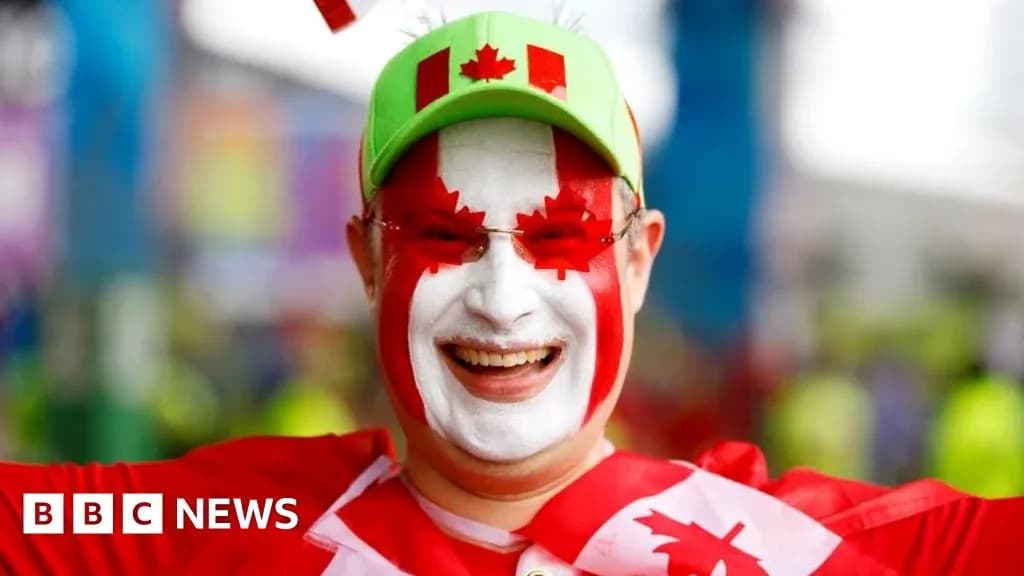
For a few weeks in June and July, that hope felt real. Toronto’s streets carried the sound of commentary drifting from packed bars. Supporters marched in colour and song through downtown to Toronto Stadium. On the Pacific coast, Vancouver turned into a carnival, capped by Canada’s ruthless 6-0 demolition of Qatar – a statement win soured only by the sight of star midfielder Ismaël Koné leaving on a stretcher with a broken leg after a heavy challenge.
While the men were writing new chapters on the pitch, Canada’s stint as host quietly ticked towards its own full stop. The country’s final act came in Vancouver, where Switzerland knocked out Colombia in the round of 16. The curtain fell, but the impression lingered.
Carney in the dressing room, and a country on show
Prime Minister Mark Carney, never shy of a jersey, embraced the moment as more than just sport. He became the only leader among the three North American hosts to actually attend games in the stands, leaning into the chance to sell Canada to a global audience.
After that 6-0 win over Qatar, he went straight to the dressing room in Vancouver.
“You showed a level of character that some people never achieve in their life,” he told the players. “And you showed it when a good part of the country and the world is watching.”
The message from government matched the mood. Sports minister Adam van Koeverden called hosting “a sincere privilege” for a country “growing up a little bit as a middle power”.
The original World Cup bid was sold on a simple idea: one continent, three countries. John Kristick, now with Playfly Sports Consulting and formerly executive director of the United Bid Committee, still believes the tournament has broadly worked. Yet he also sees how the balance slipped.
He pointed to the United States – more games, bigger stadiums, louder politics during the Trump era – and how that inevitably swallowed much of the spotlight.
“I think it’s probably been harder for Canada and Mexico to break through as hosts. I think that the US have taken more of that limelight,” he said.
But inside Canada’s borders, the story felt very different.
“Every Canadian knows Canada is hosting it, and I think there’s been a great deal of national pride,” Kristick added.
Toronto and Vancouver staged 13 of the tournament’s 104 matches. On paper, a modest slice. On the ground, it felt far bigger.
Full bars, full tills, and a hefty bill
In British Columbia, the World Cup hit like a wave.
Ian Tostenson, head of the British Columbia Restaurant and Foodservices Association, called being in a host city a crash course in “the enormity of the World Cup”. Fans didn’t just watch; they poured into venues, ordered another round, and stayed.
Alcohol sales climbed roughly 5% year-on-year, Tostenson said. More important was the mood.
“It raised the spirits of the entire province. I think the whole conversation [for the] last four weeks had been about soccer,” he said. Canada’s economy may be labouring, but he drew a blunt lesson: “You learn that if you give people a real reason to spend their money and give them value, they’ll spend it.”
That spending, though, started with taxpayers.
Canada’s price of admission to the hosting club: an estimated C$1.1bn. Toronto alone is on the hook for around C$380m. In a city wrestling with strained finances, that figure landed heavily.
“I don’t think that hosting the games made the city’s situation any better,” said City Councillor Josh Matlow, who has been a consistent critic of the outlay.
Van Koeverden pushed back. He called the investment “prudent” and pointed to the flow of money back into local economies.
“Full stadiums, full parks, full restaurants, and full hotels is a nice problem to have in 2026,” he said.
The “forgotten” host leaves a mark
If Canada sometimes felt like the quiet partner in this tri-nation World Cup, visitors didn’t see it that way.
Portugal manager Roberto Martinez praised Toronto’s compact, temporary-boosted stadium, the smallest of the lot, saying it reminded him of “old-fashioned Premier League grounds”. After Portugal beat Croatia there, he described the spectacle as “an incredible spectacle for football”.
From the stands, the reviews matched the manager’s.
Gudmund Agotnes, over from Norway, took in three games in Toronto and called himself “lucky with the draw”. The stadium, he said, offered a “pretty cool” bird’s-eye view of both the pitch and the city skyline – a snapshot of a host city trying to show its best angles.
Numbers that rival hockey
Fifa announced that more than a million fans attended the first 16 matches across the three host countries, with the expanded format driving the tournament towards a new cumulative attendance record beyond the 3.5 million mark set in 1994.
Inside Canadian living rooms, the shift was even starker.
The round-of-16 tie against Morocco on 4 July peaked at 11.7 million unique Canadian viewers, according to host broadcaster Bell Media – the highest ever figure for a World Cup match in the country that wasn’t a final.
For context, the opening night of last season’s NHL campaign drew 9.8 million Canadians in total. Bell Media reported that round-of-32 games at this World Cup averaged 1.9 million Canadian viewers. Hockey Night in Canada, a weekly institution, usually sits at about 1.2 million per broadcast.
For once, the sport that lives in Canada’s rinks had to share the stage with the one played on its parks and school fields.
A football culture looks up
Canada is not starting from zero. The country has lived with professional club football for decades: the Vancouver Whitecaps date back to 1973, Toronto FC arrived in 2005, and both now compete in MLS. Grassroots leagues are thick with players every weekend.
The problem has been turning that base into sustained elite success, especially on the men’s side. While the women’s national team sits ninth in the Fifa rankings, the men have spent much of their existence on the outside of major tournaments looking in.
This World Cup changed the conversation – and the balance sheet.
Canada Soccer, the sport’s national governing body, launched a C$25m fundraiser before the tournament. It hit the target months ahead of schedule, a sign of how quickly the mood – and the money – can shift when a team finally delivers on the biggest stage.
For the fans, the numbers matter less than the feeling.
Les Rouges’ run pulled strangers together in bars and public viewing areas from coast to coast. In Calgary, Zeileen Reardon watched the Morocco game and tried to put it into words.
“It brought a lot of people together in a very kind of segregated world that we’re living in,” she said. “So, I think it actually showed the world that we can come together, even for a game.”
The “forgotten host” tag will stick in some headlines. On the evidence of this summer, it no longer fits the team wearing red. The real question now is whether Canada lets this moment fade – or turns a breakthrough World Cup into the start of something permanent.





