
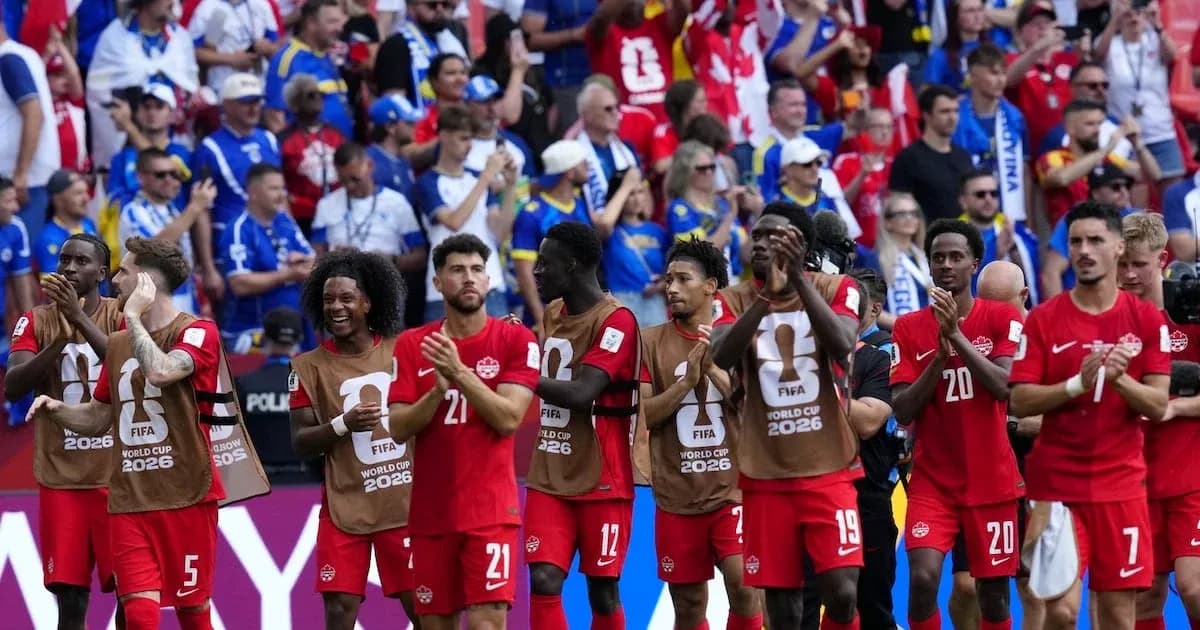
Canada's World Cup Knockout Match: Facing South Africa
Canada’s World Cup path clears – if they can first handle the danger in front of them.
On Sunday, in their first-ever World Cup knockout match, Jesse Marsch’s side walk into a fixture loaded with history and hazard. South Africa arrive as underdogs on paper, but absolutely not in mood.
Canada sit 31st in the FIFA rankings. South Africa are 60th. ESPN had the Canadians 25th in the field before the tournament, South Africa way down at 46th of 48. The numbers say one thing.
The football says something else.
A new stage for Canada
Canada reach the Round of 32 having already torn up their own record book. First World Cup point. First World Cup win. First time out of the group. Now comes the part of the tournament where the margins shrink and the stakes grow teeth.
They opened with a gritty 1-1 draw against Bosnia and Herzegovina, settled their nerves, then cut loose in a 6-0 rout of a nine-man Qatar side. That win put them on the brink of topping Group B.
Switzerland had other ideas.
Canada trailed 2-0 early in the second half on Wednesday, then surged back, pulled one back, and spent the closing minutes camped in Swiss territory, chasing a point that would have rewritten their route and sent them to Vancouver on Thursday to face a third-place finisher.
Jonathan David called stoppage time “kind of intense.” It was more than that. It was frantic, desperate, exactly what knockout football demands.
“You try not to look at the clock, because the more you look at it, the quicker time goes. But it’s garbage time,” he said. “You have to just have to crash the box and get the crosses and make sure you make your chances happen, and put shots on target, and hopefully something falls. And we came really, really close.”
They didn’t get the equalizer. They did get a lesson in how quickly a tournament can tilt.
South Africa: battle-scarred and alive
If Canada’s rise has felt steady, South Africa’s route to Sunday has been anything but.
Their World Cup started in chaos: two red cards and a 2-0 defeat to Mexico in the opener. A campaign on the brink before it had even settled.
Hope flickered, then grew. Against Czechia, they trailed, then clung to life until Teboho Mokoena buried a late penalty to salvage a point and keep the door ajar. That lifeline changed everything.
On Wednesday, they finished the job. Thapelo Maseko struck the decisive goal in a 1-0 win over South Korea that flipped Group A on its head and pushed South Africa into second place. They did it with only 31 per cent possession, defending deep, suffering, and striking when the chance arrived.
This is not a side that will be intimidated by rankings or reputation. They have already survived the red cards, the pressure, the brink.
Canada ignore that at their peril.
The Alphonso Davies question
Hanging over the tie is one name: Alphonso Davies.
Canada’s captain has yet to play a minute in this World Cup, nursing a hamstring injury while his teammates carried the load. Marsch, it turns out, had been playing his own game.
The head coach admitted after the Switzerland match that Davies had been a “decoy” throughout the group stage, never actually in line to play despite being listed as available.
“Alphonso wasn’t ready yet, but I wanted Switzerland to think about him and if you heard their press conference yesterday, they spoke about him a lot,” Marsch said. “He was never ready to play today, but I used him as a decoy.
“He will be ready for the next match, though. We didn’t want to be in a situation where he could be in danger, but he will be ready for the next match.”
Whether that’s straight truth or more gamesmanship, only the Canadian camp truly knows. The team stopped issuing injury updates before the Qatar game, and there has been no detailed public word on Davies’ progress in the past two weeks.
If he plays, Canada gain a world-class outlet, a captain, and a psychological jolt. If he doesn’t, they at least know they can reach a knockout round without him.
Canada will also be watching midfielder Stephen Eustáquio closely. He came off the bench in the 58th minute against Switzerland and could reclaim his starting role if fully fit. At the back, centreback Moise Bombito is another candidate to step into the XI for the first time this tournament, fitness permitting.
Marsch has options. He may need all of them.
What waits beyond South Africa
Canada and South Africa kick off the Round of 32 on Sunday. The winner earns six days to breathe, recover, and prepare for a brutal Round of 16 assignment on Saturday, July 4.
Waiting on that side of the bracket: a heavyweight clash between the Netherlands and Morocco.
Both arrive unbeaten at 2-0-1. Both were ranked inside the world’s top eight before the tournament, Morocco at No. 7, the Dutch at No. 8. Both know what it means to go deep.
Morocco stunned the world at Qatar 2022 by reaching the semifinals. The Netherlands fell on penalties to eventual champions Argentina in the quarter-finals, extending a long history of being agonizingly close and incredibly hard to beat. They haven’t lost a World Cup match in regulation since the 2010 final against Spain.
This time, Morocco opened with a 1-1 draw against Brazil, then edged Scotland 1-0 and outscored Haiti 4-2. The Netherlands flashed their attacking depth: a 2-2 draw with Japan, a 5-1 dismantling of Sweden, a 3-1 win over Tunisia.
Whoever emerges from Canada–South Africa will not get a soft landing.
And the climb only steepens from there. The top quarter of the bracket funnels towards a likely quarter-final against Germany or France.
Germany have already locked up top spot in Group E. France will clinch Group I with any kind of result against Norway on Friday. That would set up a Round of 16 showdown between the world’s No. 3 (France) and No. 10 (Germany) for the right to face whoever survives the Canada–South Africa–Morocco–Netherlands gauntlet.
It’s a brutal corridor. It’s also exactly where serious nations want to live.
One step, one landmark at a time
For now, Canada can’t afford to stare too far up the mountain. They’ve already ticked off milestones that eluded previous generations. The temptation is to dream in brackets and hypotheticals.
Marsch isn’t going there.
“We’re going to focus on the response,” he said after the loss to Switzerland. “We’re exactly where we want to be.”
Where they are is simple: 90 minutes, maybe 120, away from adding another first to a rapidly growing list.
The question now is whether this team is content with making history—or ready to start shaping the tournament.





