
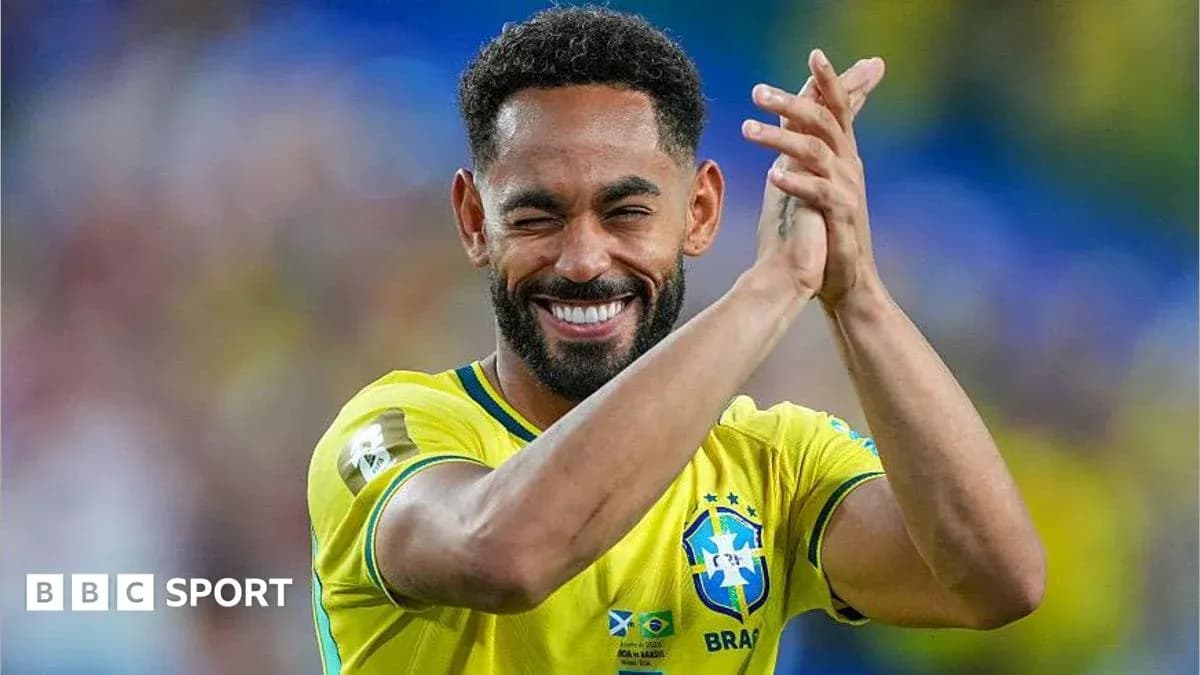
Brazil’s World Cup Transformation: The Rise of Matheus Cunha
The World Cup is starting to harden into shape. So are Brazil.
Carlo Ancelotti looks to have settled on his team, and with every step through the group stage Brazil have looked sharper, surer, more convinced by their own reflection. The anxiety that hovered over the first game has thinned out. In its place: momentum, and a growing sense that this side is arriving at the right time.
They will need to. Japan await in the last 32, a far more fluid and dangerous attacking proposition than Haiti or Scotland. But Brazil go into that tie with something precious: clarity about who they are, and who leads them.
The rise of a ‘nine-and-a-half’
The centre of this new Brazil is not a classic No 9 in the lineage of Ronaldo, Adriano or Romario. It is Matheus Cunha, the forward who has quietly become the key to everything Ancelotti’s side are doing well.
Cunha is not what the Brazilian public usually demand from their main striker. He is not the fixed reference point, the penalty-box predator. He lives in the grey area. He is a nine-and-a-half – part striker, part 10 – and that hybrid role is reshaping the attack.
He can finish. Three goals already at this tournament prove that. But he is not a pure playmaker either. Instead, he offers a profile Brazil have rarely seen at centre-forward: a player who scores, links, presses and constantly disturbs defensive structures.
There is something of Roberto Firmino about him. The way he drops off the line. The way he tugs his marker into uncomfortable zones. The way he turns a simple one-v-one duel into a question the defender never quite answers.
Follow him into midfield and you leave space behind for Vinicius Jr and Rayan to burst into. Leave him alone and Cunha receives between the lines, with time to turn, slide passes or shoot. Every movement asks a question. Every choice for the defender feels like the wrong one.
Crucially, Cunha looks completely at ease in the role. He presses from the front, initiates the defensive work, and at times almost becomes a No 6 when Brazil squeeze the pitch. That effort underpins the balance of a front line that suddenly makes sense.
From uncertainty to a defined spearhead
Not long ago, Brazil arrived at a World Cup without a clear first-choice No 9 – an almost unthinkable scenario for a nation built on centre-forwards. Even up to the Scotland game, the position felt open.
Ancelotti had experimented: Cunha, Igor Thiago, Endrick, Joao Pedro, Richarlison. No one had nailed it down. Then football’s old accomplice, injury, intervened.
Raphinha, a wonderfully gifted and versatile attacker, began the tournament as the central creative figure, even operating as a 10 behind Thiago against Morocco. He can play across the front line, drifting, roaming, searching for pockets.
His hamstring problem against Morocco changed the picture. Rayan came on, and with him came a different type of right-sided presence – one who holds his width more, who stays on that flank instead of endlessly wandering.
With Vinicius on the left and Rayan on the right, the middle of the pitch opened up. Space for Cunha to operate in exactly the zones he loves. Often alone. Often untracked. Perfect for a forward who thrives in freedom between the lines.
The knock-on effect is powerful. If Brazil need something more direct, Igor Thiago can step in as the physical reference, pinning centre-backs, occupying that central channel. Ancelotti now has a range of tools, but the growing feeling back home is that Cunha is the answer for this team, in this moment.
Opponents will have seen the tapes by now. They know what he does. But knowing and stopping are different things. Cunha’s intelligence means he will keep finding new ways to hurt you.
Ancelotti’s Brazil: control without obsession
Underpinning all of this is Ancelotti’s adaptability. His reputation often leans on man-management, on his ability to coax the best from big personalities. What sometimes gets lost is how sharp he is tactically.
This Brazil side does not obsess over possession numbers. They do not need 70% of the ball to feel in charge. They are comfortable giving it away, almost inviting opponents into traps.
Against Scotland, that approach was laid bare. Brazil ceded the ball but not the control. They guided Scottish players into specific areas, then sprang the press at the exact moment and with the right intensity. The first goal came from that plan. The second, disallowed harshly, came from the same pattern. These were not accidents.
The blueprint had already appeared in warm-up games against Panama and Egypt, where similar goals were scored. Brazil lured teams forward, compressed the space, then punished them when the press snapped shut.
It is a different form of dominance. Less about endless passing sequences, more about positioning, timing and collective intelligence. Ancelotti looks at the opponent, looks at the game state, and adjusts. With players this adaptable, why wouldn’t he?
A new Brazil, built from the back
This is not the Brazil of rampaging full-backs and constant overlaps. For the first time at a World Cup in modern memory, the flanks are not defined by the wild surges of Roberto Carlos, Cafu, Maicon, Marcelo or Dani Alves.
Instead, Douglas Santos and either Roger Ibanez or Danilo offer something more restrained. Their runs are measured, not relentless. That conservatism is deliberate. It allows Vinicius to stay higher, fresher, ready to explode when Brazil win the ball.
The result is a back four that looks solid, not spectacular, but crucially balanced. And that balance now extends into midfield.
In the opener against Morocco, Casemiro was left alone at the base, stretched across too much ground. Criticism followed, but it missed the point. At 34, he has never been the one-man pressing machine, and expecting him to cover everything was a structural flaw, not an individual failing.
The correction came quickly. Brazil shifted from a 4-2-3-1 to a 4-3-3. Now, when Bruno Guimaraes drives forward, Casemiro has Lucas Paqueta alongside him. The load is shared. The spaces are smaller. The midfield looks connected instead of exposed.
Against Haiti and Scotland, that adjustment tightened Brazil’s grip on the centre of the pitch. Against Japan, with their movement and combinations, it will be essential.
Confidence rising, tests looming
Seven goals scored, one conceded. A defined structure. A centre-forward who knits it all together. A manager unafraid to tweak the model of what Brazil are supposed to look like.
Most importantly, a shift in mood back home.
Before the first game, there was tension. After it, genuine worry. Three matches later, the tone has changed. Excitement has replaced doubt. The public are smiling again, not because of nostalgia for what Brazil used to be, but because of what this version might yet become.
The numbers so far will mean nothing if the wins stop coming. Brazil know that. This is a country that measures tournaments in trophies, not performances.
But as the knockout rounds begin, they do so with a team that looks coherent, a coach who trusts his own flexibility, and a ‘nine-and-a-half’ who has turned uncertainty into identity.
Japan will ask serious questions. The real intrigue now is whether this new Brazil – controlled, adaptable, led by Cunha between the lines – has the answers when the stakes finally spike.





