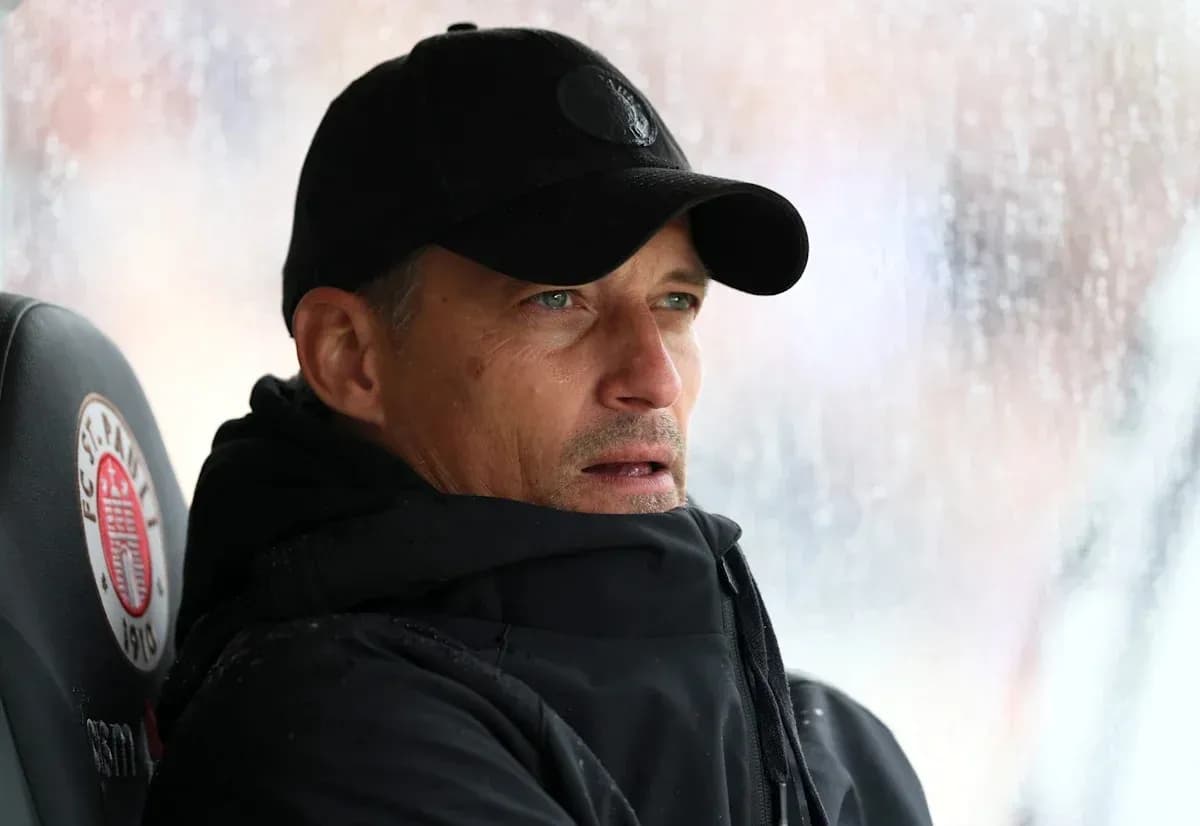
Borussia Mönchengladbach Appoints Alexander Blessin to Tackle Crisis
Borussia Mönchengladbach have turned to Alexander Blessin as the man to drag them out of a deep early-season crisis, handing the 53-year-old a contract until 2028 and a daunting first assignment: a Rhine derby away at 1. FC Köln.
The club confirmed the appointment on Tuesday, with Blessin set to be presented alongside sporting director Rouven Schröder on Wednesday afternoon. He returns to the Bundesliga barely four months after suffering relegation with FC St. Pauli – a brutal ending that only tells half of his story.
Gladbach in trouble, Blessin walks into the fire
Blessin replaces Eugen Polanski, who was dismissed after the 5-0 humiliation at Freiburg on Matchday 3. Jan-Moritz Lichte stepped in on an interim basis and, for a moment, hinted at a possible turnaround. Gladbach still lost 4-3 at home to Mainz on Saturday, but at least showed signs of life going forward.
The table is unforgiving. Gladbach hit the international break rock bottom, with zero points and a goal difference of 6:16. Only Union Berlin have conceded more. The 16 goals shipped in four games equal the Bundesliga record for the worst defensive start.
That is the mess Blessin inherits. His first competitive game in charge? A trip to Köln on 11 October, one of the most emotionally charged fixtures on Gladbach’s calendar. No gentle introduction, no time to ease in. Straight into the rivalry.
From defensive rock to relegation spiral
Blessin’s reputation in Germany is shaped by two wildly contrasting seasons at St. Pauli.
Taking over from Fabian Hürzeler after promotion in 2024, the Stuttgart-born coach built one of the most stubborn defensive units in the league. In his first Bundesliga campaign at the Millerntor, St. Pauli conceded just 41 goals – second only to Bayern Munich – and secured survival with a style built on compactness, discipline, and relentless work without the ball.
That body of work did not go unnoticed. By April 2025, reports had Hoffenheim and Wolfsburg monitoring his situation as he steered St. Pauli toward safety. Early in the following season, it looked as if he might kick on again. A September tactical breakdown highlighted an unbeaten St. Pauli side near the top of the table, seven points from three games and full of confidence.
Then the floor gave way.
A nine-game losing streak dragged the club straight into a relegation battle. Blessin clung on under heavy pressure and, for a brief spell in late February and early March, seemed to have found another escape route. Wins over Werder Bremen and Hoffenheim, plus a draw against Eintracht Frankfurt, produced seven points from three matches and a hint of momentum.
Even a 2-0 defeat in Gladbach in mid-March, dissected in detail in a relegation analysis, did not entirely kill the optimism. Blessin had squeezed results out of a limited squad before. Performances like the 2-1 victory over Stuttgart suggested there was still enough energy and resilience to survive.
Then came the collapse that defined the season.
St. Pauli blew a lead and lost 2-1 to Freiburg. In the aftermath, Blessin publicly apologized for insulting referee Florian Badstübner in an emotional post-match interview. A 1-1 draw at Union Berlin offered a point, but Bayern then tore through the Kiezkicker 5-0 at the Millerntor. Another 1-1, this time against Köln, only delayed the inevitable.
The decisive punch landed against bottom side Heidenheim. A 2-0 defeat in one of their clearest remaining chances to escape the drop zone left St. Pauli in deep trouble. From that point, the numbers told a bleak story: just two points from five matches since that mid-March relegation check.
The slide never stopped. St. Pauli lost 2-1 to Mainz, then again by the same score at RB Leipzig. Survival hopes came down to a final-day home showdown with Wolfsburg. They lost 3-1 and finished bottom of the Bundesliga. Across their last eight games of the season, Blessin’s side failed to win and picked up only two points.
Relegation meant a reset at the Millerntor. St. Pauli chose to move on without him.
Experience, scars, and a fragile back line
Gladbach, though, are betting that the coach who built that first-season St. Pauli defence is closer to the real Blessin than the one who went down with them.
His path to this job runs through more than just Hamburg. Blessin spent eight formative years in RB Leipzig’s academy, sharpening his ideas and reputation as a modern, detail-obsessed coach. His first senior job came at KV Oostende, where he impressed enough to earn subsequent roles at Genoa and Union Saint-Gilloise. In Belgium, he lifted the domestic cup and was named Coach of the Year twice.
That track record of structure and organization is exactly what Gladbach crave. The club’s back line has disintegrated in the opening weeks of the season, and the coaching position has become a revolving door.
Since Marco Rose left for Borussia Dortmund in 2021, Gladbach have burned through four permanent head coaches: Adi Hütter and Daniel Farke each lasted a single season, Gerardo Seoane survived from June 2023 to September 2025, and Polanski’s reign ended just over a year after it began. Blessin is number five in less than five years.
He now gets the international break to drill his ideas into a squad still searching for its first point of the campaign. The margin for error is already thin. The table is already ugly.
And waiting for him, just after the pause, is Köln away – a derby that rarely forgives weakness and never lacks for noise.