Beşiktaş Dominates FC Midtjylland in UEFA Europa League Clash
Beşiktaş’s 1-0 win over FC Midtjylland at Tüpraş Stadyumu was a clinic in territorial dominance and game control rather than ruthless finishing. In this UEFA Europa League 2nd Qualifying Round tie, Vincenzo Italiano’s side imposed a clear positional and possession-based blueprint, while Mike Tullberg’s visitors were forced into a reactive, survival-oriented structure after an early red card.
Beşiktaş lined up in a 4-1-4-1 that functioned as a high-possession, high-occupation system. The back four of M. Murillo, T. Djalo, E. Topcu and R. Yilmaz had the platform to hold an aggressive line because S. Ozcan, the single pivot, anchored in front of them. With 685 total passes and 606 accurate, Beşiktaş circulated the ball with control and patience, turning the game into a half-court attack. The 75% possession figure underlines how often they kept FC Midtjylland pinned in their own half.
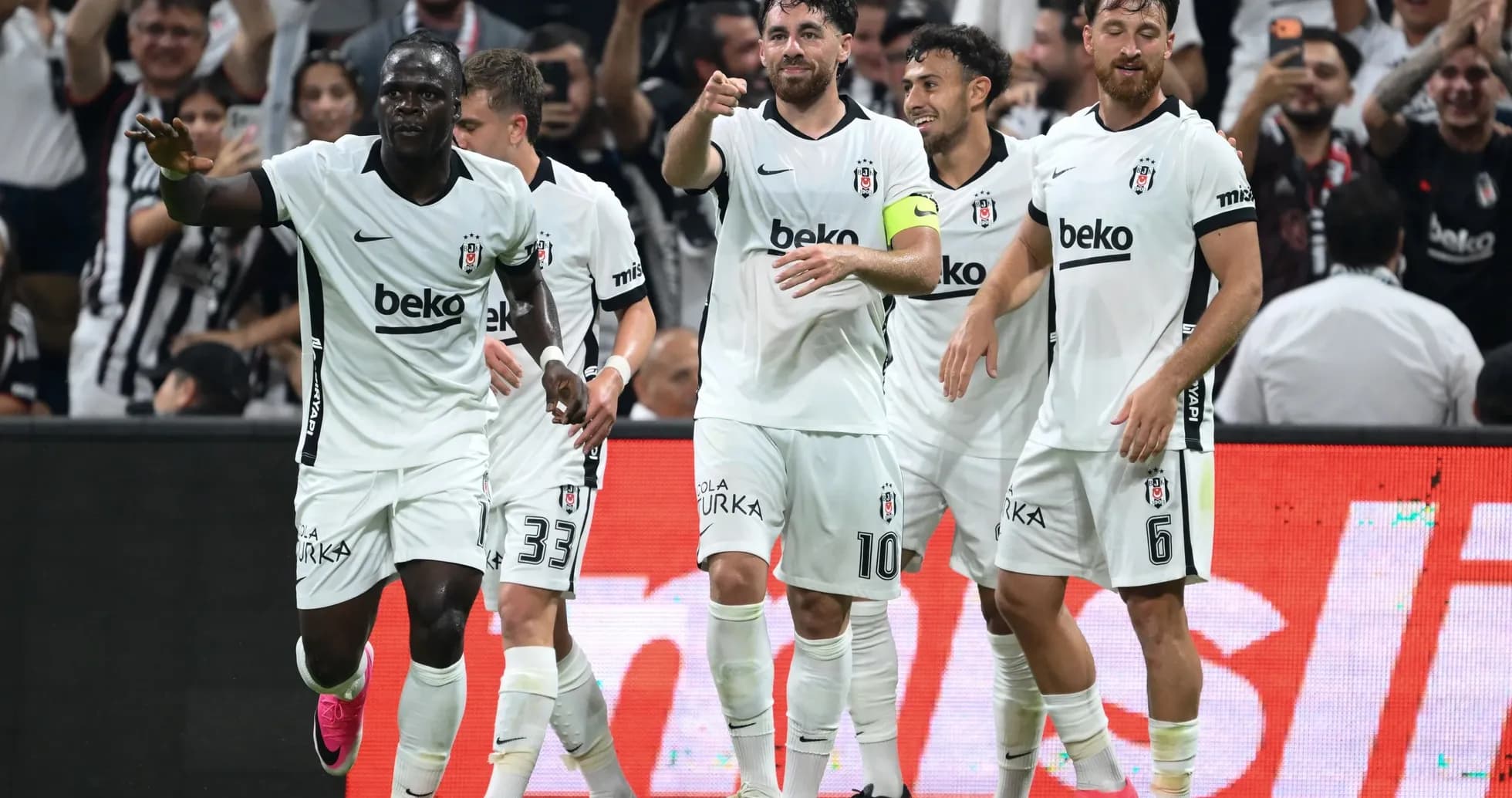
Ahead of Ozcan, the quartet of V. Cerny, J. Olaitan, O. Kokcu and I. Fakili operated between the lines, constantly overloading the half-spaces. Cerny and Kokcu were particularly influential: Kokcu found the decisive breakthrough on 26 minutes, assisted by Cerny, a pattern that reflected the tactical design. Cerny’s nominal role as a wide midfielder often morphed into an interior playmaker, stepping infield to receive between Midtjylland’s midfield and defence, while full-backs pushed high to maintain width. That structure helped generate 28 total shots, with 15 inside the box and 13 from outside, illustrating both sustained pressure and a willingness to shoot from range when central spaces were crowded.
FC Midtjylland’s 4-3-3 on paper quickly became a deep 4-4-1 after Friday Etim’s red card at 15 minutes. With only 25% possession and 237 total passes (146 accurate), they were largely confined to low-block defending and sporadic counter-attacks. The front three of Franculino, F. Etim and the supporting runners like D. Osorio rarely had the chance to combine; instead, their primary function shifted to pressing triggers and outlet runs when possession was turned over. However, with just 5 total shots (3 inside the box, 2 outside) and only 1 shot on goal, they struggled to convert transitions into meaningful threat.
The numerical inferiority shaped Tullberg’s in-game decisions. Early substitutions — V. Byskov (OUT) for D. Castillo (IN) at 18', Franculino (OUT) for M. Erlic (IN) at 46', and D. Osorio (OUT) for Cho Gue-Sung (IN) at 62' — signalled a move toward greater defensive solidity and physical presence. Erlic’s introduction in particular suggested a desire to reinforce the back line and protect central areas, accepting that attacking output would be minimal in exchange for keeping the tie alive.
Beşiktaş, by contrast, used their changes to maintain intensity rather than alter the structure. I. Fakili (OUT) for M. Rashica (IN) and Oh Hyeon-Gyu (OUT) for S. Kilicsoy (IN) at 63', followed by S. Ozcan (OUT) for K. Kayra Yilmaz (IN) and R. Yilmaz (OUT) for K. Ouattara (IN) at 73', and finally T. Djalo (OUT) for E. Agbadou (IN) at 78', were all like-for-like in positional terms. Italiano’s approach was to refresh legs in the same tactical framework, ensuring the press and circulation speed did not drop as Midtjylland tired.
The shot profile tells the story of Beşiktaş’s dominance but also their inefficiency. Of 28 total shots, only 7 were on goal, with 5 blocked. They were able to reach the final third and the box at will — 15 shots inside the area — but often faced a compact block and heavy traffic. Many efforts were taken under pressure or from suboptimal angles, which explains why the scoreline remained narrow despite the volume.
Defensively, Beşiktaş were rarely stretched. With 12 fouls and no yellow or red cards, they managed control without resorting to persistent or reckless challenges. The rest defence — the positioning of the back line and pivot behind the ball — was well-structured, limiting Midtjylland to just 2 shots outside the box and 3 inside. Transitions were smothered early, and FC Midtjylland’s 0 offsides highlight how infrequently they were able to push the line and threaten in behind.
The goalkeeping dimension, while not statistically spectacular, underlines the asymmetry of the contest. A. Nubel (Beşiktaş) faced only 1 shot on goal and made 1 save, reflecting the protection afforded by the structure in front of him. E. Olafsson (FC Midtjylland), by contrast, was far busier: with Beşiktaş registering 7 shots on goal, his 6 saves were crucial in preventing the match from becoming a rout. His performance, combined with 3 blocked shots by defenders, kept Midtjylland within a single goal despite the territorial siege.
Set pieces and restarts marginally favoured Beşiktaş as well: 5 corner kicks to Midtjylland’s 2, and 9 free kicks won versus 12 conceded. Yet the real tactical leverage came from open play circulation and positional superiority rather than dead-ball routines. Offside numbers — 1 for Beşiktaş, 0 for Midtjylland — further confirm that the home side were more often probing in advanced zones, while the visitors rarely committed enough players forward to threaten the last line.
In disciplinary terms, FC Midtjylland finished with 1 red card and 0 yellow cards, while Beşiktaş had neither yellow nor red. That single dismissal fundamentally tilted the tactical landscape, forcing Midtjylland into a damage-limitation exercise. Beşiktaş’s ability to translate a 75%-25% possession split, 28-5 total shots and 7-1 shots on goal into only a 1-0 scoreline will be a concern for Italiano in terms of efficiency, but from a structural and control perspective, this was a dominant and coherent tactical display that puts them in a strong position in the tie.