Benfica’s Tactical Masterclass in 3-1 Victory Over Aarhus
Benfica’s 3-1 win over Aarhus at Estádio da Luz was a tactical strangling disguised as a routine home victory. In a UEFA Europa League Play-offs tie that was effectively decided by half-time, Marco Silva’s 4-1-3-2 imposed total control of territory and tempo, while Jakob Poulsen’s 3-5-2 was pinned back, stretched wide, and ultimately reduced to damage limitation. The raw numbers frame the story: 71% possession, 13 shots on goal and 11 corners for Benfica against Aarhus’ 29% possession, 1 shot on goal and 1 corner. Within that imbalance, Benfica’s structure and pressing traps explained why the game felt even more one-sided than the scoreline.
Out of possession, Benfica’s 4-1-3-2 morphed into a very aggressive 4-1-3-2 press, with V. Pavlidis and Rafa Silva setting a high starting line on Aarhus’ three centre-backs. The trigger was any slow circulation across the back line: the near-side forward would jump to the ball-carrier, while the far-side forward narrowed to screen the central defender. Behind them, G. Sudakov and G. Prestianni (from their advanced midfield lines) stepped into Aarhus’ double pivot lanes, denying S. Jorgensen and M. Knudsen clean touches. With L. Barreiro as the single pivot anchoring, Benfica could commit those three aggressive midfielders high without losing central cover.
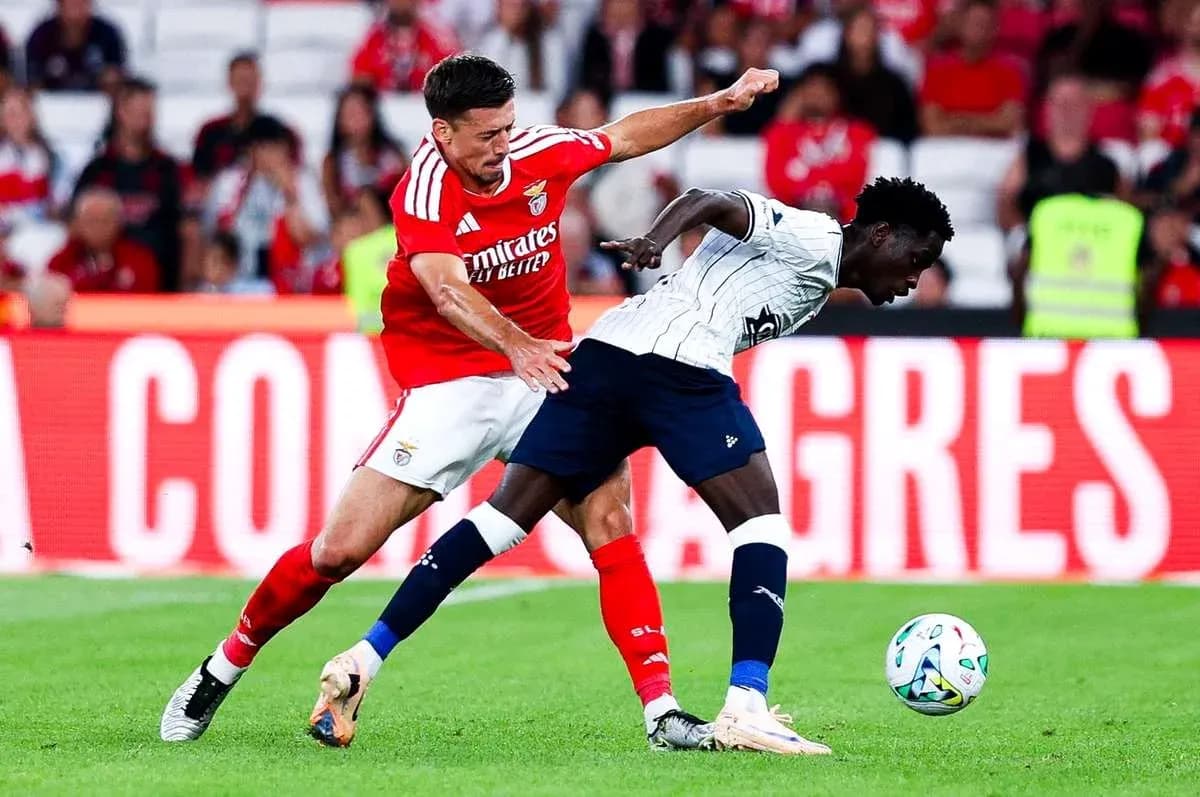
This pressing shape forced Aarhus into rushed, vertical clearances toward F. Emmery and T. Bech, which the Benfica back four handled comfortably. C. Lenglet and T. Araujo stayed tight and proactive, stepping into aerial duels early, while full-backs A. Bah and S. Dahl pushed high to lock Aarhus’ wing-backs in their own half. The result was a territorial squeeze: even when Aarhus recovered the ball, they were rarely able to string passes together through midfield. Their 1 shot on goal and single corner were the by-products of isolated moments rather than sustained patterns.
In possession, Benfica’s shape was subtly asymmetrical. Barreiro operated as a lone six in front of the centre-backs, giving the full-backs license to push simultaneously. On the right, Bah overlapped aggressively, often arriving on the last line to provide width beyond Prestianni, who drifted inside into half-spaces. On the left, S. Dahl advanced more cautiously, but Sudakov’s tendency to drop into the left half-space created a stable 3-2 base in build-up: Dahl tucked slightly inside, Barreiro held central, and one of the centre-backs spread to form a back three.
This structure underpinned Benfica’s 71% possession. They were patient but purposeful, using short passing to shift Aarhus’ compact 5-3-2 block laterally before punching vertical passes into the feet of Rafa Silva and Pavlidis between the lines. The volume of 13 shots on goal and 11 blocked shots reflects how often Benfica were able to work shooting positions around the edge of the box and inside it, even if the “Total Shots” and “Shots inside box” metrics are not specified. Aarhus’ back five spent most of the evening defending their own area, with the central trio constantly forced to collapse deep, leaving Jorgensen and Knudsen overloaded.
First Half Goals
The first-half goals illustrated Benfica’s positional superiority. Rafa Silva’s early strike at 2' came from Benfica immediately imposing a high rhythm, catching Aarhus before their block had settled. Barreiro’s goal at 31' was the reward for sustained pressure and second-ball dominance around the Aarhus box, with Benfica recycling possession quickly whenever a shot was blocked or a cross cleared. Even when Aarhus briefly broke the pattern with S. Jorgensen’s 36' goal, combining with J. Andersen, it came more from a rare successful transition than from any structural control.
Key Tactical Moment
The key tactical moment was the sequence around half-time. At 45', VAR confirmed a penalty for Benfica involving Vangelis Pavlidis, and the forward converted at 45', restoring a two-goal cushion and freezing any Aarhus momentum. The timing was crucial: instead of going into the break at 2-1 with psychological belief, Aarhus had to reset at 3-1 down, knowing they had neither the ball nor the field position to chase the game.
Second Half Adjustments
Poulsen’s response after the interval was substitution-driven rather than structural. On 57', C. Rosler (OUT) made way for R. Carstensen (IN), and S. Jorgensen (OUT) was replaced by S. Tchamche (IN), hinting at a desire for more dynamism in wide and central lanes. Later, at 73', M. Knudsen (OUT) gave way to J. Jonsson (IN), and F. Emmery (OUT) was replaced by G. Links (IN), with J. Bogere (OUT) withdrawn for M. Anderson (IN) on 81'. These moves injected fresh legs and some direct running, but did not fundamentally change the 3-5-2/5-3-2 defensive posture. Aarhus remained reactive, and their 17 fouls and single yellow card for Stefen Tchamche at 83' showed a side increasingly forced into late challenges rather than controlled pressing.
Silva, by contrast, managed the second half with the tie state in mind. On 66', L. Barreiro (OUT) was replaced by R. Rios (IN), a like-for-like swap that maintained the single-pivot structure while protecting a key player already booked earlier. At 72', V. Pavlidis (OUT) made way for J. Duran (IN), and G. Prestianni (OUT) was replaced by A. Schjelderup (IN), refreshing the front line to sustain the press and threat in behind without overextending starters. Finally, at 84', G. Sudakov (OUT) was replaced by F. Aursnes (IN), and Rafa Silva (OUT) by J. Kaminski (IN), moves that both preserved intensity and guarded against fatigue in high-running positions.
Interestingly, despite Benfica’s dominance, the disciplinary balance was relatively modest: 2 yellow cards for Benfica (Leandro Barreiro at 9', Tomás Araújo at 24') and 1 for Aarhus (Stefen Tchamche at 83'). The foul count — 10 for Benfica, 17 for Aarhus — reflects a home side largely in control and an away side often arriving late into duels as they chased shadows.
Without explicit data for goalkeeper saves, xG, or passing volumes, the tactical verdict still leans clearly: Benfica’s 4-1-3-2 provided superior spacing, pressing height, and lane occupation. Aarhus’ 3-5-2, never truly adjusted into a proactive shape, spent too long in a flat back five, with their midfield line unable to step out due to Benfica’s occupation between the lines. The 3-1 score at Estádio da Luz was a fair reflection of structural superiority rather than mere finishing variance, and the statistical profile — overwhelming possession, shots on goal, and corners — underlines just how comprehensively Benfica controlled this Play-offs fixture.