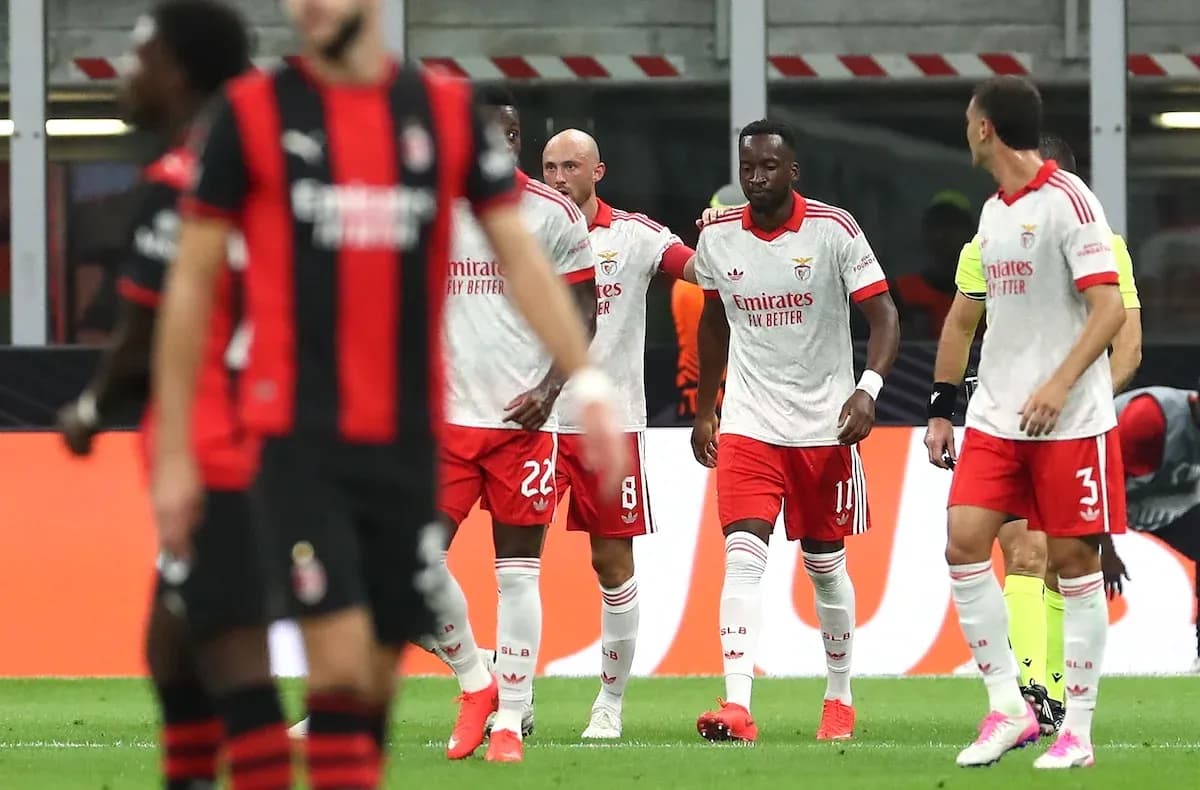
Benfica Dominates FC ST. Gallen 5-0 in UEFA Europa League
Benfica’s 5-0 dismantling of FC ST. Gallen at Estádio da Luz in the UEFA Europa League 2nd Qualifying Round was a structural mismatch as much as a scoreline one. Marco Silva’s 4-2-3-1 established control early and never relinquished it, while Enrico Maassen’s 3-5-2 collapsed once numerical parity was lost and the defensive line was repeatedly dragged apart by intelligent movement and rotations between the lines.
With no possession or shot data available, the tactical story is written primarily through positioning, events and substitutions. Benfica’s back four of A. Bah, A. Silva, C. Lenglet and S. Dahl was protected by the double pivot of L. Barreiro and E. Barrenechea, giving a clear platform for the three advanced midfielders — Rafa Silva, G. Sudakov and J. Kaminski — to overload pockets around FC ST. Gallen’s central trio. V. Pavlidis, as the lone forward, became the key reference point for depth and penalty-box occupation.
First Goal
The first goal on 11 minutes, with V. Pavlidis scoring from a Rafa Silva assist, encapsulated Benfica’s plan: the No. 10 line (Rafa Silva and Sudakov) pulled FC ST. Gallen’s midfield five narrow, while Bah and Dahl provided width. Once the visitors’ wing-backs were pinned, central defenders were forced to step out, leaving space for Pavlidis to attack early deliveries and cut-backs. The 1-0 lead at half-time (confirmed by the 1-0 interval scoreline) reflected Benfica’s territorial control more than any frantic tempo; structurally, they always had a spare man in the first phase and a numerical equality at worst in the second.
FC ST. Gallen's Strategy
FC ST. Gallen’s 3-5-2, with C. Okoroji and M. Stevanovic as wide midfielders in front of a back three of T. Gaal, J. Stanic and Okoroji sliding back, was intended to crowd central zones and then spring A. Balde and C. Witzig in transition. However, the early yellow card for J. Stanic on 21 minutes for “Roughing” hinted at the growing stress on their last line. Benfica repeatedly targeted the half-spaces around L. Daschner and C. Boukhalfa, forcing Stanic and Gaal into uncomfortable lateral defending.
Second Half Developments
The second half exposed that fragility. On 50 minutes, C. Okoroji’s yellow for “Holding” underlined how FC ST. Gallen’s wing-backs were being isolated 1v2 against full-back and winger/attacking midfielder combinations. Five minutes later, V. Pavlidis struck again at 55', this time from a J. Kaminski assist, confirming Benfica’s superiority in attacking the channels between wide centre-back and wing-back. Kaminski’s starting role on the left of the three behind Pavlidis was crucial: he frequently received between lines, then either drove inside to collapse the block or released overlapping runs.
The decisive tactical break came at 57'. In the space of the same minute, J. Stanic collected a second yellow for “Tripping” followed immediately by a straight red for “Tripping”, reducing FC ST. Gallen to ten men. Maassen reacted by reshaping his side through a triple substitution: J. Ruiz (IN) came on for T. Gaal (OUT), A. Hunziker (IN) came on for C. Witzig (OUT), and L. Frokaj (IN) came on for C. Boukhalfa (OUT). The intent was to restore a functional back line and keep two forwards, but structurally the visitors now had to defend deeper, with even less pressure on Benfica’s build-up.
From that moment, Benfica’s 4-2-3-1 morphed into a de facto 2-4-4 in settled possession. The full-backs advanced almost in line with the double pivot, Sudakov and Kaminski tucked inside, and Rafa Silva roamed freely, making it impossible for FC ST. Gallen’s reduced block to cover width and depth simultaneously. The third Pavlidis goal at 65', assisted by A. Bah, was a direct product of that pattern: Bah overlapping high on the right, exploiting the undermanned flank, and delivering into a penalty area where Pavlidis could attack mismatches.
Managing the Game
Marco Silva then used the scoreboard to manage legs without losing structure. On 66', R. Rios (IN) came on for L. Barreiro (OUT), refreshing the pivot while keeping the double-screen intact. Later, at 75', D. Lukebakio (IN) replaced Rafa Silva (OUT) and A. Schjelderup (IN) replaced J. Kaminski (OUT), injecting pace and dribbling into already stretched spaces. On 77', J. Duran (IN) came on for V. Pavlidis (OUT) and A. Dedic (IN) for A. Bah (OUT), ensuring Benfica maintained vertical threat and full-back aggression even with the game effectively decided.
Penalty and Final Goals
The 74' penalty converted by V. Pavlidis — his fourth of the night — came in a phase where Benfica were camping around FC ST. Gallen’s box, circulating the ball patiently until defensive errors emerged. Even without foul counts, the accumulation of disciplinary events for the visitors (three yellows and one red) reflects a reactive, last-ditch defending pattern, consistent with a side perpetually late to second balls and duels.
C. Lenglet’s 82' goal, assisted by D. Lukebakio, was the logical conclusion of Benfica’s set-piece and second-phase dominance. With FC ST. Gallen’s shape broken and their defensive line exhausted, even a centre-back could step into advanced zones to finish moves, underlining how thoroughly the home side controlled territory.
Goalkeeping Perspective
From a goalkeeping perspective, A. Trubin (Benfica) and L. Watkowiak (FC ST. Gallen) cannot be evaluated statistically here, as no save or goals prevented data is available. However, the clean sheet for Benfica and the five goals conceded by FC ST. Gallen, combined with the pattern of chances implied by the scoring sequence, suggest that Trubin enjoyed strong protection from his back four and double pivot, while Watkowiak was repeatedly exposed by structural collapses in front of him rather than isolated individual errors.
Statistical Overview
In statistical terms, only the card data is concrete: Benfica finished with 0 yellow cards and 0 red cards; FC ST. Gallen collected 3 yellow cards (two for J. Stanic — “Roughing” and “Tripping” — and one for C. Okoroji for “Holding”) and 1 red card (J. Stanic, “Tripping”). That disciplinary imbalance mirrors the tactical reality: Benfica’s control allowed them to defend in structure and avoid desperate interventions, while FC ST. Gallen’s 3-5-2, once under sustained pressure and then reduced to ten men, devolved into emergency defending.
Without xG or passing figures, the clearest quantitative anchor remains the 5-0 scoreline and the timing of the goals: 11', 55', 65', 74' and 82'. Each strike came from well-defined tactical mechanisms — half-space overloads, full-back overlaps, penalty-area occupation and late runs from deeper lines — showing a Benfica side whose 4-2-3-1 was not only balanced defensively but ruthlessly efficient in exploiting the structural weaknesses of a stretched and then numerically inferior FC ST. Gallen.