Bayern Munich Advances with 4–1 Victory Over VfL Osnabrück
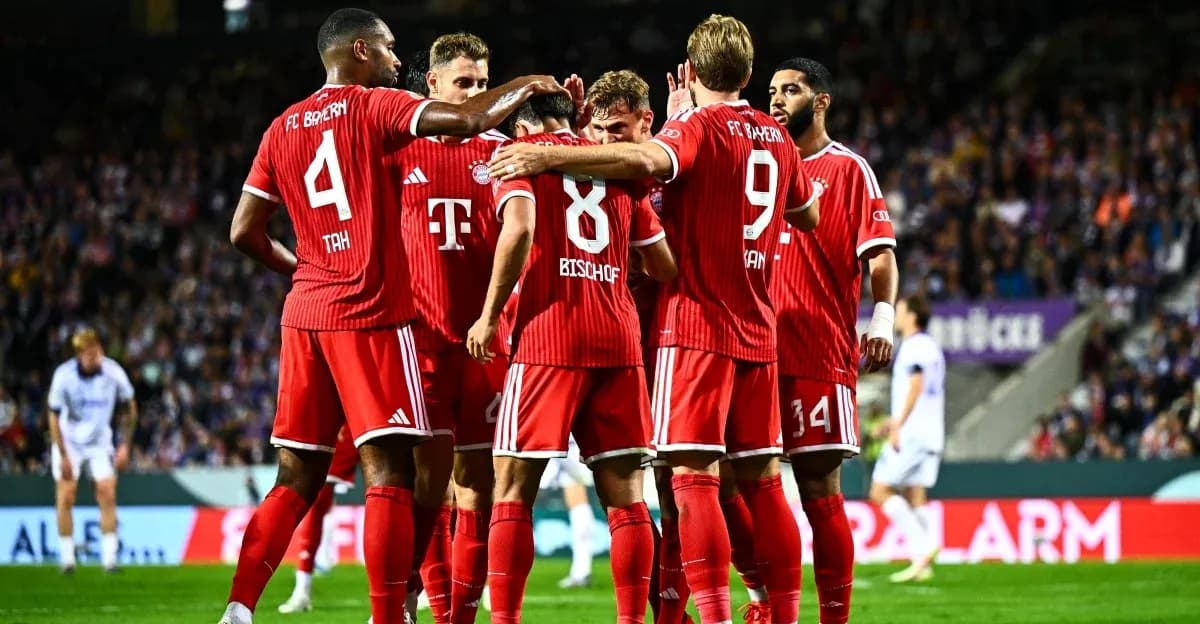
Bayern Munich needed barely a flick of the wrist to move past VfL Osnabrück in the DFB-Pokal, winning 4–1 on the road in a tie that veered between chaotic, scruffy, and – at times – downright dull.
The scoreline flatters the spectacle. But not Bayern’s superiority.
Shock to the system
Thomas Tuchel resisted the temptation to rotate heavily, and that alone spelled trouble for the third-division hosts. Kim Min-jae started ahead of Dayot Upamecano, Josip Stanišić got the nod over Konrad Laimer, and Nathaniel Brown kept Alphonso Davies on the bench. In midfield, Tom Bischof was preferred to Aleksandar Pavlović – and he made that decision look smart.
Osnabrück, though, tore up the script inside five minutes.
A messy defensive sequence from Bayern opened the door. Jonathan Tah and Kim were slack, Tah slipped, Jonas Urbig’s positioning behind them looked wild, and Robin Meißner punished all of it with a thunderous strike from distance. One lapse, one rocket. 1–0 Osnabrück. The stadium erupted.
For a few minutes, it felt like Bayern might be in for one of those nights.
They weren’t.
Bayern immediately grabbed the ball and refused to give it back. Osnabrück’s players ran, tackled, and harried with everything they had, backed by a ferocious home crowd and a tifo that set the tone. But the gap in quality was obvious every time Bayern settled into their passing rhythm.
Ismael Saibari, though, struggled to find his place in that rhythm. He showed intent, drove into spaces, tried to combine – and still looked half a beat off, his ideas sharper than his execution.
Kane and Bischof flip the script
The pressure eventually cracked Osnabrück in the 18th minute.
Joshua Kimmich floated a ball into Harry Kane, whose straight run forced a panicked defensive header straight up into the air. The clearance dropped invitingly. Kane didn’t hesitate. He met it with a clean volley and buried it. 1–1, and the noise inside the ground changed in an instant.
Bayern smelled blood.
Five minutes later, Michael Olise carved Osnabrück open with a gorgeous through ball to Luis Díaz. Jonas Krumrey saved Díaz’s effort, but the rebound fell to Bischof, who had sprinted into the box and coolly finished to make it 2–1. The young midfielder was everywhere – pressing, chasing, linking play – a constant nuisance for the hosts.
Bischof’s work rate stood out. He treated this start like an audition and refused to waste a second of it.
At the back, the story was less convincing. Tah and Kim looked like two defenders still learning each other’s movements. Their positioning wobbled, their communication didn’t quite click, and the entire backline felt jittery whenever Osnabrück broke forward. Tah, in particular, looked rusty and heavy in his lateral movement. It’s too early to sound alarms, but the discomfort was obvious.
On the left, Brown produced a mixed performance. Going forward, he barely featured, the flow of the game rarely running down his flank. Defensively, though, he stayed switched on and rarely put a foot wrong. Davies replaced him later, but neither man truly seized control of the left-back battle on this night. The duel remains wide open.
Just before the break, Krumrey produced a superb save to deny Olise and keep Osnabrück alive. Bayern walked into the dressing room in front, but not entirely satisfied.
Second-half drag, Olise’s moment
The second half never really caught fire.
Osnabrück kept fighting, kept tackling, kept making life awkward. Bayern, dealing with early-season fatigue and an English Week, drifted into a slower gear. The visitors controlled the ball but not the tempo, and the match slipped into a flat, stop-start rhythm.
On 62 minutes, Brown and Saibari made way for Davies and Lennart Karl. The changes didn’t dramatically alter the pattern. Bayern still probed, Osnabrück still resisted, the game still felt stuck in second gear.
Then Olise stepped up.
Now operating centrally after Saibari’s withdrawal, he finally found his goal in the 73rd minute. He used his body cleverly to bring the ball under control – an action that would likely have been scrutinized and possibly ruled out by VAR for an elbow – and then finished neatly. The referee’s whistle never came. The goal stood. 3–1, and with it, any lingering tension disappeared.
That strike also seemed to jolt Bayern out of their lethargy. The heavy legs, the dragging pace, the sense of going through the motions – all of it eased once the two-goal cushion arrived.
Kane closes it out
The final blow came in the 84th minute.
Pavlović, on as a substitute, drove into the box and was brought down. The referee pointed to the spot. Kane stepped up, as he always does, and dispatched the penalty with his usual cold precision. No fuss, no drama. 4–1.
From there, Bayern simply saw it out. No late flourish, no extra fireworks. Just a professional close to a professional job.
This will not be a win that lives long in Bayern folklore. The second half dragged, the backline looked shaky at times, and the attack occasionally lacked sharpness. But it is still early in the season, and this group is clearly still learning how to move as one.
The result, though, is what matters in the cup. Bayern are through, relatively unscathed, and already turning their attention to the weekend meeting with Schalke 04 – and to the question that will define their autumn: how quickly can this talented, slightly disjointed side turn control into something truly ruthless?