Bayern Munich Claims Supercup: Key Takeaways and Tactical Insights
Bayern Munich walked out of Signal Iduna Park with the first trophy of the 2026/27 season and a familiar feeling: a win over Borussia Dortmund, but with enough flaws to keep everyone talking. A 2-1 victory in the Franz Beckenbauer Supercup, shaped by a sharp first half, a wobblier second, and a goalkeeper who still lives on the edge.
Nathaniel Brown (28') and Michael Olise (45+1') put Bayern 2-0 up by the break, a scoreline that reflected their control. Fabio Silva’s reply on 75 minutes brought BVB back into it, but not quite far enough.
The game, though, was about more than the score.
Neuer: still genius, still a gamble
Manuel Neuer has built a career on risk. He redefined what a goalkeeper could be with his work outside the box and on the ball. That same instinct is now starting to look like a fault line.
The warning signs have been there. The misplaced pass to Arda Güler in Madrid last April, the gift that helped Real Madrid on their way in the Champions League quarter-final. In Dortmund, the pattern reappeared.
After 15 minutes, Neuer tried to play out through Min-jae Kim and got it wrong. The pass invited trouble, Kim had to clean up, and only the defender’s sharp reaction prevented an early Dortmund lead and an uncomfortable inquest.
Late on, Neuer put himself in another mess. Kim rolled the ball back, Neuer tried to be clever, letting Jobe Bellingham run past with a feint behind his standing leg. The trick failed. Suddenly Bellingham had a clear route to goal and the stadium roared. Neuer threw himself at the ball and bailed himself out with a desperate, brave intervention. Outstanding reflexes. Unnecessary situation.
This is the contradiction now. On the line, he remains elite. Early in the second half he underlined it, reacting superbly to keep out new signing Konstantinos Karetsas from close range, a save that belonged to the prime years.
But Bayern are already planning for life after him. Neuer again hinted this could be his final season. Jonas Urbig is in the building, 23 years old, expected to see more minutes, to be eased into the role. Officially, Neuer still starts the big nights. Unofficially, every risky touch on the ball nudges the debate forward: at what point does the legend’s style become too big a risk for a team with titles to defend?
Brown the surprise No. 10 – and Bayern’s new trump card
Bayern signed Nathaniel Brown to play left-back. Vincent Kompany used him as a No. 10 in a Supercup away to Dortmund. That says plenty about both the player and the coach.
With Jamal Musiala absent due to his neurological issue and after collapsing in both recent friendlies, Serge Gnabry and Lennart Karl also missing, and new signing Ismael Saibari not yet ready to start, most expected Tom Bischof to slot in behind Harry Kane.
Instead, Brown took the role. Central, high, right in the traffic zone. Kompany had his reasons: he sees parallels between the spaces his full-backs occupy and the pockets a No. 10 must exploit. Brown, he argued, is “unbelievably good between the spaces”, whether he starts wide or centrally.
The experiment worked. Not perfectly, but convincingly enough to matter.
Brown is still learning Bayern’s patterns, still adjusting to a role that is not his natural one, so a few movements and combinations didn’t quite connect. But he kept finding useful positions, linked play, and then produced the moment that will stick: the opener, struck with authority, his first big contribution in a Bayern shirt and a direct step towards his first trophy with the club.
His versatility suddenly looks like a weapon. Bayern can use him as a left-back, as a holding midfielder, as a No. 10. In a long season, that kind of flexibility is gold.
And he is not alone. Konrad Laimer can cover both full-back positions and operate as a No. 6, No. 8 or even as a No. 10. Josip Stanisic is equally at home on either flank and can slide into central defence. Bayern’s full-backs are no longer just full-backs; they are chess pieces Kompany can move almost anywhere on the board.
Kovac’s inverted wing-backs: bold idea, real cost
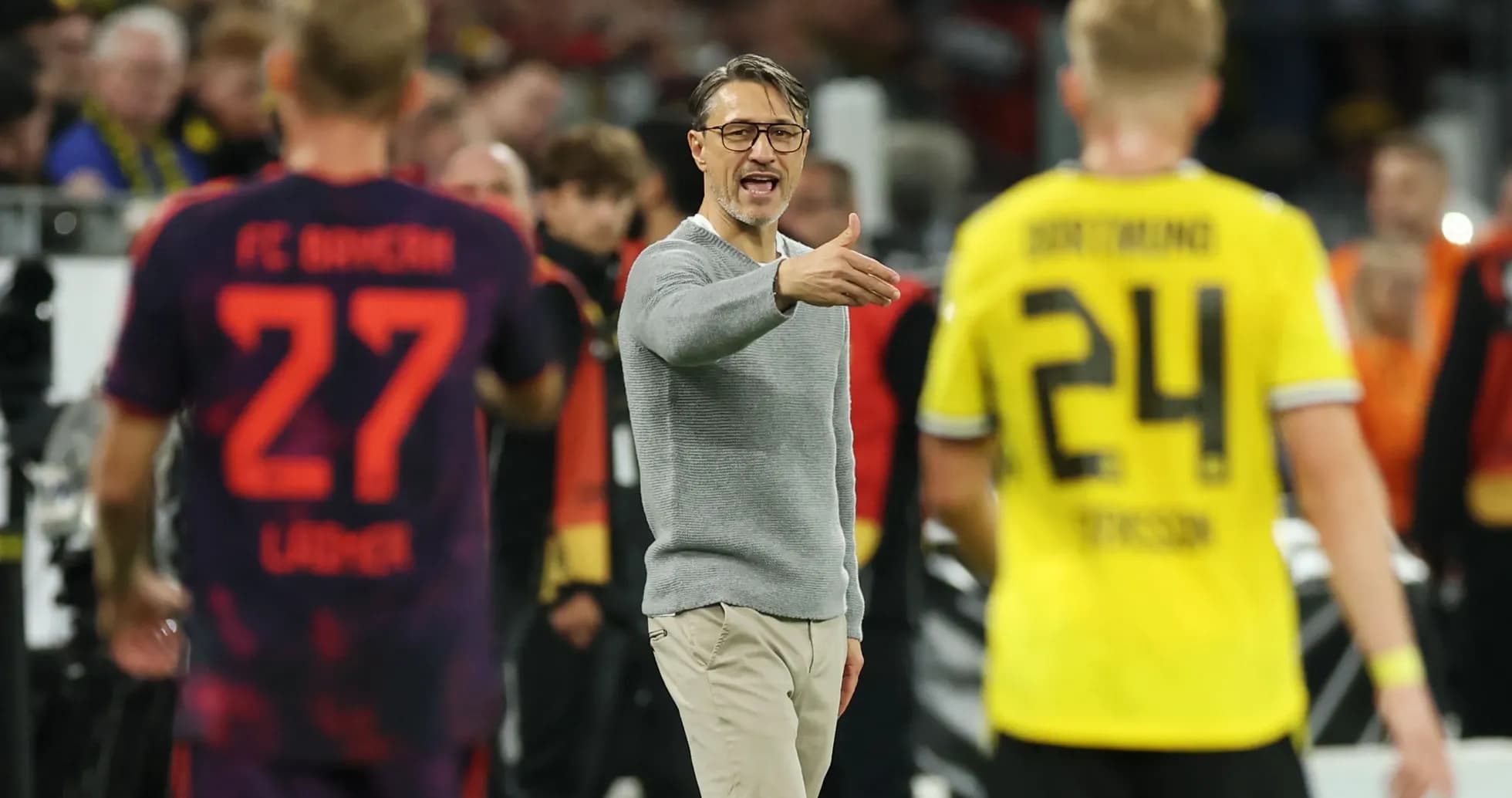
On the other bench, Niko Kovac used the Supercup to push a tactical tweak he has been trialling all pre-season. Left-footed Daniel Svensson started on the right, right-footed Julian Ryerson on the left. Wing-backs on their “wrong” sides, encouraged to drive inside like wingers.
Kovac’s thinking is clear: with inverted wing-backs, Dortmund always have the option to cut inside, combine, and shoot or play the final pass from central zones rather than simply bending in crosses from the touchline.
At times in the first half, it looked promising. Ryerson drifted into the left half-space and whipped a dangerous cross towards the back post with his stronger right foot. Ramy Bensebaini met it with the faintest of touches, glanced it into the net – but the flag went up. Offside. Marginal, but correct.
There was a downside. The more Dortmund tried to play inside, the less often they reached the byline with natural angles, and some situations simply looked unnatural for the players involved.
The clearest example came before the break. Bensebaini drilled a low ball across from the left. Svensson, coming in off the right, arrived near the penalty spot but had to use his weaker right foot. The body shape was wrong, the timing off, and he completely missed the ball. Put Ryerson there on his stronger side and that chance probably looks very different.
Kovac saw enough. At half-time he switched them back to their usual flanks. The impact was immediate. Dortmund carried more threat, attacked the spaces behind Bayern’s full-backs more naturally and with greater frequency.
The 2-1 goal came from exactly that kind of pattern: Svensson now on the left, racing to the byline and cutting the ball back intelligently for Fabio Silva to finish. It was the sort of move that rarely materialises when the wing-backs are inverted.
Kovac’s tweak gives Dortmund another tool, another way to attack. It also takes away some of their most straightforward strengths. The balance between those two will define how often he dares to roll that dice in bigger games.
Silva’s response, Guirassy’s problem, and a decision for Dortmund
Serhou Guirassy’s transfer noise has quietened in recent weeks. For now, he looks set to stay. His performance against Bayern, though, echoed some of last season’s more frustrating nights.
He worked. He pressed. He battled. But he barely touched the game in dangerous areas and never really troubled Neuer. For a striker of his pedigree, that’s a problem.
After just over an hour, Kovac made the change. Guirassy off, Fabio Silva on. The mood around Dortmund’s attack shifted.
Silva had already shown flashes in his first year at BVB without ever truly claiming the stage. Here, he did. He dropped into clever spaces, linked play, then attacked the box at the right moment. When Svensson cut the ball back from the left, Silva pounced and finished with conviction from close range to drag Dortmund back to 2-1.
It was the kind of cameo coaches remember when they pick their next team. It was also the sort of performance that complicates a transfer window.
Because Silva is not just fighting for minutes; he is also sitting in the middle of a market. Several clubs are tracking him, with Betis Sevilla recently viewed as particularly keen. Reports suggest Silva is not fixed on staying at Borussia, and the club’s hierarchy would consider a sale if the right offer lands on the table.
His impact against Bayern changes the equation. So late in the window, can Dortmund really afford to lose a 24-year-old forward who has just shown he might be ready to explode in his second season? Or does this performance simply increase his price and accelerate the exit?
Bayern have their first trophy. Dortmund have their first defeat. But the more interesting stories from this Supercup lie between the lines: a legendary goalkeeper wrestling with his own evolution, a full-back reinvented as a playmaker, a coach testing the limits of his system, and a striker forcing his club to think twice before they pick up the phone.