Bayern München vs Paris Saint Germain: A Semi-Final Battle
Under the lights of the Allianz Arena, a semi‑final that finished 1–1 felt less like a stalemate and more like a prologue. Bayern München and Paris Saint Germain walked off level on the night, but the numbers and the patterns beneath the scoreline hint at two very different paths to control – and two very different ways this tie can tilt in the return leg.
I. The Big Picture – Two attacking giants, one narrow margin
Following this result, Bayern’s Champions League campaign still carries the unmistakable imprint of an aggressive, front‑foot side. Overall they have played 14 matches, winning 11, drawing 1 and losing 2. At home they have been close to flawless: 7 fixtures, 6 wins, 1 draw, 0 defeats. That Allianz aura is backed by hard data – at home they average 3.0 goals for and concede 1.0, with a home goal difference of +14 (21 scored, 7 conceded).
Paris arrive as a different kind of heavyweight. Overall they have played 16 matches, with 10 wins, 4 draws and only 2 defeats. On their travels they are quietly ruthless: 8 away fixtures, 5 wins, 2 draws, 1 loss, scoring 19 and conceding 8 for an away goal difference of +11. Their away average of 2.4 goals for and 1.0 against paints them as a side comfortable suffering without the ball, then cutting through games in bursts.
In a semi‑final where both teams average 3.1 (Bayern overall) and 2.8 (Paris overall) goals per match respectively, the 1–1 feels like an anomaly – and a warning. The tie is finely balanced, but the underlying offensive volume suggests the second leg is unlikely to stay this low‑scoring.
II. Tactical Voids – Absences and the discipline tightrope
Both squads arrived scarred. Bayern were without M. Cardozo (thigh injury), S. Gnabry (muscle injury), C. Kiala (ankle injury), W. Mike (hip injury) and B. Ndiaye (inactive). Gnabry’s absence in particular strips Vincent Kompany of a high‑volume, direct runner who had already produced 2 goals and 5 assists in 11 appearances. It forces Bayern to lean even harder on Luis Díaz and Michael Olise for wide penetration and secondary goals.
Paris were missing L. Chevalier (muscle injury), A. Hakimi (thigh injury) and Q. Ndjantou (muscle injury). The loss of Hakimi is tactically seismic: 1 goal, 6 assists and 23 key passes from right‑back in this campaign, plus 21 tackles and 1 blocked shot. Without him, Enrique Luis had to reshape the right flank, asking Warren Zaire‑Emery to balance defensive discipline with progression from deeper zones.
Discipline will hover over the second leg. Bayern’s yellow‑card profile is heavily back‑loaded: 37.04% of their cautions arrive between 76–90 minutes, underscoring how their intensity can boil over late. Joshua Kimmich has already collected 4 yellows, and Konrad Laimer also sits on 4; both are key structural pieces in Kompany’s press. Any early booking for either could blunt Bayern’s aggression between the lines.
Paris mirror that late‑game edge. For them, 42.86% of yellows fall in the 76–90 minute window, suggesting a side that often defends a lead or clings to control under pressure. Red cards in this competition for I. Zabarnyi and L. Hernández underline that their defensive depth is not immune to rash decisions when stretched.
III. Key Matchups – Hunter vs Shield, and the engine rooms
Hunter vs Shield
Harry Kane is the clearest narrative axis of this tie. With 14 goals and 2 assists in 13 Champions League appearances, 36 shots and 25 on target, he is the purest “hunter” in this semi‑final. He has also won 2 penalties and converted 4, but crucially he has missed 1 – a reminder that even his ruthlessness has a crack in it under extreme pressure.
Facing him is a Paris defensive unit that, on their travels, concedes only 1.0 goal per match. Marquinhos anchors a back line that has allowed just 8 away goals in 8 games. The duel is not just physical – Kane’s 339 passes and 16 key passes show how often he drops to knit play, dragging Marquinhos and Willian Pacho into zones they would rather not occupy. If Paris hold their line and deny him those pockets, they can starve Bayern’s central combinations. If they bite too hard, space opens for Jamal Musiala and Olise between the lines.
On the other side, Khvicha Kvaratskhelia is Paris’ own apex predator‑creator hybrid: 10 goals, 6 assists, 30 shots (18 on target), 20 key passes and 51 dribbles attempted with 29 successful. Against a Bayern defence that concedes 1.9 goals on their travels but only 1.0 at home, his challenge at the Allianz was always going to be about isolation: can he drag Josip Stanišić and Laimer into 1v1s, or will Bayern double him with Kimmich shuffling across?
Engine Room – Playmakers vs Enforcers
The midfield battle is where this tie will be written. For Bayern, Kimmich is the metronome and the enforcer in one frame: 1,117 passes at 90% accuracy, 30 key passes, 15 tackles and 1 blocked shot. Alongside Aleksandar Pavlović, he gives Kompany the platform to keep Bayern’s 4‑2‑3‑1 compressed and aggressive.
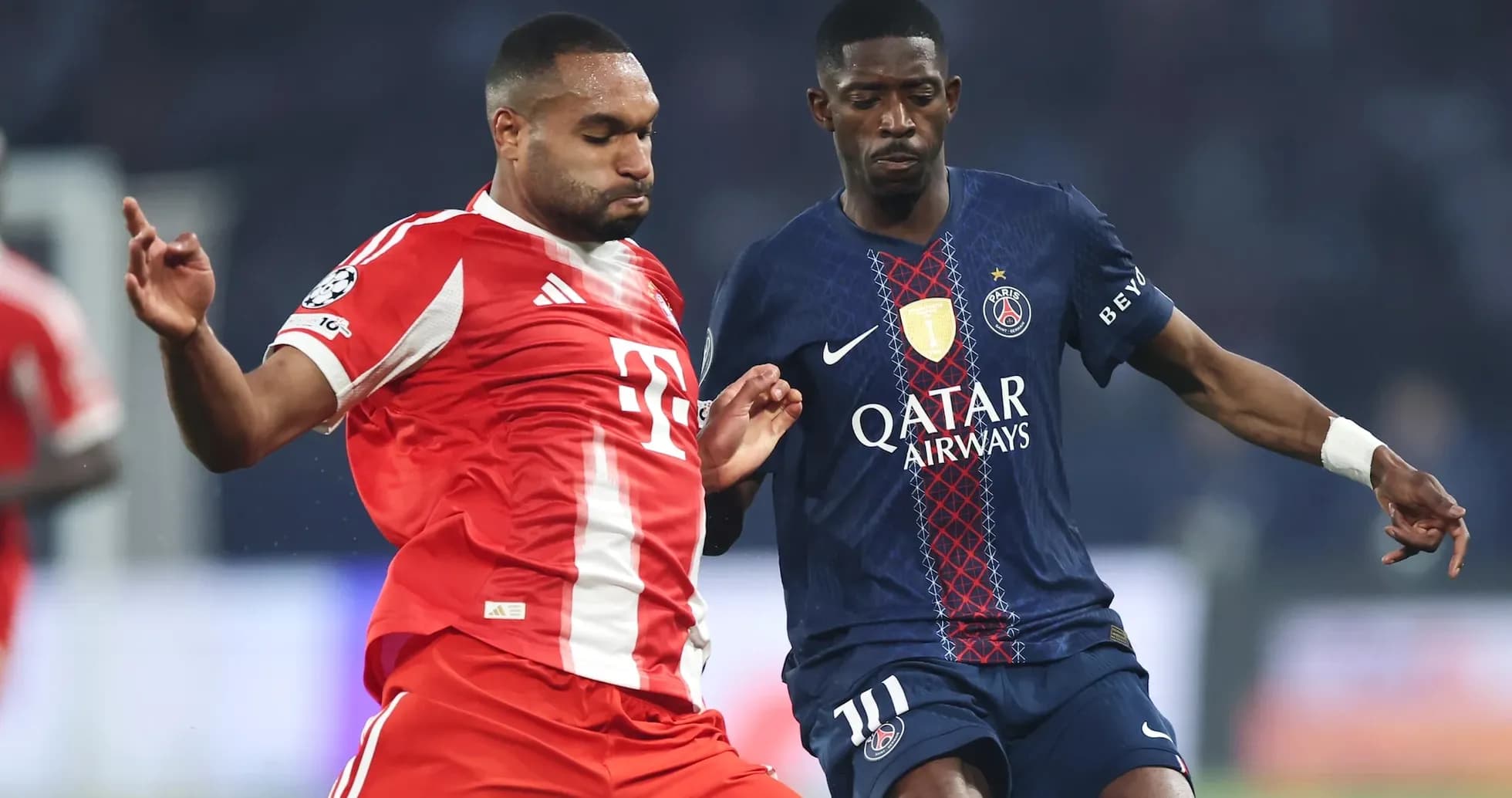
Paris counter with Vitinha and João Neves. Vitinha’s numbers are extraordinary: 1,553 passes at 93% accuracy, 23 key passes, 25 tackles, 1 blocked shot and 17 interceptions. He is less a traditional destroyer and more a possession shield, constantly offering angles to break Bayern’s press. If he can keep turning away from Musiala and Olise’s pressure, Paris can escape the first wave and release Ousmane Dembélé and Désiré Doué into transition.
Dembélé and Doué themselves form a second “engine” between lines. Dembélé’s 7 goals, 2 assists and 20 key passes, plus his ability to attack the half‑spaces, test Dayot Upamecano and Jonathan Tah laterally. Doué’s 5 goals, 4 assists and 28 key passes, with 18 tackles and 8 interceptions, make him a rare two‑way wide threat – capable of tracking Luis Díaz and then sprinting past him the next phase.
IV. Statistical Prognosis – Where the tie tilts
Following this result, the tie leans towards a second leg where Expected Goals should swell. Bayern’s overall attacking average of 3.1 goals per match meets a Paris side that concedes 1.0 away but scores 2.4 on their travels. Both teams have only failed to score once all campaign (Paris away just once; Bayern never), and both carry multiple high‑usage creators: Olise (6 assists, 34 key passes), Kvaratskhelia (6 assists, 20 key passes), Vitinha, Doué and Díaz.
The late‑card surges on both sides suggest that the final quarter‑hour will again be chaotic, with tired legs and aggressive pressing inviting mistakes inside the box. Kane’s perfect club penalty record this season in open play is blemished by that single Champions League miss; Dembélé and Vitinha have also each missed one from the spot. In a tie this tight, the next penalty may decide everything – and the data says there is a strong chance it appears in a frantic, card‑heavy final act rather than a controlled opening.
Narratively, Bayern’s home invincibility and Kane’s scoring volume make them marginal favourites on the balance of play. Statistically, Paris’ away efficiency and the dual‑threat of Kvaratskhelia and Dembélé keep the xG outlook almost level. The first leg’s 1–1 did not resolve the argument; it simply sharpened its edges. The second chapter promises more goals, more space, and a finale where the hunter who stays calm from twelve yards may write the last line.