Inside the Balotelli Chaos at Liverpool: Rickie Lambert's Experience
Rickie Lambert arrived at Anfield in the summer of 2014 like a man chasing a second chance at a childhood dream. Mario Balotelli turned up like a man chasing…something else entirely.
Both were brought in by Brendan Rodgers to help fill the crater left by Luis Suárez’s departure to Barcelona. One was the local lad who’d been released as a teenager and fought his way back through the lower leagues. The other was the mercurial Italian who had already left a trail of headlines behind him at Inter Milan and Manchester City.
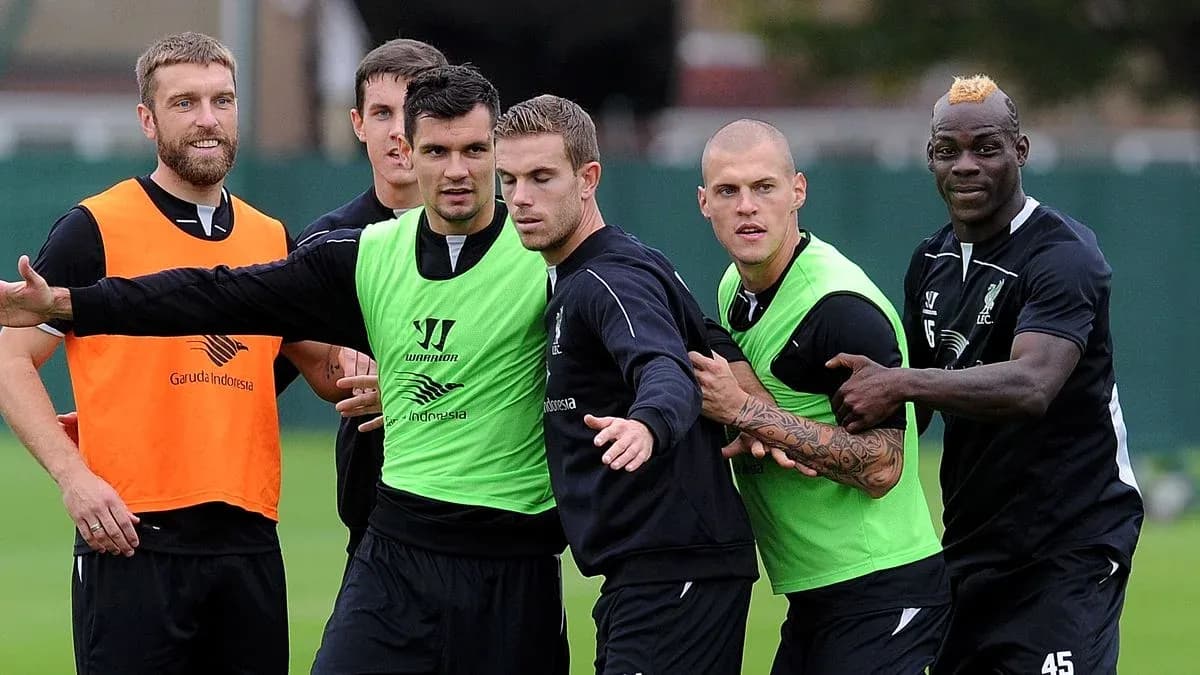
They were meant to form part of a new-look Liverpool attack. Instead, they had to be kept apart in training.
Lambert, speaking on the Straight From the Off podcast in 2021, painted a picture of Balotelli that will not surprise many who watched his career unfold.
“He was a good lad, childish but infectious,” Lambert recalled. Off the pitch, the Italian could light up a room. On it, things changed. “As soon as he stepped on the training pitch he became a different person.
“I’ve never seen anything like it, to be honest.”
At first, Balotelli put the work in when it mattered most – on matchdays. But training told a different story. Lambert quickly sensed the drop-off.
“In training, I could tell he wasn’t giving his all,” he said. Balotelli would answer Rodgers back, and that was the line for the veteran forward. “My head went with that.”
It wasn’t about selection, Lambert insisted. Balotelli starting ahead of him wasn’t the issue initially. The issue was watching someone, in his eyes, coast through the week and still get the nod.
“The fact that he was playing in front of me didn’t bother me at first, I thought ‘I’ll get myself in’,” Lambert said. “But just seeing the way he was in training, and then he was playing, it did affect me a little bit.”
Eventually, it became too much.
“My head went with him in training and I had to go in and say to Brendan, ‘Don’t put me on his team again’,” Lambert admitted. He wasn’t alone in that sentiment. “I think Stevie [Gerrard] had said the same.”
The flashpoints were not just about attitude. They were sometimes spectacular, sometimes infuriating, and occasionally both at once.
A report in The Standard in August 2015, shortly before Balotelli’s loan return to AC Milan, captured one such moment. In a 10-v-10 training game at Melwood, Balotelli was on the weaker side, likely a scratch team of substitutes and squad players ahead of a Premier League clash with Arsenal.
Frustration simmered. Then it boiled over.
From halfway, Balotelli unleashed a “jaw-dropping” strike that flew past reserve goalkeeper Brad Jones and ripped into the net. The problem? It was his own net.
Bystanders were astonished. Team-mates were far less amused. For them, this was not a party trick. It was another sign that when Balotelli grew tired, bored or annoyed, he would simply check out – sometimes literally by scoring for the wrong side.
Those flashes of defiance, or self-sabotage depending on your view, came to define his short and forgettable Liverpool spell. Signed as a gamble to replace one of the world’s most relentless forwards, Balotelli managed just four goals in 28 games before being moved on to Nice in 2016, after that loan at Milan.
By then, the pattern was familiar. Moments of outrageous ability, swallowed up by long stretches where emotion took the wheel. That refusal – or sheer inability – to rein himself in followed him from club to club, from league to league.
For Lambert, trying to prove he belonged at the club he had once left as a boy, it was a nightmare combination. He was fighting his own battle to show he was more than a sentimental signing. Sharing a pitch, even in training, with someone who treated sessions like a stage for rebellion cut deep.
Balotelli moved on, chasing the next chapter. Lambert’s Liverpool story never quite became the fairytale he wanted. But those days at Melwood, watching a team-mate blast the ball into his own net from halfway, remain a stark snapshot of a dressing room trying to balance professionalism with a force of nature that refused to be tamed.