Bafana Bafana vs Canada: World Cup Knockout Clash in Los Angeles
Bafana Bafana and Canada step into the unknown together on Sunday in Los Angeles, two footballing outsiders finally breaking through the glass ceiling of the FIFA World Cup group stage and into the glare of knockout football.
Neither country has been here before. Both arrive with scars, storylines and a sense that this might be the moment everything changes.
Bafana’s slow burn to liftoff
South Africa were supposed to be heading home by now.
They opened their campaign with a flat 2-0 defeat to co-hosts Mexico, a performance that looked painfully familiar to anyone who has watched Bafana drift through past World Cups. When they then conceded first against Czechia, the script felt depressingly pre-written: another group-stage exit, another cycle of regret.
Then the mood flipped.
Teboho Mokoena dragged them level in the 83rd minute of that second game, a strike that did more than just save a point. It jolted a squad, and maybe a football nation, awake. The belief that had been missing suddenly had a pulse.
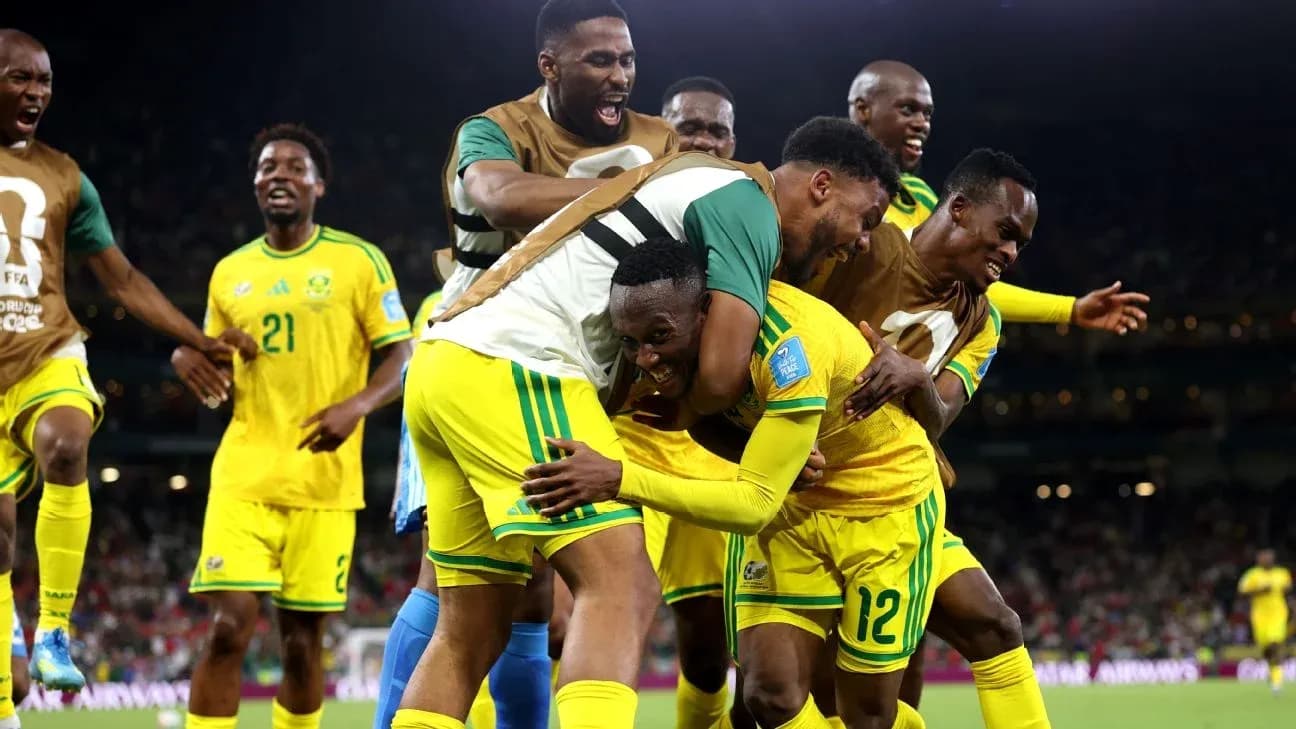
The pressure carried into the decisive clash with South Korea, and this time South Africa held their nerve. Thapelo Maseko’s 63rd-minute winner sealed a gritty 1-0 victory, one of the standout shocks of the tournament so far, and with it second place in Group A. Bafana Bafana, written off after matchday one, were on a plane to Los Angeles instead of back to Johannesburg.
This is a different kind of test. A first-ever World Cup knockout tie for a country that has always talked like a giant but too often played like an undercard act. Now they have a chance to show that talk has substance.
Canada’s co-host gamble pays off
Across the bracket, Canada have been on their own rollercoaster.
Jesse Marsch’s side opened Group B with a 1-1 draw against Bosnia & Herzegovina, a result that kept nerves steady but didn’t exactly ignite a co-hosting nation. What followed did. A ruthless 6-0 demolition of Qatar sent a surge of optimism across Canadian football, the sort of statement win that suggests a team growing into a tournament rather than shrinking from it.
They stumbled in their final group game, losing 2-1 to Switzerland, yet still did enough to claim second place and step into their first World Cup knockout match. For a country that had only ever known group-stage exits in 1986 and 2022, this is uncharted territory – and it is happening on home soil, shared with Mexico and the USA.
Canada now stare at the chance to turn a historic breakthrough into a deep run. The margins tighten here. The pressure sharpens too.
Los Angeles stage, high stakes
The stage could hardly be bigger.
On Sunday, June 28, at 12 p.m. local time in Los Angeles (9 p.m. CAT, 8 p.m. BST, 7 p.m. GMT), Los Angeles Stadium in Inglewood hosts a meeting of two restless football nations desperate to shed their underachiever labels.
The game will be beamed into living rooms across both countries. In South Africa, SuperSport will show it on DSTV channels 201, 202 and 235, with SABC carrying free-to-air coverage and SportyTV offering a streaming option. In Canada, TSN, RDS, CTV and Crave will handle the broadcast, while US-based fans can tune in via FOX, Telemundo or Peacock.
On the pitch, Portuguese referee João Pinheiro will take charge. An experienced official with a high profile in European competition, he arrives with his own baggage after drawing criticism for his handling of Bayern Munich’s UEFA Champions League semi-final against Paris Saint-Germain. Every decision will be magnified in a match of this weight.
Team news: stars missing, leaders returning
Hugo Broos’ preparations have been a mix of frustration and relief.
South Africa lost their appeal against the extended suspension of Themba Zwane, whose red card against Mexico has now sidelined him for three matches rather than one. For a side that leans heavily on his attacking craft, that is a significant blow.
Yet Broos does get a key piece back. Mokoena, the midfield heartbeat and scorer of that crucial equaliser against Czechia, returns from a one-match ban after picking up yellow cards in Bafana’s first two fixtures. His presence alongside Sphephelo Sithole should restore balance and bite in the centre of the pitch.
Canada have their own injury cloud hanging over them. Alphonso Davies, the Bayern Munich star and face of Canadian football, has yet to play a minute at this tournament as he recovers from a hamstring problem. His absence strips Marsch’s side of their most explosive outlet on the left.
The news is even harsher for Ismaël Koné. The Sassuolo midfielder suffered a broken leg against Qatar, ruling him out for the rest of the tournament and forcing Canada to lean deeper into their midfield reserves. Marsch’s squad has battled niggles all over the pitch; the margin for further setbacks is thin.
Expected lineups and key battles
Barring late surprises, South Africa are expected to line up with Ronwen Williams in goal, shielded by a back four of Aubrey Modiba, Mbekezeli Mbokazi, Ime Okon and Khuliso Mudau.
In midfield, Sithole and Mokoena form the double pivot, tasked with both protecting the defence and launching transitions. Ahead of them, the creativity and movement of Oswin Appollis on the left, Relebohile Mofokeng through the middle and Maseko on the right will look to feed Evidence Makgopa as the central striker.
Mofokeng’s influence has been growing. In the 1-0 win over South Korea, he led the match with four key passes, according to FlashScore, quietly dictating much of Bafana’s attacking rhythm. If he finds pockets of space between Canada’s lines, the North Americans could be in trouble.
Canada are expected to respond with Maxime Crepeau in goal and a back four of Richie Laryea, Derek Cornelius, Luc de Fougerolles and Alistair Johnston.
Across midfield, Ali Ahmed should operate on the left, with Mathieu Choiniere and Nathan Saliba in the middle and Tajon Buchanan on the right. Up front, Tani Oluwaseyi and Jonathan David form a front two that offers both physical presence and penalty-box sharpness. David, in particular, carries the burden of being Canada’s proven finisher on the biggest stage.
The contest in midfield feels decisive. Can Mokoena and Sithole disrupt Canada’s passing lanes and spring quick counters, or will Choiniere and Saliba dictate the tempo and pin Bafana back? One moment of composure or one loose touch in that zone could tilt the entire tie.
History offers a quiet reminder
These nations have barely crossed paths. The only previous meeting came in Durban in 2007, a friendly in which Teko Modise scored both goals in a 2-0 win for South Africa. It is a footnote, not a template, but it does underline one thing: Bafana have, at least once, found a way past Canadian resistance.
This time the stakes are immeasurably higher. The winner steps into the rarefied air of a World Cup quarterfinal. The loser walks away having made history, but also knowing chances like this do not come around often.
For Canada, it is a chance to prove that co-hosting a tournament is not just about ticket sales and fan zones, but about a team ready to stand up under the weight of expectation.
For South Africa, it is an opportunity to show that the “sleeping giant” tag is no longer a comforting myth but the prelude to a genuine awakening.
In Los Angeles, one of them will finally take that step. The other will be left wondering how long it will be before the door opens again.