Aston Villa Triumphs in Europa League Final Under Unai Emery
Aston Villa’s long road back to Europe’s summit ended under the Istanbul lights, 44 years after Bayern Munich and Rotterdam. Different era, different cast, same outcome: claret and blue on a European podium, and Unai Emery at the heart of it all.
The Europa League belongs to him. Again.
The 54-year-old, already synonymous with this competition, has now lifted the trophy five times with four different clubs. Sevilla, Villarreal, now Aston Villa join his personal roll of honour, a record that puts him alongside Carlo Ancelotti in the rarest of coaching company. Only Ancelotti, with five Champions League titles, has matched Emery’s haul in a single major European tournament.
In Istanbul, Emery didn’t just add another medal. He completed a transformation.
From relegation to a European crown
Villa’s last major trophy came in 1996, a League Cup win over Leeds United. Their last European final was even further back, that famous night in 1982. Between those peaks lay a 2016 relegation that felt like the end of something, not the beginning.
This was the night that story was rewritten.
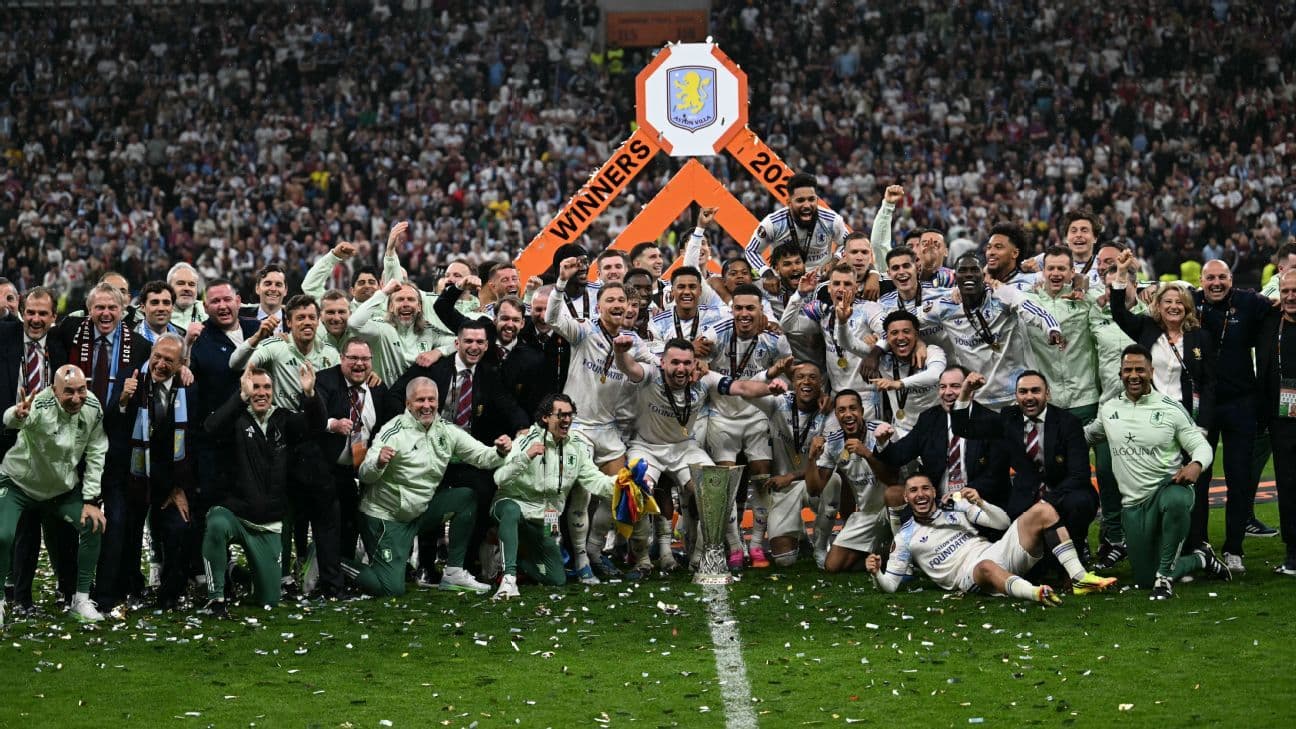
The Europa League triumph, sealed by a 3-0 dismantling of Freiburg at Besiktas Park, stands as the high-water mark of the club’s modern history. It is the culmination of a journey that began in the Championship, with midweek trips to Preston and cold afternoons in the second tier, and ended with a captain from Glasgow lifting silverware on the banks of the Bosphorus.
John McGinn, who dragged Villa back to the Premier League with that playoff win over Derby County in 2019, now stands as the first Scotsman to captain a side in a major European final since Barry Ferguson with Rangers in 2008, and the first Scot to do it for an English club since Graeme Souness with Liverpool in 1984. The image of McGinn hoisting the Europa League trophy into the night, claret and blue scarves swirling around him, is more than a celebration shot. It is a statement about what this squad has built.
Around him, a core that has grown together. Tyrone Mings and Tammy Abraham were part of that Wembley climb back to the Premier League. Ezri Konsa, Emi Martínez, Ollie Watkins and Matty Cash arrived soon after. Together they formed the spine of a side that kept threatening to break through, only to find the door slammed shut: a Conference League semifinal in 2024, a Champions League quarterfinal exit to eventual winners Paris Saint-Germain last season.
Those near-misses hardened them. In Istanbul, they played like a team that had learned every lesson.
Emery’s plan, Villa’s power
The opening stages did not scream three-goal rout. The first 40 minutes were scrappy, punctuated by fouls and broken rhythm. Freiburg pressed, Villa refused to be drawn into a midfield battle they didn’t need.
Emery had seen something. His side went long, again and again, bypassing Freiburg’s press with direct balls towards Watkins. It was not pretty. It was not expansive. But it was deliberate.
Then the pressure finally told.
A set piece, a quiet corner of the pitch, and the cunning of Austin MacPhee, Villa’s set-piece specialist. Lucas Digne rolled a short corner, catching Freiburg flat-footed. Morgan Rogers took a touch, lifted his head, and hung a teasing ball to the edge of the area. Youri Tielemans arrived like a hammer.
His volley crashed past Noah Atubolu, a thudding, ruthless finish that exploded the contest into life. One flash of technique, one rehearsed routine, and Villa had the platform.
From there, the night belonged to the Premier League side.
Tielemans’ strike released the handbrake. Villa, whose goals all season have outstripped their underlying numbers, went hunting for another moment of brilliance. They found it in Emi Buendía.
The Argentine picked up the ball on the edge of the box, shifted onto his weaker left foot and whipped a glorious strike into the top corner. Atubolu flew, hand clawing at air, but the ball arced away from him and into the side netting. It was a goal to win any final. Here, it simply doubled the margin.
François Letexier barely allowed Freiburg to restart before blowing for half-time. Villa walked down the tunnel two goals up, the pattern of the match set. The last three Europa League finals with a two-goal half-time lead have all finished 3-0. Atlético Madrid in 2012, Atalanta in 2024. Now Aston Villa in 2026.
History has a rhythm. Villa were in tune with it.
Rogers seals it, Freiburg left chasing shadows
Freiburg ran. They covered 102.9km to Villa’s 100.4km, chasing, closing, trying to claw back a game that was slipping through their fingers. The numbers say they worked harder. The scoreboard says they were outclassed.
Villa kept them at arm’s length, managing the game with a calm that spoke of Emery’s influence. No wild lunges forward, no reckless openings. Just control, territory, and the occasional incision.
The third goal came from one of the newer names in this emerging European story. Morgan Rogers, at 23 years and 298 days, pounced to finish and become the youngest Englishman to score in a major UEFA final since Steven Gerrard in the 2001 UEFA Cup. It wasn’t as spectacular as the first two, but it didn’t need to be. It was sharp, decisive, and it killed the final as a contest.
For those who endured last year’s scrappy, forgettable decider between Tottenham Hotspur and Manchester United, this felt like compensation: a scoreline that matched the performance, a final settled by quality rather than chaos.
By then, the Villa end had long since turned into a party. Among the 11,000 in claret and blue was Prince William, a future king watching a man who insists he is not the “king” of this competition prove, again, that no one understands it better.
Emery’s modesty will endure, but the numbers are inescapable. Five Europa League titles, three different clubs as a winner – Sevilla, Villarreal, Aston Villa – and a fourth, Arsenal, taken to the final. He inherited a side sitting 17th in the Premier League. He has taken them to the Champions League and now to a major European trophy.
This is no longer a rescue job. It is a project with a crown on top.
A club back among Europe’s elite
The scale of Villa’s achievement stretches beyond one night. Their 44-year gap between major European finals is the third-longest of any club, behind only Manchester City’s 51-year wait and West Ham United’s 47-year hiatus. Now they stand alongside those names as English clubs who have returned to the continental stage and won.
With Tottenham’s triumph last year, English sides have now lifted the Europa League/UEFA Cup in consecutive seasons for the first time since the competition’s first two editions in 1972 and 1973. Back then it was Spurs and Liverpool. Now it is Spurs and Villa.
There were other threads woven into the evening’s tapestry. Jadon Sancho, in claret and blue, became the first player to appear in the final of three different major European competitions in three consecutive seasons: Champions League in 2023-24, Conference League in 2024-25, Europa League in 2025-26. His journey has been turbulent, but his place in European history is now fixed.
Most important of all, this squad has secured its own immortality. They now sit in the same conversation as Paul McGrath, Peter Withe and the heroes of 1982. The 30-year wait for a trophy is over. The decades-long longing for another European night to match Bayern Munich has finally been answered.
Villa did not just win a cup. They changed the shape of their future. The question now is not whether they belong on nights like this, but how often they plan on coming back.