Arsenal's £20m Price for Gabriel Jesus: A Strategic Decision
Arsenal have drawn a clear line in this summer’s market. Gabriel Jesus can go – but only on their terms.
David Ornstein’s report that the Premier League champions value the Brazilian at up to £20 million is more than a transfer titbit. It is a statement of how a club that once wavered now negotiates from a position of steel.
Multiple clubs have asked the question. Arsenal’s answer has been consistent: somewhere between £18m and £20m. No fire sale. No sentiment-led discount. Just a cold, calculated valuation of a forward who still carries the sheen of title-winning pedigree.
Jesus has 12 months left before his contract runs down to its final year, expiring in June 2027. Under normal circumstances, that ticking clock would invite opportunists. Arsenal are refusing to play that game. They “will not consider selling him cheaply before then”, and you can see the logic.
Injuries have bitten. His role has shrunk. Yet the player remains what he has always been: tactically sharp, ferociously committed, and capable of shaping big moments.
Between Numbers and Influence
This is where the economics collide with the dressing room.
Letting Jesus drift towards the final year of his deal would weaken Arsenal’s hand. They know it. The market knows it. But Mikel Arteta also understands that Jesus offers more than a goal tally on a spreadsheet.
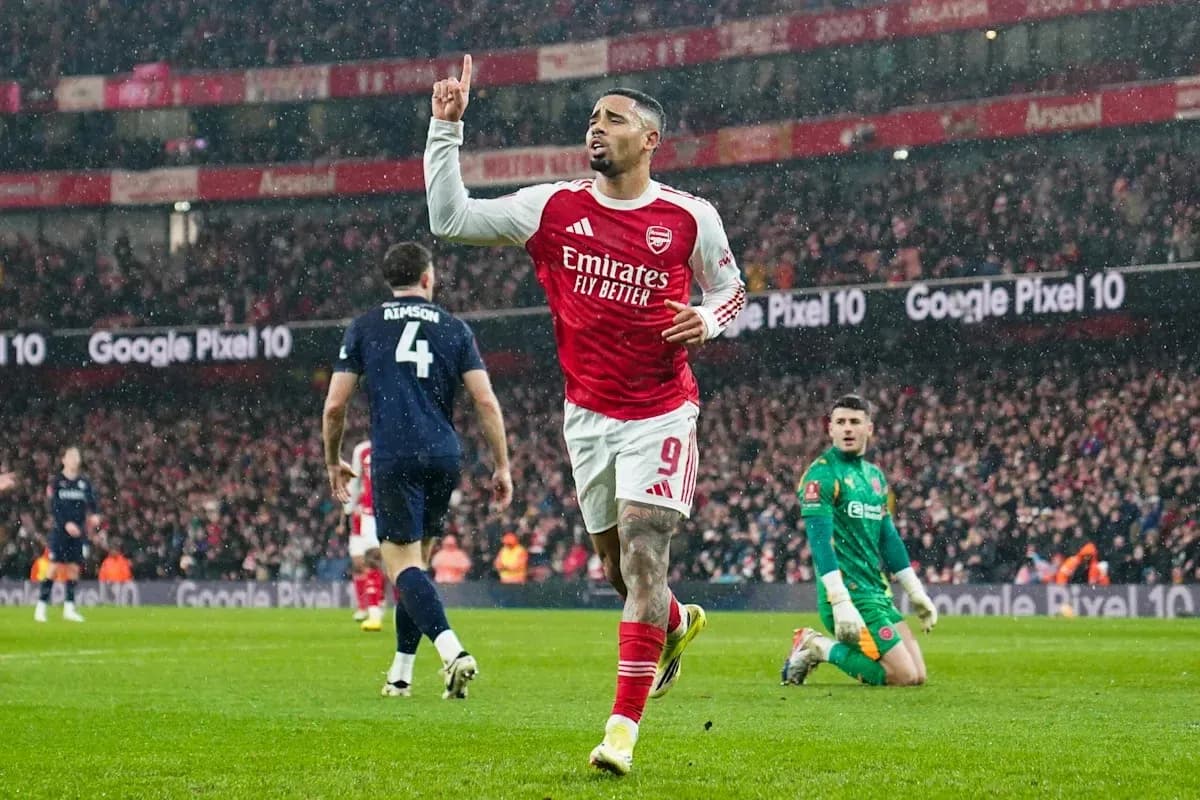
Six goals in 27 appearances after a serious knee ligament injury is not the return of a ruthless No 9. Still, one of those goals – the opener in the 2-1 win over Crystal Palace on the final day – underlined why coaches keep trusting him. Even short of full rhythm, he finds ways to matter.
His overall record in north London stands at 32 goals and 22 assists in 123 games. For a club now calibrated to chase the biggest prizes, those are not the numbers of an undisputed leading striker. Yet they only tell half the story.
Jesus presses high and hard. He drags centre-backs into places they hate. He shifts wide, links play, and injects a certain edge into Arsenal’s front line. His value has always lived in the spaces between the obvious metrics: movement, aggression, versatility, emotional charge.
“Unfinished Business” Meets a New Reality
The emotional thread here is impossible to ignore.
Back in December, Jesus addressed the questions about his future. Why not leave? Why not cash in with a move to Saudi Arabia or a return to Brazil? His response cut through: he spoke of a dream to one day go back to Palmeiras – but “not today”. At Arsenal, he said, he had “unfinished business”. He didn’t want to leave.
That phrase will still echo around the Emirates. When he arrived from Manchester City in 2022, alongside Oleksandr Zinchenko, he brought more than medals. He brought standards. Training habits. A sense of what a champion looks like, day in, day out.
He helped flip the mood. Arsenal stopped feeling like plucky outsiders and started behaving like genuine contenders. In that sense, Jesus became a symbol of the club’s new era as much as a signing.
But football does not pause for sentiment.
Viktor Gyokeres and Kai Havertz now sit ahead of him in Arteta’s plans. Jesus has started only three Premier League games this season. That is not a blip. It is a hierarchy. And at the top level, hierarchies tend to harden quickly.
Business, Not Betrayal
So what does a summer exit really represent?
If Arsenal collect close to £20m, it will look like smart business. They would be cashing in on a 29-year-old with one year before his deal enters its final stretch, recouping a healthy fee while clearing space in a squad that has moved on a notch.
If they keep him, they retain a forward who knows the league inside out, owns five English top-flight titles and carries Champions League experience. A player who can cover across the front line when the fixtures pile up and the margins narrow.
That is the balance the club are striking. No panic. No rush to discard a player who helped drag them back towards the top. Equally, no blind loyalty to a past version of Jesus that no longer fits the reality of a title-winning squad.
Interested clubs will sense opportunity in his contract situation, but they will also understand the profile they are pursuing: a seasoned Premier League operator with proven intelligence and a relentless work ethic. That costs money, even with caveats around injuries and reduced minutes.
A £20m stance captures that nuance. It protects Arsenal’s position without cheapening a player who, in many ways, helped lay the foundations for their current success.
For supporters, the calculation is more emotional. Jesus was one of the players who made them believe again. His finishing could infuriate, his fitness could worry, but his commitment rarely dipped. He pressed, he chased, he knitted attacks together. At his best, Arsenal looked sharper, more spiteful, more alive with him on the pitch.
If he stays, he will do so as a squad player in a machine built to win now. If he goes, he will leave a club that no longer needs him in the same way – but will remember what he gave when belief was still fragile.
Arsenal have set their price. The next move belongs to the market. And to Gabriel Jesus, a player standing at the crossroads between what he helped build in north London and what comes next in a career that still has chapters left to write.