Andy Robertson: Liverpool Legend and Spurs’ New Standard-Setter
Andy Robertson leaves Liverpool as more than a fine left-back. He leaves as a reference point. A benchmark. For seven years he patrolled the left flank of Anfield’s greatest Premier League side, and in doing so entered the conversation about the best to ever play the position in England’s top flight.
At Liverpool, he won everything. Two Premier League titles, a UEFA Champions League, an FA Cup, two League Cups, a FIFA Club World Cup. He did it not as a peripheral figure, but as a relentless constant in Jurgen Klopp’s high-octane machine.
In the Premier League era, Liverpool have never had a better left-back. To find anyone who can argue with Robertson’s status in the club’s history, you have to go back to Alan Kennedy, scorer of two European Cup-winning goals. That is the level of company he keeps.
Klopp’s Perfect Left-Back
Klopp wanted chaos with control, aggression with intelligence. Robertson embodied that brief.
He did not just overlap; he attacked space like a winger, defended like a centre-back, and ran like a middle-distance athlete. His game was built on repetition: up, back, press, overlap, recover. Again and again.
Jose Mourinho, never generous with praise for Liverpool, could not ignore him after Manchester United’s 3-1 defeat at Anfield in December 2018. The then-United manager watched Robertson tear up and down the touchline and admitted he was “still tired from looking at Robertson”, describing his 100-metre bursts as “absolutely incredible”. That was the impression Robertson made on elite opponents: exhausting just to watch.
A Running Machine
The numbers backed up the eye test. In 2020/21 he covered 389.3km in the Premier League, the second-highest total by any full-back, just behind Leeds United’s Luke Ayling.
From 2019 to 2022, no full-back in the division sprinted more. He topped the sprint charts three seasons in a row:
- 2019/20: 567 sprints
- 2020/21: 843 sprints
- 2021/22: 656 sprints
Those figures are not just fitness metrics; they are a map of mentality. Robertson never stopped. His pressing, in particular, became part of Liverpool folklore.
One moment captures it best. January 2018, Anfield, Liverpool v Manchester City. A 13-second press that has been replayed ever since. Robertson hunted Bernardo Silva, Kyle Walker, John Stones, Ederson and Nicolas Otamendi in one ferocious, unbroken run. The crowd rose with every stride. It looked wild, but it was calculated chaos, a defender turning pressing into a spectacle. It remains one of the Premier League’s most iconic defensive sequences.
Elite Production in the Final Third
Robertson was never just a runner. He was a creator of the highest order.
Only two full-backs have delivered 10 or more Premier League assists in three separate seasons: Trent Alexander-Arnold and Andy Robertson, in 2018/19, 2019/20 and 2021/22. At their peak, Liverpool’s full-backs effectively operated as playmakers from the flanks.
Robertson’s assist numbers in those seasons underline his consistency:
- 2018/19: 11 assists
- 2019/20: 12 assists
- 2021/22: 10 assists
Since his £8million arrival from Hull City in 2017, no left-back in the Premier League has matched his attacking output. Across that span he ranks:
- 1st for touches in the opposition box (612)
- 1st for chances created, including assists (430)
- 1st for big chances created (88)
- 1st for assists by a left-back (56)
- 1st for open-play crosses attempted (973)
- 2nd for successful open-play crosses (191)
- 1st for successful passes ending in the final third (4,000)
Only Lucas Digne has more successful open-play crosses among left-backs. Among all defenders, Robertson sits second in most of those creative categories. That is not the profile of a workhorse. It is the profile of a high-end playmaker stationed at full-back.
Is he the greatest left-back in Premier League history? Ashley Cole probably still edges that debate, given his longevity at the very top and impact for both Arsenal and Chelsea. But Robertson is right behind him, and firmly ahead of the rest.
Why Spurs Moved
So why Tottenham? And why now?
Spurs pounced as his Liverpool contract ran down, one of several clubs trying to secure a free transfer for a proven winner. The north London side had already explored a January move, only for it to collapse when Liverpool were unable to recall Kostas Tsimikas from his loan at Roma.
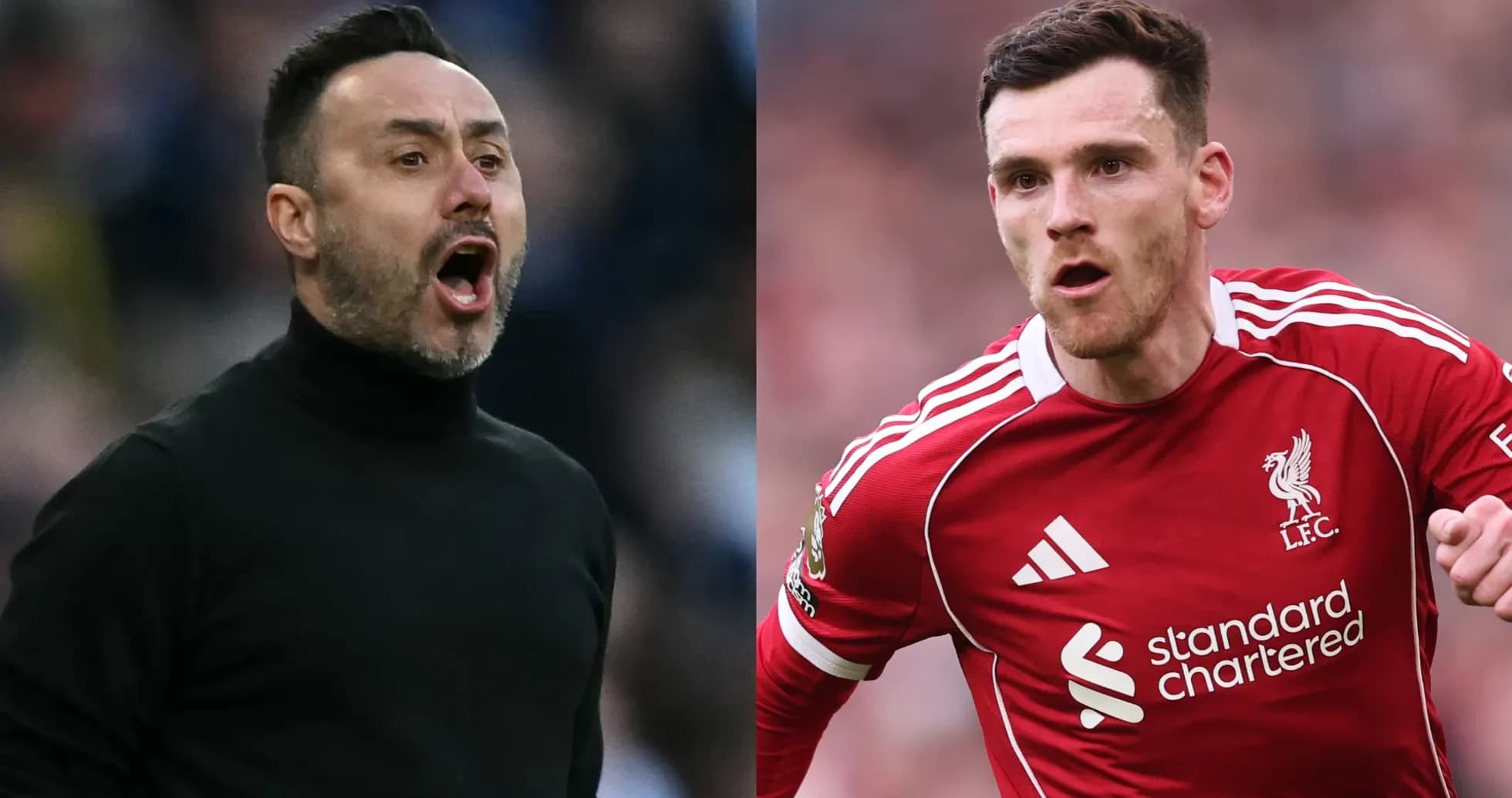
Roberto de Zerbi did not let it go. The new Spurs head coach pushed to revive the deal and, after fending off reported interest from Juventus, finally landed the 32-year-old.
On paper, Spurs are not short of left-back options. Destiny Udogie and Djed Spence are already in the building. But that is only half the story. This is a young dressing room that has been short on hardened, senior voices and players who know what it takes to maintain elite standards every day.
De Zerbi was blunt about what he wanted when the move was confirmed: “He brings experience, mentality and qualities. He’s a big player for us.” Spurs are not just signing a defender; they are importing a culture.
Back-to-back 17th-place finishes have left the club searching for direction and authority. Robertson has lived inside a winning environment, where trophies are expected and sloppiness is not tolerated. He knows how to drive standards on the training ground and in the dressing room, not just on matchdays.
What Version of Robertson Are Spurs Getting?
At 32, Robertson is no longer the blur of red that terrorised right-backs in his mid-20s. But he remains a high-level performer with plenty of mileage left.
He will captain Scotland at the FIFA World Cup 2026, a sign of his continued importance at international level. For Liverpool in 2025/26, he started 11 Premier League matches and came off the bench 13 times, featuring in 35 games across all competitions. He was not a fading squad filler. He was a trusted member of the rotation.
His heat map from last season shows a player still intent on advancing, hugging the touchline high up the pitch and providing width. He does not crash into the box as often as before, but he continues to stretch defences and offer an outlet in advanced areas.
Crucially for Spurs, his underlying numbers remain superior to what they already have. Per 90 minutes in 2025/26, Robertson outperformed every Spurs defender in tackling, crossing productivity and chance creation.
Among Spurs’ left-back options last season, his superiority is stark:
- Passes into the box (per 90)
- Robertson: 5.07
- Spence: 2.67
- Udogie: 1.75
- Tackle success
- Robertson: 75.00%
- Spence: 61.36%
- Udogie: 61.29%
- Successful open-play crosses (per 90)
- Robertson: 0.92
- Spence: 0.44
- Udogie: 0.34
- Chances created (per 90)
- Robertson: 1.54
- Spence: 0.81
- Udogie: 0.44
These are not marginal gains. They are the numbers of a player who can walk straight into the starting XI and lift the level of those around him.
The De Zerbi Fit
De Zerbi demands intelligent, technical footballers who also play with edge. His teams build from the back, overload wide areas and ask full-backs to be brave with the ball and aggressive without it.
Robertson ticks every one of those boxes. He can hold width when wingers drift inside, whip early crosses into dangerous zones, and still snap into tackles on the transition. He reads pressing triggers instinctively, having spent years inside Klopp’s ultra-demanding structure.
For a side that has too often lacked personality in tight moments, his competitive streak matters as much as his left foot. He argues, he drives, he cajoles. He does not hide.
An Astute Gamble on a Proven Winner
This is not a signing for the distant future. It is a move for the here and now, to raise the floor of the team and sharpen its edge.
Robertson may not quite be the force he was at his absolute peak, but the class remains. So does the mentality. Spurs are getting a serial winner with elite creative numbers, a pressing machine with a track record of delivering in the biggest games, and a leader who knows what a ruthless dressing room feels like.
For a club desperate to reset its standards, the question is not whether Robertson can be the player he once was at Liverpool. It is whether his presence can drag Tottenham closer to that level — and how quickly the rest of the squad can keep up with him.