Andoni Iraola's Rest Defence Challenge at Liverpool
Andoni Iraola walked into Liverpool with one big question hanging over him: could his football scale?
His high-octane, front-foot style had worked at Rayo Vallecano and Bournemouth. Those teams could live with the chaos, ride the waves, pick their moments. Liverpool, though, are supposed to chase titles, not survival. The stakes are different. The margins are thinner.
So when his first Premier League game with Liverpool — away at Newcastle United, no less — finished in a wild, slightly lucky 2-2 draw, the debate didn’t settle on pressing or chance creation or intensity.
It landed on something far more niche.
The hidden phase that cost Liverpool
By full-time at St James’ Park, this fairly nerdy tactical concept had become the lens through which both Newcastle goals were being viewed. Not pressing triggers. Not individual errors in isolation. The problem behind the problems.
Strip football down and it looks simple enough: you either have the ball or you don’t. With it, you attack. Without it, you defend. Two phases, cleanly divided.
But matches don’t work in clean lines. The moment you lose the ball, you flip from one phase to the other. That hinge — the instant possession turns over — is where rest defence lives.
Rest defence, borrowed from the German restverteidigung, isn’t about taking a breather. It’s about what’s left. The “rest” are the players not directly involved in the attack. Their job? To be ready — structurally and mentally — for the moment the ball is lost.
How many are behind the ball? Where are they standing? Who are they close to? Can they kill a counter before it grows teeth?
Against Newcastle, Liverpool failed that test twice.
Goal one: space, risk and a five-minute punishment
The warning signs were there before the ball was even lost for Newcastle’s opener.
Ryan Gravenberch picked it up deep, spun away smartly and drove into space. On the surface, it looked ideal: Liverpool’s most advanced midfielder carrying the ball, teammates flooding forward.
Look closer and the picture changes.
Gravenberch, crucially, was the deepest of the midfield three. Dominik Szoboszlai had pushed high, almost on the front line, threatening the run in behind. Florian Wirtz drifted left and also looked to break forward. All three were thinking about the Newcastle goal, not Liverpool’s.
Behind them, a chasm opened in front of the Liverpool back line. It was the sort of space that only becomes a problem if possession is lost. But that’s exactly what rest defence is about: being ready for that “if”.
In that pocket lurked Will Osula. Dangerous if found early. And no Liverpool player had good access to him.
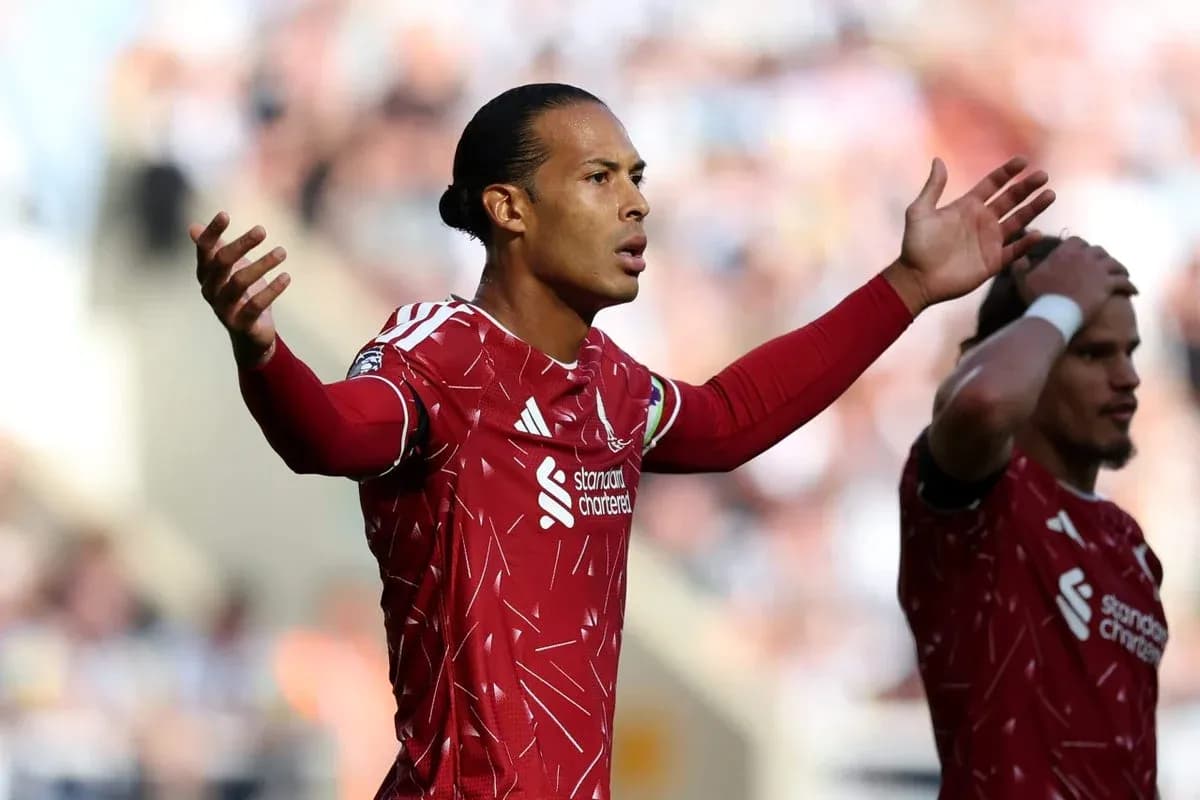
Virgil van Dijk sat too deep — something he later admitted — and Wirtz had pushed too aggressively, especially with Szoboszlai already high. The result? When the ball did break, Osula was free to receive, turn and run without pressure, forcing the Liverpool centre-backs to retreat.
The trigger came from a decision on the ball.
As Gravenberch tried to thread a pass into Alexander Isak on the edge of the box, he ignored two safer outcomes. He could have slipped Szoboszlai in on the right — a harder angle on his stronger foot, but still possible — or simply taken the shot himself. Either option would likely have ended the move in an area that didn’t expose the space in front of his own defence.
Instead, he chose the riskiest route. The pass bobbled loose. Amar Dedic stabbed it away, and suddenly Osula was in business.
Another detail hurt Liverpool. Milos Kerkez wasn’t tight enough to Anthony Elanga. Had he been closer, he might have intercepted Dedic’s weak ball out and killed the break. He wasn’t, so he couldn’t.
From there, the problems were classic transition defending. Van Dijk failed to show Osula decisively towards the left touchline, allowing the pass inside to Elanga. Kerkez then allowed Elanga, one of the quickest players in the division, to get around him and into a straight sprint at goal.
Elanga did the rest with a sharp finish. Five minutes gone. Newcastle 1-0. And all from a Liverpool attack that had looked promising seconds earlier.
Goal two: same story, slightly better shape
The second Newcastle goal carried a familiar theme, even if the structure behind the ball had improved slightly.
This time, Liverpool weren’t quite as exposed. Szoboszlai had better access to Yoane Wissa in the space that opened up when Gravenberch again pushed on and Wirtz dropped in to cover — almost certainly a half-time adjustment to plug that central gap.
Even so, the centre-backs still sat a touch too deep. One of them could have stepped up more aggressively, with the other sweeping behind, to tighten that crucial middle zone.
Once again, though, the decisive moment came with Liverpool in possession.
Gravenberch, still in attacking mode, attempted an ambitious backheel. High reward if it comes off, high risk if it doesn’t. In the context of the game state and the structural exposure, it simply wasn’t worth it.
The ball turned over. Wirtz and Szoboszlai reacted quickly and sprinted back to cover. On paper, Liverpool had the numbers to deal with the break. In reality, Wissa powered past both, raising an obvious question: why didn’t one of them take the tactical foul?
A yellow card in midfield is often the price of a title challenge. Here, Liverpool let Wissa run.
They still had an overload against the Newcastle forwards, but it didn’t matter. The ball broke to Joe Willock on the edge of the box and he finished sharply. Another goal born from a Liverpool attack, another punishment for a rest-defence structure that had been placed under unnecessary stress.
Not just defending – decisions with the ball
It would be easy to file both goals under “poor defending” and move on. There were duels lost, lines not stepped up, forwards allowed to ride challenges too easily.
But the root cause sat earlier in the chain.
Liverpool’s issues at St James’ Park came from a blend of structure and decision-making. The positions of the “rest” behind the ball weren’t quite right. The choices on the ball didn’t respect that reality. Risky passes were played in moments when the team behind the ball was too open to absorb a turnover.
That is rest defence in action: the link between your attacking shape and your ability to survive the instant you lose it.
Why this is new territory for Iraola at this level
These kinds of conversations didn’t dominate the discourse when Iraola was at Bournemouth. Part of that is simple: expectation.
At Bournemouth, his side were not asked to dominate the ball every week. They were often reacting, countering, picking moments. Rest defence still mattered, but it was less constantly under the microscope.
Liverpool are different. They will have more of the ball. They will camp in opposition halves. That automatically pushes rest defence to the forefront. Your “leftover” structure isn’t an occasional concern. It’s a weekly exam.
The encouraging sign for Liverpool is that Iraola’s previous teams, when placed in rest-defence situations, didn’t show this level of vulnerability. The teething problems at Anfield feel more like an adaptation issue than a fundamental flaw.
Fixes on the board – and in the squad
The solutions are obvious enough on the tactics board.
Midfielders need a clearer awareness of each other’s positions when one drives forward. If Gravenberch carries, someone must slide into the space he vacates. One centre-back can step into midfield more aggressively when the team is settled in the opposition half, with the other ready to cover in behind. Distances to dangerous opposition players, like Osula in that first goal, must be tighter.
None of these tweaks ask Iraola to dilute his principles with the ball. They simply tighten the net underneath them.
Personnel can help too. Gravenberch’s instinct is to carry forward and open up the pitch, which naturally stretches the space in front of his own defence. That doesn’t make him the villain of the piece, but it does mean his tendencies have to be balanced by teammates — or, in certain games, by different profiles.
Within the current squad, there are options. Trey Nyoni has looked the most natural fit as the deeper of the two midfielders in pre-season, showing a feel for those holding positions. Alexis Mac Allister, if his physical load allows, has also impressed in that role. Neither requires a shopping spree to solve the issue.
A different Liverpool than expected
The irony is that many expected Liverpool to look chaotic in the press and clunky with the ball under Iraola in the early weeks. Instead, at Newcastle, they dominated possession and carved out enough chances to stay in the game.
They were undone not by a lack of ideas, but by the space their own ideas left behind.
Two transitional punches. Two lessons in rest defence. And a manager who now knows exactly which part of his high-intensity blueprint needs tightening if Liverpool are to turn promise into something more serious this season.