A Beautiful Obsession: Guardiola's Vulnerability and City's Cold Decisions
Pep Guardiola has spent the past decade being framed as football’s great perfectionist, the architect of Manchester City’s winning machine. Amazon’s new four-part series, A Beautiful Obsession, shows something else entirely: a genius coming apart in public, and a club cold enough to keep moving while he does.
The surprise is how little is hidden. City control the cameras, yet they leave the ugliest parts in.
This is not a soft-focus farewell to Guardiola’s “gilded” era. It dives straight into the brutal winter of 2024-25, when the champions fell into a tailspin: nine defeats and a single win in 13 games, the aura shredded week by week. The series, which lands on Prime on Wednesday, lingers on that collapse and refuses to tidy it up.
It doesn’t spare the club’s biggest decisions either. Kevin De Bruyne’s exit, the cold cutting loose of City’s greatest modern player, is handled with a bluntness that jars. So is the fury of chair Khaldoon al-Mubarak after Guardiola rotates 10 players for a Champions League home tie against Bayer Leverkusen – and loses 2-0. None of that anger is airbrushed away.
Instead, the camera moves in closer. Sometimes uncomfortably close.
A manager stripped bare
The most jarring moments are not tactical debriefs or dressing-room tirades. They are about Guardiola’s private life, dragged into the middle of a crisis.
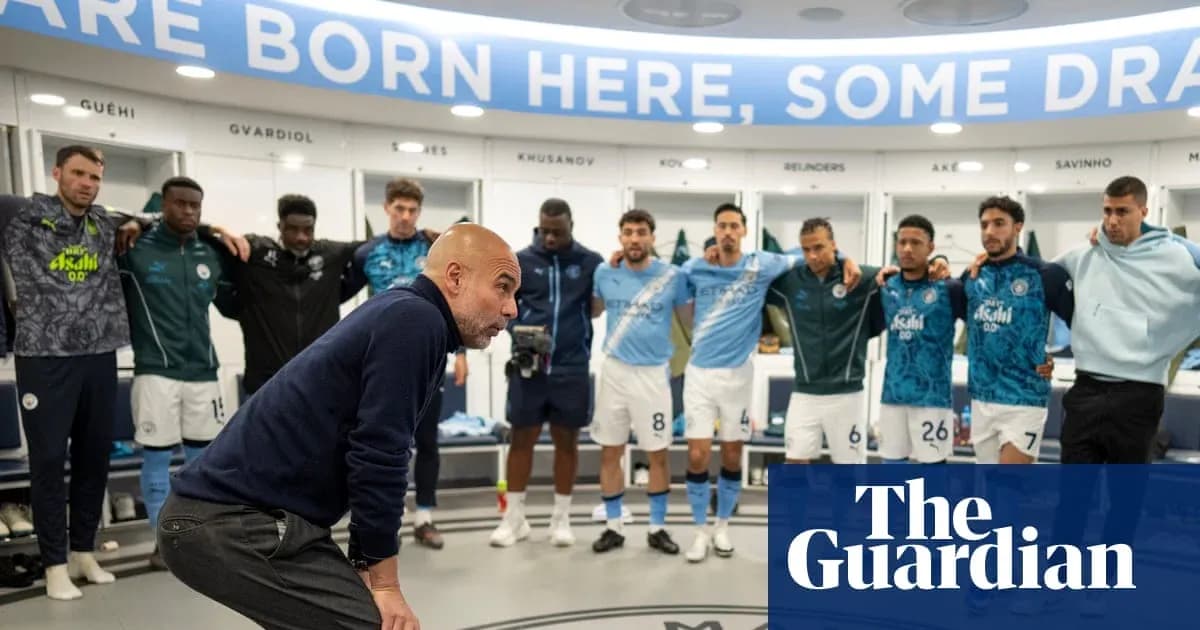
After a 2-0 defeat by Juventus on 11 December 2024 – City’s seventh loss in 10 games – Guardiola stands in front of his players and detonates a bombshell. He tells them his marriage has broken down and tries to turn that pain into a question of their own commitment.
“I’m fucking divorced from the most beautiful woman on your planet,” he says. “I love her unbelievably, but we lost the passion. How do you play football, because you are paid? Or because of something inside? Where is the passion?”
It is raw, startling, and, on screen, deeply uneasy. Guardiola has every right to talk about his life, yet the speech feels like a desperate reach for a new lever of motivation, a line crossed in search of a reaction. Instead of reinforcing his authority, it risks doing the opposite, exposing how little of his old power he feels he has left.
He later explains what he believes a No 1 must be: a figure who can convince players to “go to the penthouse, the roof and jump down” for him. In these scenes, he looks like a man who fears they might not even follow him out of the dressing room.
A year on, after that infamous 10-man rotation against Leverkusen, he returns to the same theme. “I leave my life, my divorce and my family is away, and everything for all of you. And what do you give back?” he asks. The plea is naked. So is the sense of a manager who has gambled every part of himself on this squad and cannot understand why the return feels so thin.
The series underlines that vulnerability through the words of Manuel Estiarte, Guardiola’s close friend and City’s director of first-team operations. In episode two, The Rebuild, Estiarte reveals he went to the players to explain the manager’s state of mind.
“I said to the team: ‘Please, you have to understand, you’re not playing with a coach who can be a bit impulsive, intense, sometimes a bit up and down. You’re seeing a human being. He’s getting a divorce.’ It was necessary for the team not only to visualise Pep as a manager but for the first time as a human being.”
The admission raises its own questions. Why did Guardiola not tell them himself? And behind the scenes, did Khaldoon and CEO Ferran Soriano quietly ask whether their manager’s private turmoil was now cutting into his work?
Just when the documentary threatens to drown in the bleakness, it cuts to a different Guardiola: smiling, lighter, almost breezy. “In my life I made a lot of changes – I got divorced and I have to settle a bit. But no complaints at all honestly,” he says, then quickly narrows the definition of happiness. “In my job, yeah.” The emphasis lands like a warning: the personal world is scorched, the professional one is all he has left.
Love, hugs and a captain’s exit
Interpersonal relationships run through the series like a thread. Episode three is even titled Love and Hugs. The title sounds warm. The reality is more painful.
In part one, The Desert, Guardiola is close to tears over Kyle Walker’s departure. The timing could hardly be worse. It is January 2025, City are listing badly, and their captain chooses that moment to walk away.
Guardiola turns to the dressing room and challenges them. Walker did not behave like a leader, he says. Then he flips the spotlight. They chose him. Why did no one grab him, pin him to the wall, demand he stay and fight?
The flashpoint that pushes Walker towards the exit is filmed with a kind of cruel beauty. At Anfield, his mistake leads to Luis Díaz winning a penalty, converted by Mohamed Salah, in a 2-0 defeat. Back in the dressing room, Guardiola references the error. Walker snaps. He says he is being singled out “every meeting”. The air thickens.
The argument ends not with a row, but with Guardiola in tears, delivering a monologue about loyalty and commitment. Only 11 days earlier, in the middle of the worst run of his City career, he had signed a new contract. He did it, he tells them, to fight.
“If captains first, then the other ones, for example [feel] that there’s a problem, tell me,” he says. “It’s not going to change the love I have for all of you. I’m sorry.”
The cameras catch him in the foreground, voice cracking, while behind him Walker sits in silence, staring into the middle distance. It is a moment of pure cinema – and of a relationship that cannot be repaired.
Cold decisions, real tears
Episode two opens with more regret. This time, it is De Bruyne.
There is no new contract. No romantic last dance. Just a decision that the club’s most important modern player must go. Soriano stresses to Khaldoon that “Kevin gets the respect he deserves as the greatest player in the modern history of City”, but the conclusion does not change.
Guardiola recalls “Super Kev” breaking down in his office. He also makes it clear that emotion could not dictate the call. The machine has to keep winning. Sentiment is a luxury it cannot afford.
The cameras then find De Bruyne as he is asked what he will miss most. He cries. “My kids don’t want to go,” he says.
In that single line, the series cuts through the usual clichés of elite sport. Behind the polished interviews and tunnel shots are people with lives, families, roots. The same industry that reduces Guardiola and De Bruyne to assets also asks their children to pack up and leave.
The contrast is sharp: the boardroom’s clinical language about cycles and rebuilds, followed by the sight of a club legend unable to speak through tears. It underlines a truth often ignored – that the emotional current, the “passion” Guardiola keeps searching for, is not an optional extra. It is the game.
Calling out the boss
The documentary’s honesty does not stop at players. Guardiola himself comes under fire from inside the club.
His decision to make 10 outfield changes for that Champions League tie against Leverkusen in November 2025 is dissected with unusual candour. “Our attitude with Pep Guardiola should not be too negative. But it shouldn’t be too kind or accommodating either. This is his mistake this time,” Soriano says.
Khaldoon goes further. “To pick an entire new [outfield] team in a game this important is probably one of the lowest points we’ve had. I can’t speak to him – I’m so angry.”
For a club that has spent years protecting its image, to release those lines is striking. It shows the ruthlessness runs upwards as well as down. Even a manager with 20 trophies in a decade is not shielded when he gets it wrong.
Nothing is eternal
By the time the fourth episode, Nothing Is Eternal, winds towards its close, the storm has eased. Not completely, but enough.
City do not reclaim the league, yet they still collect the Carabao Cup and FA Cup, lifting Guardiola’s haul to 20 trophies – including three Community Shields – in 10 years. They finish second, the rebuild complete enough to restore order if not dominance.
The farewell is warm, almost gentle, compared with what has come before. Guardiola gets the send-off his body of work demands, framed not as a broken man leaving the wreckage but as someone finally stepping away from the grind.
“Life should not just be about football. It’s too much to be honest,” he says.
For a decade, City have sold the image of a flawless machine, guided by a mind that always had the answers. A Beautiful Obsession shows something more human: a manager who bleeds for his job, a club that keeps turning even as he does, and a final season that asks a simple question.
How much of yourself can you give to football before it takes everything?