
World Cup 2023: The Absence of Italy and the Rise of New Stars
The world gathers. Italy watches.
At 20:00, under the lights of the Azteca, Mexico–South Africa will open a World Cup that is bigger, longer and noisier than any that came before it. Forty-eight participants, three opening ceremonies, a final set for 19 July. A maxi American World Cup that stretches across a continent and feels like a television epic.
And yet, for the second time running, there is no Italy on the pitch. Only on the benches.
Messi’s crown, Yamal’s dawn, Mbappé’s response
The defending champions arrive with the same leader and the same conviction. Lionel Messi, now the veteran king of this circus, does not bother to hide it: Argentina will be hard to beat. The group around him knows the route, the pressure, the weight of the shirt. They have done this dance before.
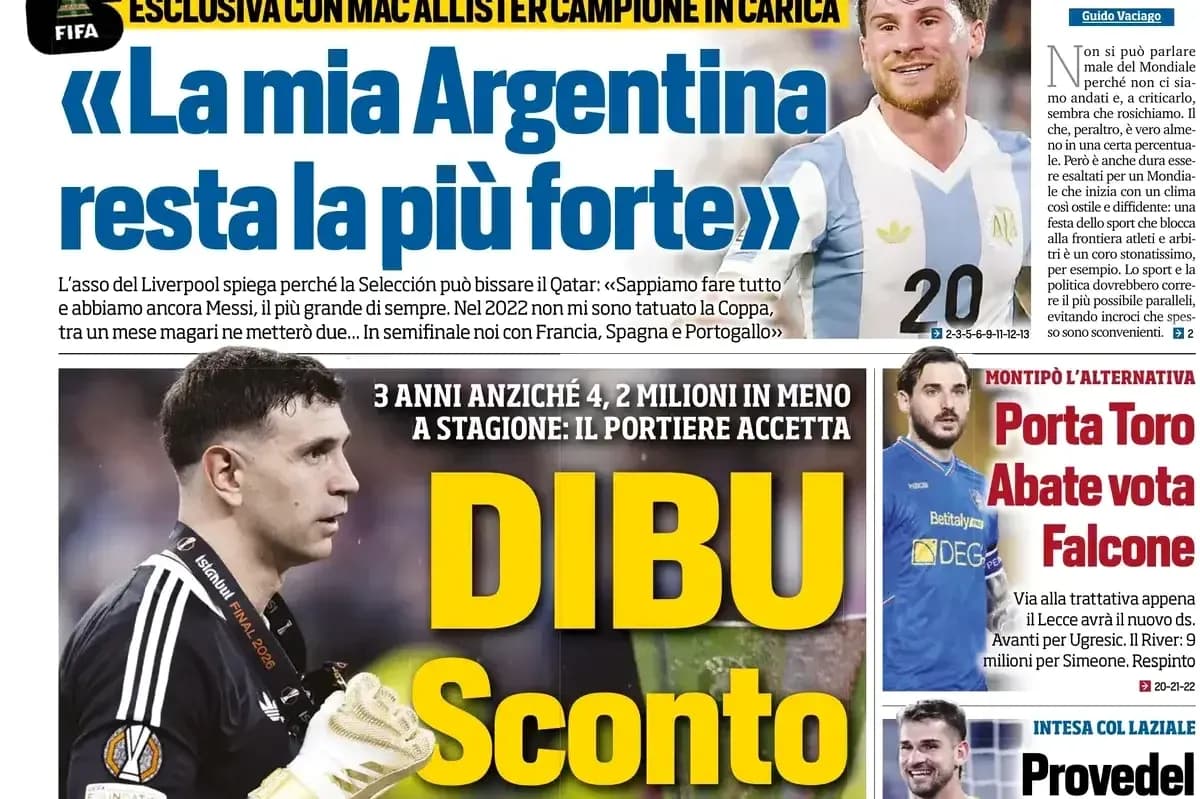
Alexis Mac Allister, one of the pillars of that triumph in Qatar and now a Liverpool mainstay, lays it out simply. His Argentina, he insists, “remains the strongest.” Not out of nostalgia, but out of structure. They understand how to win this tournament and, crucially, they still have Messi, “the greatest of all time.” He did not ink the World Cup trophy onto his skin in 2022. He jokes that in a month he might have space for two. It is bravado with a competitive edge.
Mac Allister already sees the last four in his mind: Argentina, France, Spain, Portugal. No surprises, only heavyweights. A World Cup built for giants, where a misstep in the early chaos can still be corrected, but where the final stretch belongs to the usual faces.
France return with an attack that borders on excess. So many stars, perhaps too many. Kylian Mbappé leads a forward line that can terrify any defence, yet the question lingers: can Didier Deschamps blend all that ego and electricity into a coherent unit one more time?
Spain, though, are the team that keep popping up in the algorithms and the data models. Rodri, the brain and metronome of their midfield, does not hide behind modesty. The level has risen, he says, and his Spain are favourites. It is a bold statement, but it matches the numbers. The machines agree with the man.
And then there is the new generation. Lamine Yamal, still a teenager, arrives as the symbol of a fresh wave that refuses to wait its turn. The World Cup has a habit of taking young promise and turning it, overnight, into global obsession. Yamal walks into that spotlight now.
The last dance for two icons
This is edition number 23 of the World Cup. It also carries the scent of farewell.
Two icons are expected to bow out when this tournament ends. The “last dance” headline is not just marketing. It is the reality of ageing legs and full trophy cabinets. The sport moves on, even if the names still dominate billboards.
France and Argentina sit on top of most predictions, but the algorithms keep whispering “Spain.” Data versus aura. Control versus chaos. It is a battle that will play out from the group stages to the final act.
Tonight brings the first of three opening ceremonies, a sign of how inflated and globalised this event has become. The Azteca, a stadium soaked in World Cup mythology, hosts the first kick. Diego Maradona’s ghost will be somewhere in the stands, even as Messi and his generation try to write their own final chapters.
Italy’s presence: three coaches, no anthem
Italy’s anthem will not ring out before any group game. There is no Azzurri squad, no debate over formations or false nines. The tricolore, instead, sits on the touchline.
Carlo Ancelotti, Fabio Cannavaro and Vincenzo Montella carry Italian football into this World Cup as coaches. Three different profiles, one shared responsibility: to prove that Italian ideas still matter on the global stage, even if Italian players are watching from home.
Ancelotti, “our Carletto,” arrives with his usual mix of calm authority and tactical clarity. Cannavaro brings the perspective of a former World Cup-winning captain now navigating the chaos from the technical area. Montella, the more mercurial of the trio, adds a creative streak to the Italian contingent abroad.
It is a strange consolation. Italy, four-time champions, reduced to sideline influence while others fight for the trophy. The whole world is there. Apart from them.
Transfer market rumblings: Juve eye Dibu, Inter build, Milan and Modric
While the World Cup opens, the Italian clubs keep working in the shadows.
At Juventus, the goal is clear: secure a top-level goalkeeper at sustainable terms. Emiliano “Dibu” Martinez has taken a decisive step. The Aston Villa and Argentina goalkeeper has accepted a three-year deal with Juventus that would see him earn 4.2 million euros less per season than his current terms. A significant discount from a player who has just helped deliver a World Cup.
Juve have an agreement with Martinez, but now must unlock the deal with Aston Villa. The English club want 15 million euros. Cristiano Giuntoli’s structure is holding at five. The gap is wide, the negotiation delicate. While that plays out, Besiktas are moving for Michele Di Gregorio, another name linked to the Bianconeri in recent months. A domino effect is taking shape.
On the attacking front, Nico is close to finalising a move that would bring Alexander Sorloth in. At the same time, Atletico Madrid have developed a liking for Ruggeri. The market spins, and every move triggers another.
In the Premier League, there is strong interest in Marcus Thuram. A move to England would mean more money flowing back towards Inter and, indirectly, more margin to work on a big sale such as Randal Kolo Muani. Contacts have also been made for Lucumi, while Cagliari have put forward a proposal for Gaetano. Italian clubs are juggling budgets, opportunities and timing, as always.
Inter, fresh from securing Oumar Solet, have now reached an agreement with Lazio goalkeeper Ivan Provedel. Two signings that strengthen the spine. A meeting with Provedel’s agent went smoothly, while Alessandro Bastoni’s representative has been clear: “Ale is happy at Inter.” That message stabilises a defence that many in Europe would love to unsettle. The Reggiani idea remains in the background as another potential piece of the puzzle.
Torino, meanwhile, are reshaping their own goalkeeping plans. Coach Abate has thrown his support behind Wladimiro Falcone as the primary target, with Lorenzo Montipò as the alternative. Talks will start in earnest as soon as Lecce appoint a new sporting director. Ugresic is one of the names on their list. Across the ocean, River Plate have seen a 9 million euro offer for Simeone rejected, another sign of how inflated the striker market has become.
In Milan, the story refuses to close. Luka Modric is not finished with the Rossoneri just yet. Real Madrid have offered him a role as director, a dignified and prestigious landing spot for a legend. The Croatian, though, wants to speak to new coach Oliver Glasner first. He still feels the pull of the pitch, the lure of one last chapter at the highest level. Milan wait, listening carefully.
A World Cup without Italy, and a question that will not go away
So the stage is set. Mexico and South Africa will write the first lines at the Azteca. Messi will try to defend his crown. Mbappé, Yamal, Rodri and a constellation of stars will chase him. France and Argentina carry the weight of expectation, Spain the cold endorsement of the algorithm. Portugal lurk with their own ambitions.
Italy, absent again, must settle for three coaches, transfer negotiations and distant memories of lifting the trophy. The world game marches on without them.
How long can a country with this history, these coaches, and this obsession afford to stay outside the gates?





