Tottenham vs Everton: Tactical Analysis of a Goalless Stalemate
Under a grey north London sky, Tottenham and Everton walked out at the Tottenham Hotspur Stadium with their seasons already pulling in opposite directions. The Premier League table framed the story starkly. Heading into this game, Tottenham were 17th with 2 points from 4 matches, no goals scored and 5 conceded overall – a goal difference of -5. Everton arrived in 8th, unbeaten with 6 points, 5 goals scored and 3 conceded overall, their goal difference a positive 2 and their mood to match.
Yet the 90 minutes that followed refused to bow to narrative. A 0-0 at full time, under Darren England’s watch, left both sides with familiar questions, but for very different reasons.
I. The Big Picture – Two 4-2-3-1s, two very different burdens
Both managers leaned into a mirrored 4-2-3-1, but the personnel told the real tale.
Roberto De Zerbi’s Tottenham looked like a side rebuilt in fast-forward. A. Kinský in goal, shielded by a back four of A. Robertson, M. van de Ven, J. van Hecke and A. Gray, set a platform that had at least delivered some clean sheets this season: 2 in total, split evenly with 1 at home and 1 away. In front of them, the double pivot of R. Bentancur and S. Tonali was designed for control, not chaos. Ahead, Sávio, Mateus Fernandes and Omar Marmoush floated behind lone forward D. Solanke.
The problem was brutally simple. Heading into this game, Tottenham had played 4 league matches, 2 at home and 2 on their travels, and failed to score in all of them. Their goals for column read 0 at home, 0 away, 0 in total. They had already failed to score 2 times at home and 2 times away, 4 in total – every outing. The shape was familiar, the movements often elegant, but the cutting edge was missing.
David Moyes’ Everton, by contrast, carried a quiet confidence. J. Pickford anchored a back four of A. Maitland-Niles, J. Tarkowski, J. Branthwaite and V. Mykolenko. In midfield, H. Armstrong and J. Garner formed a disciplined base, with B. Johnson, K. Dewsbury-Hall and Tyrique George supporting T. Barry up top. Everton’s season profile was more balanced: 5 goals for and 3 against overall, with 4 scored at home and 1 on their travels, conceding 2 at home and 1 away. On their travels they averaged 0.5 goals for and 0.5 against per game, a picture of controlled, low-risk football.
II. Tactical Voids – The weight of absences and discipline
Tottenham’s attacking drought was not just tactical; it was structural. The list of absentees read like a catalogue of missing creativity and punch. D. Kulusevski, M. Mudryk, W. Odobert and X. Simons were all ruled out, all with knee or ankle issues, while Richarlison was sidelined by transfer negotiations. That is an entire band of potential line-breakers, dribblers and finishers removed from the equation.
In their absence, De Zerbi leaned on Sávio’s one‑v‑one ability, Marmoush’s direct running and Solanke’s holdup play. But with no natural wide finisher of Kulusevski’s profile, no raw pace of Mudryk, and no between-the-lines guile of Simons, Tottenham’s attacks too often died at the edge of the box.
Everton had their own loss in C. Norgaard, missing through injury, depriving Moyes of another combative presence in midfield. But the visitors’ structure absorbed that blow more easily; Armstrong and Garner were already drilled as a partnership.
Disciplinary patterns also shaped the tone. Tottenham’s yellow card profile this season showed a pronounced late spike: 40.00% of their cautions arriving between 76 and 90 minutes, with 20.00% in each of the 0-15, 31-45 and 46-60 windows. It painted a picture of a team fraying as games stretched, chasing lost positions or tiring under pressure. Everton, by contrast, spread their bookings more evenly, but with a notable 28.57% of yellows between 61 and 75 minutes – often when Moyes’ side tighten the screw in the middle of the second half.
III. Key Matchups – Hunter vs Shield, Engine vs Enforcer
The “Hunter vs Shield” duel was less about an individual marksman and more about collective identity. Tottenham’s “hunter” was the entire front four, tasked with finally breaking a barren run against an Everton defence that had conceded just 1 goal on their travels and 3 overall.
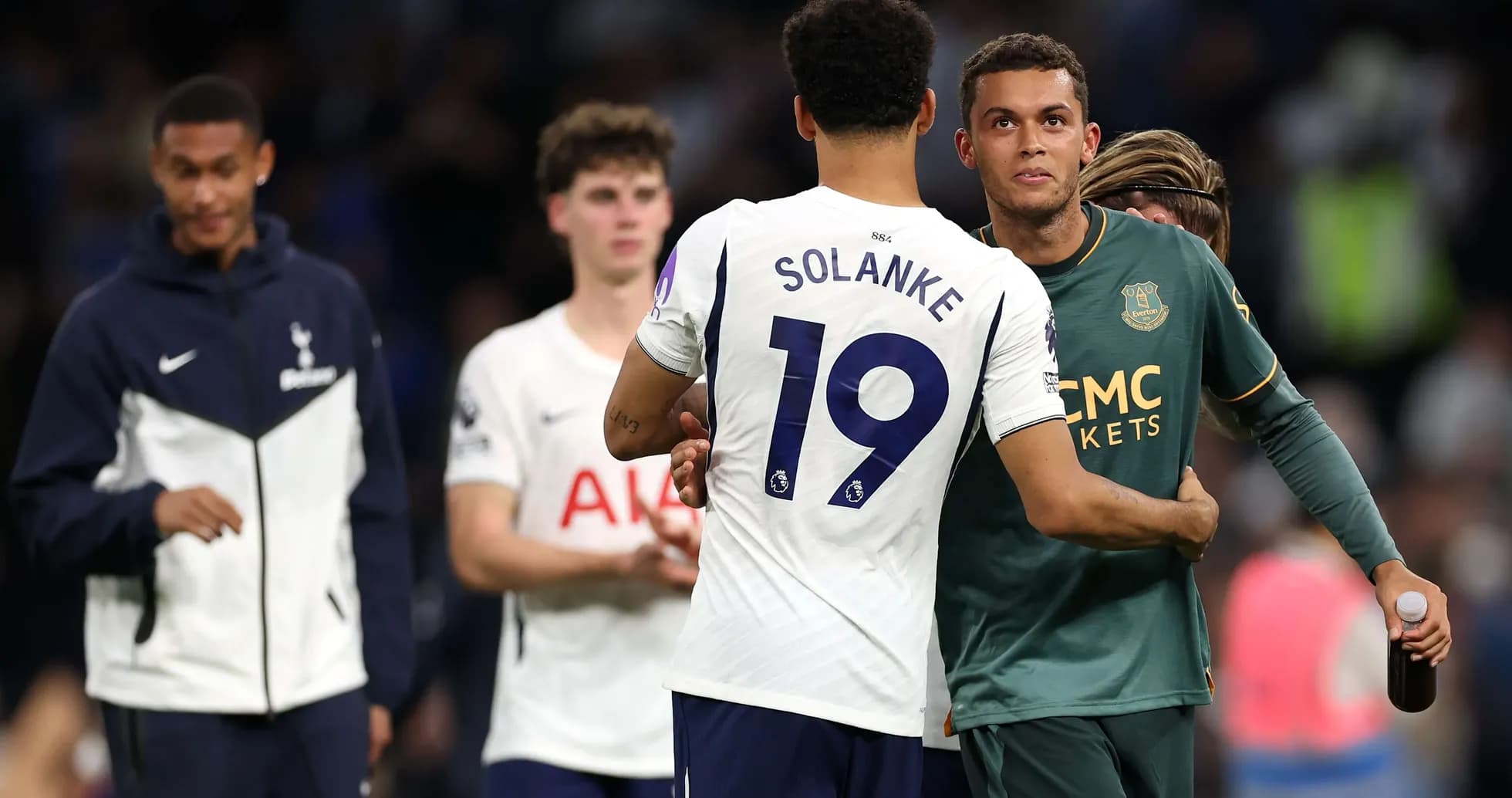
Solanke’s battle with Tarkowski and Branthwaite was central. Tarkowski’s aggression and Branthwaite’s composure allowed Everton to hold a relatively high line, compressing the space where Mateus Fernandes and Marmoush wanted to receive. Without runners of Kulusevski or Mudryk’s pace to threaten in behind, Tottenham were forced into intricate combinations in front of the block – exactly what Moyes’ structure is built to absorb.
In the “Engine Room”, the contrast was vivid. For Tottenham, Bentancur and Tonali sought to dictate tempo, recycling possession and feeding the advanced trio. For Everton, Garner was the fulcrum. His season numbers underlined his importance: 4 appearances, 3 starts, 240 minutes, with 128 passes and 3 key passes at an accuracy of 90. He had also made 11 tackles and 2 interceptions, and engaged in 27 duels, winning 16. This was not a player who merely screened; he engaged, bit and then played forward.
Garner’s disciplinary edge – 2 yellow cards in the campaign and also listed among the league’s notable red card profiles – added bite to that zone. His willingness to foul when necessary, combined with Armstrong’s energy, repeatedly disrupted Tottenham’s attempts to build rhythm through Tonali and Bentancur.
IV. Statistical Prognosis – A stalemate that confirms the trends
A goalless draw felt, in many ways, like the logical intersection of these profiles. Tottenham, with 0 goals for and 5 against overall before kick-off, had already shown they could keep games tight – 2 clean sheets overall, 1 at home and 1 away – but lacked the final action. Everton, with an overall goals against average of 0.8 per match and just 0.5 conceded on their travels, arrived as one of the league’s more solid defensive units.
Without explicit xG data, the pattern still suggests a familiar storyline: Tottenham probing, circulating, and then running out of ideas against a compact block; Everton content to manage space, trust their structure and take what the game offered. The absence of penalties for both sides this season – 0 awarded, 0 scored, 0 missed overall – hinted that there would be no easy route to breaking the deadlock either.
Following this result, Tottenham’s identity crisis sharpens. The structure is there, the ball progression is there, but the numbers are brutal: 4 matches, 0 goals, 5 conceded, still a goal difference of -5 and a place mired in the lower reaches of the table. Everton, meanwhile, will quietly bank another clean sheet on their travels, adding to a defensive record that already looked robust, and walk away knowing that in a season built on margins, their shield is firmly in place – even on a day when neither side found a hunter worthy of the name.