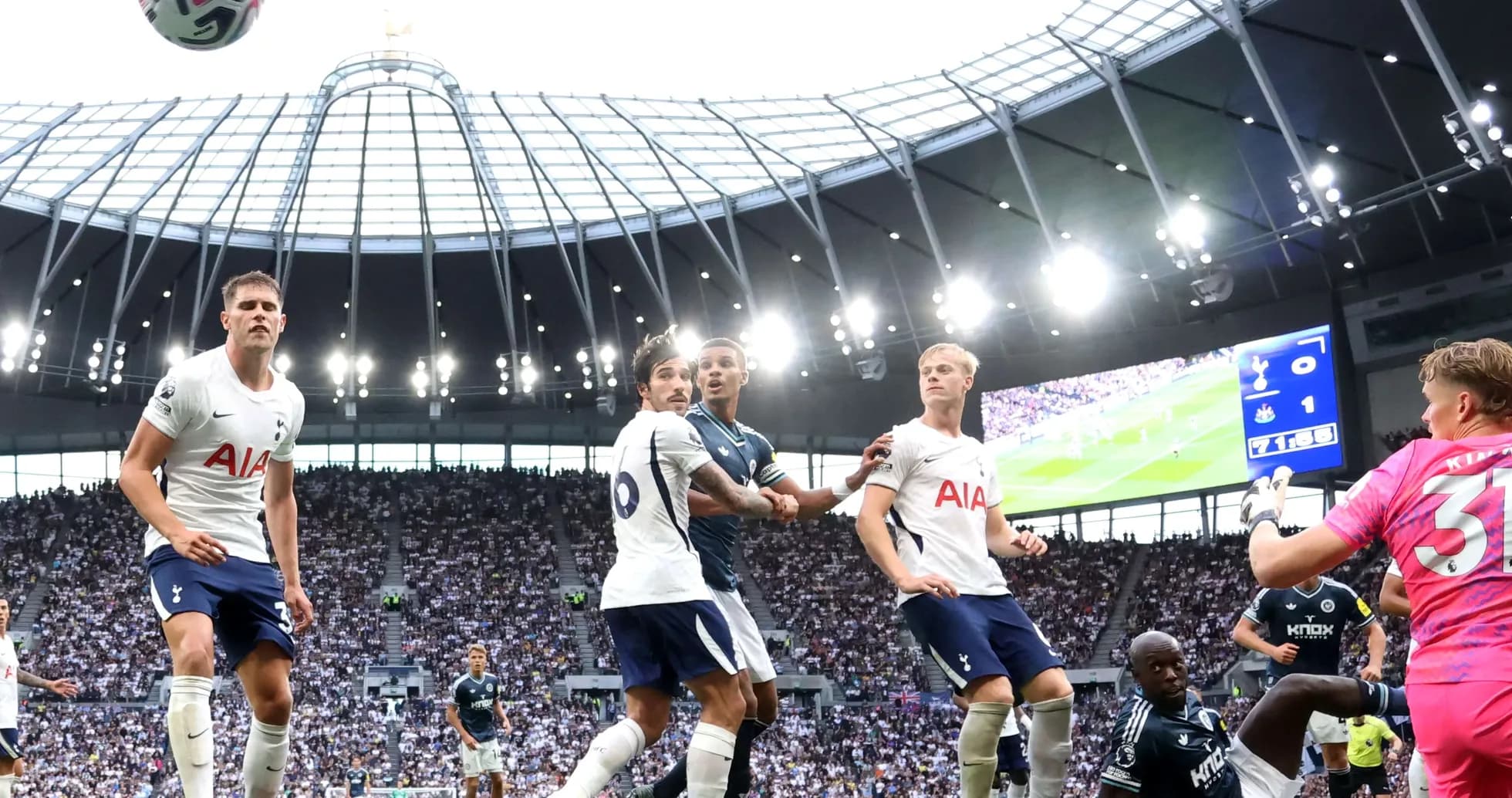
Tottenham vs Newcastle: A Tale of Diverging Trajectories
Under the grey London sky of the Tottenham Hotspur Stadium, this early‑season fixture set two clubs on sharply diverging trajectories. Tottenham, beaten 3‑0 away on the opening weekend, fell 2‑0 at home to Newcastle, leaving them rooted to 20th with 0 points, 0 goals scored and 5 conceded in total. Newcastle, by contrast, departed north with 3 away points, a second unbeaten outing, and a total goal difference of +2 from 4 goals for and 2 against after 2 matches.
I. The Big Picture – Two 4‑2‑3‑1s, opposite moods
Both managers doubled down on a 4‑2‑3‑1, but the same shape told two very different stories.
Roberto De Zerbi’s Tottenham are built on technical control, yet heading into this game they had failed to score in total across 2 league matches, averaging 0.0 goals per game both at home and away. The numbers underline the fragility: in total they had conceded 5, with an average of 2.0 at home and 3.0 on their travels. The league table mirrored the data – 2 defeats from 2, no clean sheets, and a goal difference of −5 (0 scored, 5 conceded).
Matthias Jaissle’s Newcastle arrived with a more balanced profile. In total they had 1 win and 1 draw, 4 goals scored and 2 conceded, averaging 2.0 goals for per match both at home and away, and 1.0 goal against per match overall. Away from home, they had already delivered a 0‑2 win and a clean sheet, suggesting a side comfortable playing without the ball and punishing transitions.
The 2‑0 scoreline at full time felt like the statistical logic of August made flesh: a blunt Tottenham attack running into a Newcastle side that, in total, had yet to lose and had already shown it could manage games from the front.
II. Tactical Voids – Creativity ripped out of Spurs, balance tested at Newcastle
The absences list read like a tactical autopsy for Tottenham’s attacking plan.
Dejan Kulusevski (knee injury), James Maddison (knock), Wilson Odobert (knee injury), Pape Matar Sarr (injury) and Xavi Simons (knee injury) were all missing. Between them, that is a huge portion of Spurs’ ball‑carrying, final‑third passing and vertical thrust. Without Maddison between the lines or Kulusevski driving from the right half‑space, De Zerbi turned to a more improvised creative core: Sandro Tonali and Rodrigo Bentancur as the double pivot, with Pedro Porro, M. Fernandes and Mathys Tel supporting Omar Marmoush.
On paper, it offered fluidity; in practice, it lacked a natural playmaker. The season data had already warned of structural issues: Tottenham had failed to score in both of their league fixtures so far, and had yet to keep a clean sheet at home or away. The yellow‑card pattern – 50.00% of their cautions arriving in the first 15 minutes and another 50.00% in the 31‑45 segment – hinted at a team often chasing, over‑stretching early, and resorting to tactical fouls rather than controlled pressing.
Newcastle’s own absences were significant but more compartmentalised. Dan Burn (ankle injury), Joelinton (injury), Valentino Livramento (hamstring injury) and William Osula (injury) were all out. That removed height on the left, a powerful midfield runner and a dynamic right‑back option. Yet Jaissle could still field a structurally coherent side: L. Hornicek in goal, a back four of Amar Dedic, Malick Thiaw, Sven Botman and Lewis Hall, with Nico and Lewis Miley anchoring midfield.
Crucially, Newcastle’s disciplinary record suggested controlled aggression rather than chaos. Their yellow cards were spread across the game, with a late‑game spike: 28.57% of their cautions arrived between 76‑90 minutes, and 14.29% in each of several earlier windows. That profile fits a side willing to foul to break rhythm late on, but not one that loses its head.
III. Key Matchups – Hunter vs Shield, Engine Room vs Engine Room
Hunter vs Shield: Wissa and Elanga vs a porous Spurs back line
Newcastle’s attacking edge has been sharpened by Anthony Elanga and Yoane Wissa. Heading into this match, Elanga had 2 goals in total from 2 appearances, with 4 shots (3 on target) and a 7.75 average rating. He is Newcastle’s early‑season finisher, the one who turns vertical breaks into scoreboard pressure.
Wissa, nominally a midfielder but functionally a roaming forward, had 1 goal and 1 assist in total, with 6 shots and 2 key passes, plus 8 fouls drawn – a magnet for contact and a constant nuisance between the lines. He also carried 1 yellow card, emblematic of his combative style.
They were up against a Tottenham defence that, in total, had already conceded 5 goals in 2 matches. At home, Spurs had allowed 2 goals; away, 3. The back four of A. Gray, J. P. van Hecke, Micky van de Ven and Andrew Robertson is individually strong, but the collective numbers speak of a unit still learning De Zerbi’s high‑risk, high‑line demands. With no clean sheets in total and an average of 2.5 goals conceded per game, the “shield” was clearly not yet calibrated to the “hunter”.
Engine Room: Tonali and Bentancur vs Nico and Miley
In midfield, the battle was more about rhythm than raw chance creation. Tonali and Bentancur offer control and progression, but without Maddison and Sarr, their passing lanes ahead were flatter and more predictable. Tottenham’s reliance on a 4‑2‑3‑1 in both league matches so far (their only recorded formation this season) shows De Zerbi is insisting on this structure even as personnel change.
For Newcastle, Nico and Lewis Miley formed a double pivot tasked with screening and launching. Behind them, Thiaw and Botman provided an aerial and positional platform; in front, Elanga, Joe Willock and Harvey Barnes offered three different ways to run beyond the ball. Willock, with 1 goal in total and 100% passing accuracy so far, is the understated third‑man runner who can punish any midfield that presses without cover.
The contest in the centre was less about tackles flying in and more about who could create the better passing angles into the half‑spaces. Newcastle, with their more complete attacking cast, had the clearer vertical routes: Dedic overlapping on the right (47 passes, 2 key passes, 4 tackles and 2 successful blocks in total this season) and Wissa drifting inside to combine.
IV. Statistical Prognosis – Why 0‑2 felt inevitable
Even without explicit xG data, the underlying patterns are stark.
Tottenham entered this match with, in total:
- 0 wins, 0 draws, 2 losses
- 0 goals scored, 5 conceded
- 0.0 goals for per game at home and away
- 2.0 goals against per game at home, 3.0 on their travels
Newcastle arrived with, in total:
- 1 win, 1 draw, 0 losses
- 4 goals scored, 2 conceded
- 2.0 goals for per game both home and away
- 0.0 goals against per game away, thanks to a prior 0‑2 win on their travels
Overlay those numbers onto the tactical landscape and the 2‑0 away victory almost writes itself. Newcastle are already comfortable playing compact, then breaking through Elanga, Wissa and Willock. Tottenham, by contrast, are a possession side without end product, missing their primary creators and still leaking goals at both ends of the pitch.
The “Hunter vs Shield” duel was asymmetric: Newcastle’s hunters were in form and statistically sharp; Tottenham’s shield was still full of gaps. In the engine room, Nico and Miley could sit and choose their moments, knowing their forwards would make use of the few clean breaks they engineered.
Following this result, the trajectories harden. Tottenham remain winless, goalless and bottom, their 4‑2‑3‑1 looking like a framework waiting for missing pieces. Newcastle, now with 4 points, a total goal difference of +2 and a perfect defensive record away from home, look every inch a side built to punish exactly this kind of fragile, possession‑heavy opponent.