
Spygate Controversy Overshadows Championship Play-off Final
Kim Hellberg stood in the bowels of St Mary’s, his side’s season over, his voice cracking.
"It breaks my heart," the Middlesbrough head coach said.
He was not talking about the 2-1 extra-time defeat to Southampton. Not about the missed chances, the tired legs, the dream of Wembley slipping away in the south-coast drizzle.
He was talking about Spygate.
A semi-final overshadowed
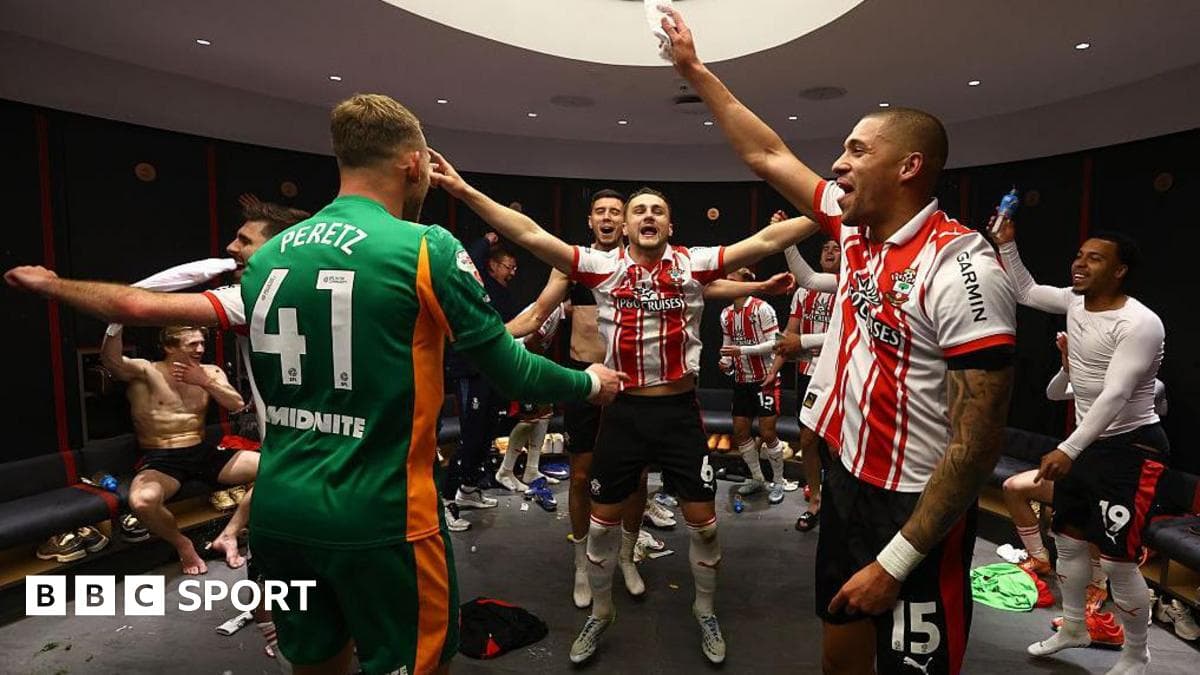
Southampton are in the Championship play-off final. On paper, that is the story. They have a date with Hull City on 23 May, 90 minutes from the Premier League.
But the football has been dragged into the dock. The decisive contest of the EFL season now hangs on the ruling of an independent disciplinary commission, not just on a linesman’s flag or a goalkeeper’s fingertips.
Southampton have been charged by the English Football League with breaching rules by observing one of Middlesbrough’s final training sessions before last Saturday’s first leg at the Riverside.
Boro staff caught the man they say was sent to spy on them, a man who had driven five hours to Rockliffe Park.
"If we hadn't caught that man that they sent up five hours to drive, you would sit there and say well done [to Southampton] in the tactical aspect of the game and I would go home and feel like I've failed," Hellberg said.
"When that is taken away from you – 'we're not going to watch every game, we're going to send someone instead and film the sessions and hope they don't get caught' – it breaks my heart in terms of all the things I believe in."
This is not background noise now. It is the story. It will decide who walks out at Wembley.
A final that may not happen
In any normal year, attention would already be locked on 23 May. Team selection. Nerves. Ticket scrambles.
Instead, there is no guarantee the match will even go ahead as planned.
Southampton have asked for a delay to complete an internal review. The EFL, staring at the calendar and a booked-up Wembley, know time is running out. The governing body has pushed for an expedited hearing.
The Championship play-off final is 10 days away. Tickets must be printed and sold. Trains and hotels will soon fill. Supporters need to know if they are heading for Wembley Way or staying at home.
Yet the season now moves from the pitch to a quiet room, where three people will decide what happens next.
The case has been passed to an independent disciplinary commission, managed by Sport Resolutions. A chair – typically a KC or QC – will sit alongside two side members drawn from sports lawyers, barristers or mediators. Suitability and availability dictate who takes the seats. Speed, in this case, is essential.
Their timeline will not be made public. Their verdict will shape not only this season, but the boundaries of acceptable behaviour in English football.
Saints prepare, Boro wait
On the south coast, the message is clear: carry on.
Even if the celebrations on Tuesday night felt strangely subdued, Southampton have tried to act like a club preparing for a final. On Wednesday morning, they launched a play-off final merchandise range on their website. No fanfare on social media, no triumphalism, but the shop window is dressed for Wembley.
Tickets are due to go on sale on Thursday. Saints fans could end up buying seats for a game they are not allowed to attend.
For head coach Tonda Eckert, the routine remains. Analyse Hull. Plan sessions. Pick a team. He has a match to prepare for until someone tells him otherwise.
Middlesbrough live in limbo.
Rather than plough on with training, the players are expected to be given a few days off, though they cannot disappear to Dubai, Ibiza or the usual post-season boltholes. They must be ready to come back at a moment’s notice. Ready, in their minds at least, for the possibility that they are reinstated.
From the start, Boro have made their stance clear: only a sporting sanction will do. A fine would be an insult, not a solution.
Gibson arms up for a fight
Boro owner Steve Gibson has not sat quietly. He has reportedly turned to Nick De Marco, the go-to sports lawyer for high-stakes disputes with football’s authorities.
De Marco’s track record matters. He played a key role in ensuring Sheffield Wednesday began this season on zero points when a 15-point deduction once looked nailed on. Now he will be pushing for a penalty, not trying to erase one.
If Middlesbrough do not get what they want from the disciplinary commission, Gibson has form for taking matters further.
In 2021, Boro launched legal proceedings against Derby County, claiming the Rams’ financial breaches had cost them a play-off place in 2018-19. The dispute ended in a "resolution" believed to have delivered £2m to Middlesbrough.
If Southampton keep their place in the play-offs and perhaps even win promotion, it would be no surprise to see Gibson pursue a similar compensation route.
A case with no precedent
The EFL wants clarity. Quickly. But the commission steps into almost untouched territory.
There is no neat tariff for this type of offence. No profit and sustainability-style sliding scale. No ready-made precedent that slots neatly into place.
Leeds United’s notorious spying episode at Derby County in 2019 is the obvious reference point. Marcelo Bielsa admitted sending a staff member to watch Derby train. Leeds were fined £200,000.
Two crucial differences stand out.
At the time, there was no specific rule banning clubs from watching opponents’ training sessions. Leeds were charged under regulation E.4, which demands clubs act in the "utmost good faith" towards each other.
The fallout from that case helped usher in regulation 127, which now explicitly states: "no club shall directly or indirectly observe (or attempt to observe) another club's training session in the period of 72 hours prior to any match".
Southampton have been charged with breaching both E.4 and 127. They have not tried to deny the allegations.
Then there is timing. Bielsa’s spy was caught in mid-January, in the long slog of a league season. Important, but not decisive.
Southampton’s alleged spying came in the build-up to a play-off semi-final – one of the most consequential fixtures of the year, a gateway to the Premier League and its riches.
At Boro, the feeling is blunt: if Saints go on to beat Hull and secure promotion, Premier League money will dwarf any financial penalty. A fine alone would feel like a small parking ticket on a luxury car.
Middlesbrough want Southampton thrown out of the play-offs.
The nuclear options
How would that even work?
The most obvious route would be to award Boro a default 3-0 win for the first leg at the Riverside, overturning the original result and handing them a 4-2 aggregate victory.
It would be dramatic, but not entirely without precedent. In 2002, West Bromwich Albion were awarded a 3-0 win after their match against Sheffield United was abandoned. United had three players sent off and two injured who could not be replaced, leaving them below the minimum seven players required. The game could not continue; the record books gave Albion the points.
Throwing Southampton out would be the modern equivalent of a red button. The nuclear option.
There is a softer route: a points deduction. That would allow the commission to impose a sporting sanction while stopping short of expelling Saints from the play-offs.
If Southampton go up, the EFL cannot itself apply the penalty in the Premier League. It can, however, recommend to the Premier League board that the deduction carries over into the top flight.
Whatever the punishment, it must do two things: feel fair to those wronged, and warn every other club that spying, particularly before a game of this magnitude, carries real consequences.
Silence from the south coast
Southampton have largely closed ranks. The club’s media officer has shut down attempts to question Eckert on the issue. Publicly, at least, there is little appetite to explain.
Behind closed doors, serious questions hang over the coaching staff.
Who knew what, and when? Was there a live stream of Middlesbrough’s session? Was footage stored, shared, dissected on laptops in a hotel meeting room? Or was this, as Southampton may argue, a rogue operative acting alone, a "lone wolf" who drove to Rockliffe Park 24 hours before the squad flew north, without instruction?
Hellberg is adamant. "There's someone who makes decisions to go and try to cheat," he said after Tuesday’s match.
The commission will have to decide which version of events to believe – and who should pay the price.
There is even scope for individual sanctions. At the 2024 Olympics women’s football tournament in Paris, Fifa deducted six points from Canada after they were found to have spied on New Zealand using a drone. Three members of Canada’s staff, including the head coach, received one-year bans from all football.
Could members of Southampton’s coaching team face similar personal penalties? Handed bans that outlast any fine or points deduction?
Fans caught in the crossfire
One argument keeps surfacing: what about the fans?
Southampton supporters have followed their team around the country all season. Across 48 games, their side have earned the right, on the table at least, to play for promotion. Should they suffer for decisions taken in a backroom or on a training ground perimeter?
Yet without sporting sanctions, the message to the game is clear: push the boundaries, take the risk. If the worst outcome is a cheque, why not test the line?
If Saints are lining up in the Premier League next season with only a financial slap on the wrist, where is the real deterrent?
Somewhere in the coming days, three people in a hearing room will decide where that line is drawn.
They will not just be ruling on Southampton v Middlesbrough. They will be defining what clubs can and cannot do in the pursuit of promotion, in an era where every marginal gain is chased, and every secret session can be watched from a hedge, a car, or a drone.
The play-off final is coming. The tickets are ready. The shirts are printed.
The only thing missing, for now, is certainty over who has earned the right to walk out at Wembley.





