Slovan Bratislava vs Celje: Tactical Insights from a 1-1 Draw
Slovan Bratislava and Celje produced a finely balanced 1-1 draw at Tehelne Pole Stadion, a match defined more by structure and control than chaos. Both sides finished with identical 50% possession and a goal apiece, but they arrived there via contrasting tactical routes: Slovan through territorial pressure and volume of efforts, Celje through compact defending and sharp transitions.
Tactical Setup
Yaya Toure set Slovan Bratislava up in a 4-3-3 that behaved like a classic home-side Champions League qualifying blueprint: full-backs high, wide forwards aggressive, and a midfield three tasked with both circulation and counter-pressing. The shot profile underlines that intent. Slovan generated 14 total shots to Celje’s 8, with 9 of those from inside the box. The home side consistently managed to work the ball into dangerous central areas, but only 2 of their 14 attempts hit the target, a glaring efficiency issue that ultimately defined the night.
In possession, Slovan were methodical rather than frantic. They completed 380 of 465 passes (82%), a solid technical base that allowed them to pin Celje back for long spells. The midfield triangle, built around P. Pokorny and A. Mustafic from the start, gave Slovan the platform to keep Celje under pressure, especially down the flanks where C. Blackman and S. Cruz pushed on from full-back. The 4-3-3 morphed into a 2-3-5 in settled attacks, with both wide forwards, T. Barseghyan and S. Camara, holding width while R. Cerepkai operated more centrally.
First Half
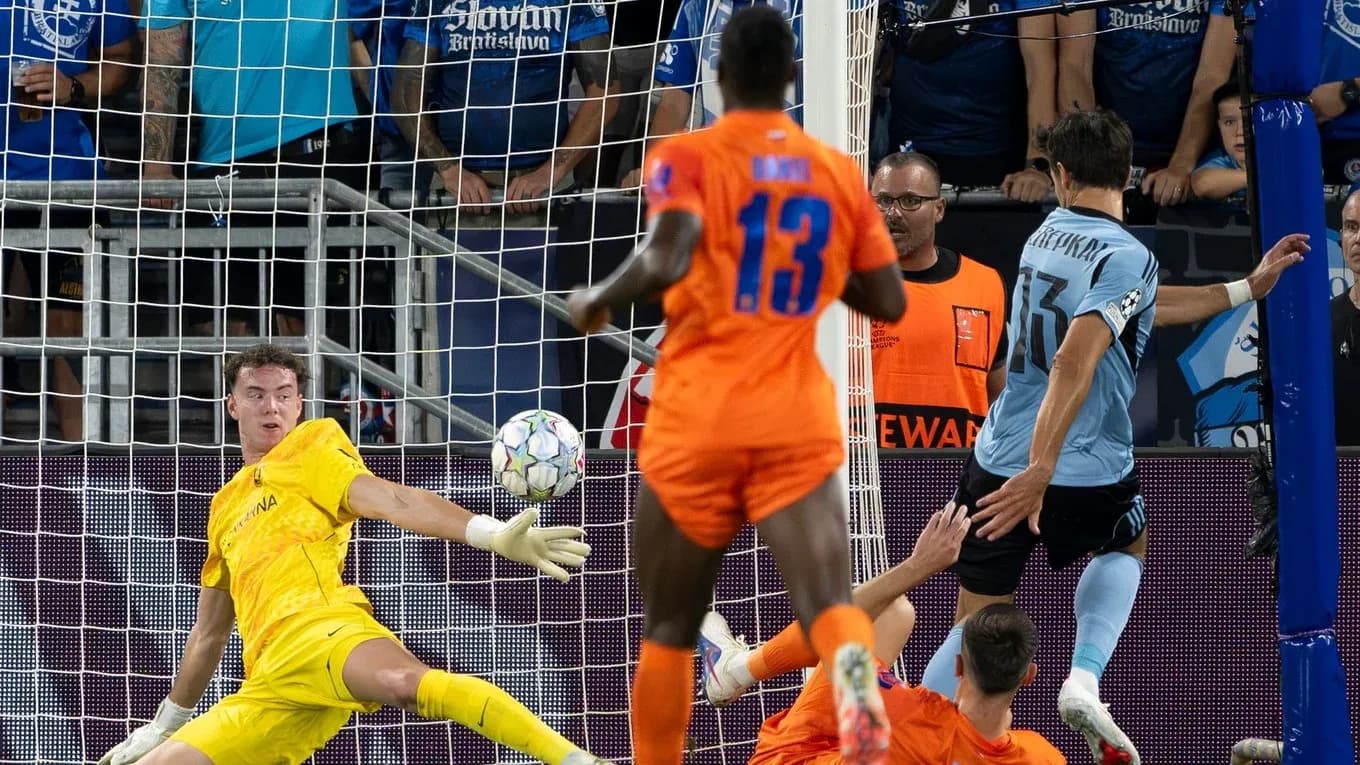
The early breakthrough on 15 minutes, with R. Cerepkai finishing from a C. Martinez assist, was a textbook example of Slovan’s positional play paying off: occupation of the half-spaces, quick combination in the final third, and a central runner arriving in the box. That they failed to add a second despite their territorial dominance is explained by the combination of blocked lanes and poor final execution. Six of Slovan’s 14 shots were blocked, showing how often Celje managed to get bodies in front of attempts, and the low shots-on-goal count (2) reveals a recurring problem in turning promising positions into clean looks at goal.
Defensive Structure
Out of possession, Slovan’s 4-3-3 pressed selectively rather than relentlessly. Their foul count (12) was moderate, and the two yellow cards – K. Bajric and C. Blackman both for “Roughing” – reflected isolated aggressive interventions rather than systemic ill-discipline. The back four generally held a medium line, trying to compress space between the lines while accepting that Celje would occasionally break behind via direct passes or switches.
In goal, D. Takac (Slovan Bratislava) was asked to do less in volume but more in terms of concentration. Celje hit the target 4 times, yet the Slovan goalkeeper registered 3 saves. That indicates that, aside from the equaliser by M. Avdyli, Takac handled what came his way with reasonable assurance. The fact Celje created fewer total shots but more shots on goal (4 vs Slovan’s 2) hints that when they did attack, they were able to engineer clearer, more direct chances.
Celje's Approach
Vitor Campelos’ Celje lined up in a 4-2-3-1 that was unapologetically pragmatic. With only 8 total shots and no corner kicks across the 90 minutes, they accepted long periods without the ball and focused on defensive structure. The double pivot of P. Daniel and M. Zabukovnik shielded the back four, often dropping into the back line to form a situational back five in deeper phases. This compactness forced Slovan to shoot from suboptimal positions or through crowds, feeding into the high number of blocked efforts.
Their attacking plan revolved around quick verticality and exploiting Slovan’s advanced full-backs. The equaliser on 41 minutes, scored by left-back M. Avdyli from an assist by M. Kvesic, epitomised Celje’s capacity to break with purpose: a wide overload, a well-timed run from deep, and a decisive finish. Even with fewer forays forward, Celje’s front four – S. Seslar, M. Ivansek, M. Kvesic and A. Kucys as the striker – were efficient in turning limited possession into meaningful entries, as reflected by their 4 shots on goal.
Discipline and Passing
Discipline-wise, Celje walked a fine line. They committed 13 fouls and picked up two yellow cards, both tied to duels in central areas: M. Avdyli for “Roughing” and M. Zabukovnik for “Tripping”. These cautions were the by-product of a strategy that relied heavily on disrupting Slovan’s rhythm between the lines, especially when the home midfield tried to accelerate play.
With the ball, Celje were quietly tidy. They completed 402 of 487 passes (83%), marginally outpacing Slovan in accuracy. Rather than long spells of circulation, their passing quality showed in their ability to play out of pressure in pockets and then switch quickly to the far side or into the channels. The lack of corner kicks underscores how rarely they sustained pressure in the final third; their attacks tended to be sharp and short-lived, either ending in a shot or being broken up before they could force set pieces.
Goalkeeping Performance
In goal, Z. Leban (Celje) had a relatively light but high-stakes evening. Slovan’s 2 shots on target meant the Celje goalkeeper was called upon sparingly, registering 1 save. The rest of his contribution was about command of area and positioning behind a back line that blocked a significant share of attempts before they reached him.
Substitution Patterns
The substitution patterns confirmed the tactical intentions. Slovan’s changes – introducing A. Yirajang for R. Cerepkai, D. Matsuoka for A. Mustafic, M. Kianga for S. Camara, then R. Ibrahim for C. Martinez and A. Sporar for T. Barseghyan – were aimed at refreshing energy in all three lines while preserving the 4-3-3 structure and attacking posture. Celje’s alterations, including B. Verbic for M. Ivansek, A. Kotnik for A. Kucys, A. Dionkou for P. Sirvys, I. Calusic for P. Daniel and Y. Dukuly for M. Kvesic, maintained the 4-2-3-1 shell but added fresh legs to protect the flanks and sustain counter-attacking threat.
Conclusion
Statistically and tactically, the draw feels like a fair outcome. Slovan’s greater volume and box presence were offset by Celje’s superior shot quality and compact defending. Both sides showed clear identities: Slovan as a ball-dominant, territory-focused 4-3-3; Celje as a disciplined, transition-oriented 4-2-3-1. Over two legs, this balance of styles sets up a finely poised tie where marginal gains in finishing and set-play execution could prove decisive.