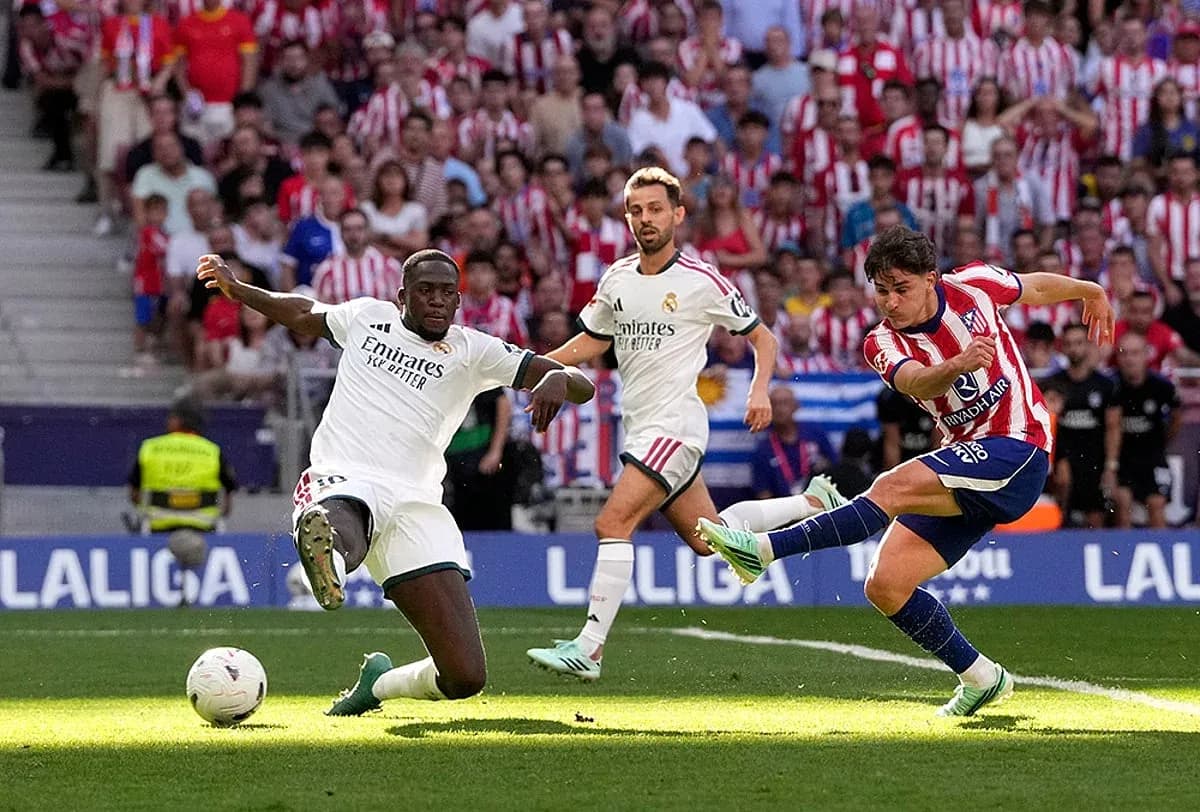
Sevilla vs Real Madrid: Tactical Showdown in La Liga
Under the late-afternoon heat of the Estadio Ramón Sánchez Pizjuán, Sevilla’s season-long tightrope walk met Real Madrid’s title-chasing relentlessness – and, in the end, the hierarchy held. Following this result, the 1–0 away win preserved Madrid’s status as La Liga’s most ruthless travellers, while Sevilla’s mid-table reality was laid bare in a performance that was organised, brave, but ultimately blunt.
I. The Big Picture – Styles Colliding in Round 37
This was Round 37 of La Liga, with Sevilla entering the day in 13th place on 43 points and a goal difference of -13, a team defined by volatility: 12 wins, 7 draws, 18 defeats overall, scoring 46 and conceding 59. At home they have been almost perfectly balanced – 7 wins, 4 draws, 8 losses, with 24 goals for and 25 against – but that balance is fragile, not dominant.
Real Madrid arrived in Sevilla as the league’s juggernaut in everything but name, sitting 2nd with 83 points and a goal difference of 40, built on 26 wins, 5 draws and just 6 defeats. On their travels they had won 11 of 19, drawing 4 and losing 4, with 32 goals scored and only 19 conceded. Their seasonal DNA is clear: 2.0 goals scored per game overall, just 0.9 conceded, and 14 clean sheets in total – a machine that usually finds a way.
The formations told their own story. Luis Garcia Plaza rolled out a classic 4-4-2, with O. Vlachodimos behind a back four of José Ángel Carmona, Castrin, K. Salas and G. Suazo, a narrow, workmanlike midfield of R. Vargas, N. Gudelj, D. Sow and Oso, and a front pair of A. Adams and N. Maupay. It was a structure designed for compactness, second balls and direct transitions.
Alvaro Arbeloa answered with a 4-3-3 that was pure Real Madrid: T. Courtois in goal; D. Carvajal, A. Rudiger, D. Huijsen and F. Garcia across the back; a midfield triangle of T. Pitarch, A. Tchouameni and J. Bellingham; and a front three of B. Diaz, K. Mbappe and Vinicius Junior. On paper, it was an XI built to dominate territory and isolate Sevilla’s defenders in wide and half-space duels.
II. Tactical Voids – Absences and Discipline
Both squads arrived scarred. Sevilla were again without M. Bueno (knee injury) and Marcao (wrist injury), stripping depth and aerial presence from the defensive unit. That absence helps explain why Garcia Plaza trusted Castrin and K. Salas centrally, keeping his full-backs relatively conservative against Madrid’s wingers.
Madrid’s missing list was even longer, but crucially, not structurally fatal. D. Ceballos (coach’s decision), Eder Militao and A. Guler (muscle injuries), A. Lunin (illness), F. Mendy (muscle injury), Rodrygo (knee injury) and F. Valverde (head injury) all sat this one out. Yet Arbeloa could still field Mbappe, Vinicius Junior and Bellingham, plus a back line anchored by Rudiger. The depth of the squad allowed them to absorb absences that would cripple most sides.
From a disciplinary perspective, the underlying season data framed the risk. Sevilla’s card profile shows a pronounced late-game spike: 19.81% of their yellow cards arrive between 76–90 minutes, and a further 20.75% between 91–105. Their red cards are evenly scattered, with 20.00% in each of the 16–30, 31–45, 61–75 and 76–90 windows. Madrid, by contrast, cluster yellows between 31–75 minutes, with 19.12% in the 31–45 range and 22.06% between 61–75, while their reds flare late, with 28.57% in the 91–105 window.
This match, decided 1–0, never fully boiled over, but those profiles mattered: Sevilla’s need to chase the game in the final quarter came with built-in disciplinary danger, especially for combative figures like Carmona and the benched but ever-aggressive L. Agoume.
III. Key Matchups – Hunter vs Shield, and the Engine Room
The headline duel was always going to be Kylian Mbappe against Sevilla’s defensive structure. Heading into this game, Mbappe had 24 league goals and 5 assists, from 105 shots (61 on target), plus 8 penalties scored but 1 missed. He is not only a finisher but a volume shot-taker and high-usage dribbler, with 145 attempts and 76 successes. Against a Sevilla side conceding 1.3 goals at home on average and 1.6 overall, the Hunter arrived with every statistical edge.
The Shield was collective rather than individual. Sevilla’s defence at home had allowed 25 goals in 19 matches, an average of 1.3, but only 3 home clean sheets overall. The central pairing of Castrin and K. Salas had to compress space, while G. Suazo and Carmona were tasked with the impossible balance of containing both Mbappe/Vinicius Junior and supporting transitions.
Carmona, La Liga’s leading yellow-card collector with 13 bookings, encapsulates Sevilla’s risk-reward profile. He has made 64 tackles and blocked 9 shots this season, an aggressive defender who steps forward rather than holds the line. Against Vinicius Junior – 16 goals, 5 assists, 75 shots, 195 dribbles attempted and 87 completed – that front-foot style is both weapon and liability. The Brazilian thrives when defenders dive in; Carmona thrives when attackers hesitate. Over 90 minutes, Vinicius’s constant duels (403 this season, 197 won) and drawn fouls (81) were always likely to stretch Sevilla’s right side to breaking point.
Up front, Sevilla’s hope was A. Adams. With 10 goals and 3 assists, 30 shots on target from 48 attempts, and 4 successful blocks defensively, Adams is a classic penalty-box reference who also works without the ball. His battle was primarily with Rudiger and Huijsen, the latter not just a passer (1643 completed passes at 89% accuracy) but a defender who has blocked 17 shots this season and won 96 of 155 duels. Huijsen’s single red card in the campaign underlines his willingness to defend on the edge; here, his timing against Adams was immaculate.
In the engine room, the duel between J. Bellingham and Sevilla’s double axis of N. Gudelj and D. Sow framed the midfield narrative. Gudelj’s remit was to screen, to narrow the lanes into Mbappe’s feet and Bellingham’s late surges, while Sow’s legs had to shuttle out to R. Vargas and Oso when Sevilla tried to break. On the other side, A. Tchouameni’s presence allowed Bellingham to push higher, trusting Madrid’s defensive record – just 33 goals conceded overall, 19 away – to hold even when the full-backs advanced.
IV. Statistical Prognosis – Why 1–0 Felt Inevitable
Even without explicit xG numbers, the season-long data offers a clear Expected Goals narrative. Madrid, averaging 2.3 goals at home and 1.7 away, simply generate more and better chances than almost anyone. Sevilla, with 1.3 goals scored at home and 1.2 overall, live on thinner margins. Against a side that has kept 8 clean sheets away and failed to score away only twice, Sevilla’s path to victory required near-perfect efficiency.
Instead, the match followed the probabilities. Madrid’s front three repeatedly pulled Sevilla’s back four into wide and deep spaces, while Bellingham and T. Pitarch occupied the pockets that Gudelj and Sow could not always close. The single goal – fittingly in a game where Madrid often win by narrow but controlled margins – reflected their ability to convert pressure into at least one decisive moment.
For Sevilla, the 4-4-2 brought organisation but limited progression. R. Vargas, with 6 assists this season and 28 key passes, tried to be the creative hinge from the right, yet Madrid’s pressing lanes and Tchouameni’s covering angles starved Adams and Maupay of sustained service. When Garcia Plaza turned to his bench – options like L. Agoume, Joan Jordan, Peque or Isaac Romero – the pattern shifted in energy but not in outcome. Madrid, with Courtois commanding and Rudiger and Huijsen unmoved, saw the game out with the calm of a side accustomed to defending one-goal leads.
Following this result, the story is less about surprise and more about confirmation. Sevilla remain a spirited but flawed 13th-placed side whose home numbers mirror their inconsistency. Real Madrid, even rotated and depleted, still look every inch a 2nd-placed powerhouse: structurally sound, individually devastating, and statistically wired to win matches exactly like this – by doing just enough, and rarely any less.