Real Madrid's Methodical 2-0 Victory Over Oviedo
Real Madrid’s 2-0 win over Oviedo at Estadio Santiago Bernabéu was a methodical, control-heavy performance shaped by structural superiority in possession and a clear territorial plan rather than sheer volume of chances. In a La Liga context, it was the archetypal big-side home display: 65% of the ball, 616 passes and a back line rarely stretched, but with enough incision around the box to translate dominance into two well-timed goals.
Executive Summary
Across the 90 minutes, Alvaro Arbeloa’s 4-4-2 functioned as a high-possession, asymmetrical attacking system that consistently pinned Oviedo’s 4-3-3 deep. Real Madrid’s midfield box around Eduardo Camavinga and Aurelien Tchouameni gave them overwhelming control of central zones, while the front pairing of G. Garcia and Vinicius Junior exploited half-spaces and wide channels. Oviedo, under Guillermo Almada Alves Jorge, were forced into a reactive, counter-punch approach: 35% possession, nine total shots and just one on target. Their xG of 1.03 suggests a few dangerous moments, but they lacked sustained attacking structure.
Scoring Sequence & Disciplinary Log
Goal verification from events:
- 44' G. Garcia (Real Madrid) — assisted by B. Diaz
- 80' J. Bellingham (Real Madrid) — assisted by K. Mbappe
This matches the final score of Real Madrid 2-0 Oviedo, with both goals for the home side and none for the visitors. There are no yellow or red cards recorded in the events, and the statistics confirm zero cards for both teams. Therefore:
- Real Madrid: 0, Oviedo: 0, Total: 0
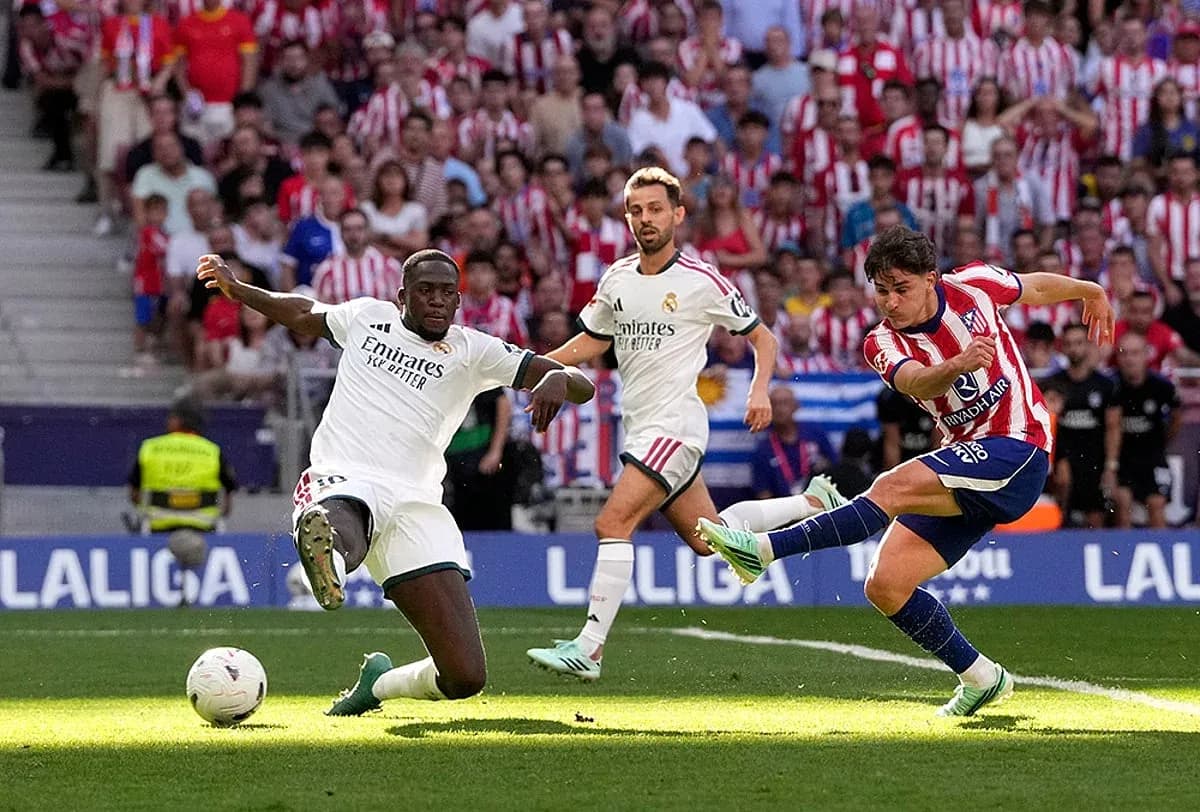
Chronologically, Real Madrid broke the deadlock at 44'. With Oviedo’s block compressed in front of the box, Brahim Diaz found a pocket between the lines and slipped a decisive pass into G. Garcia. The forward’s movement off the shoulder of the centre-backs was rewarded, and he finished clinically for 1-0, a goal that validated Madrid’s territorial dominance before half-time.
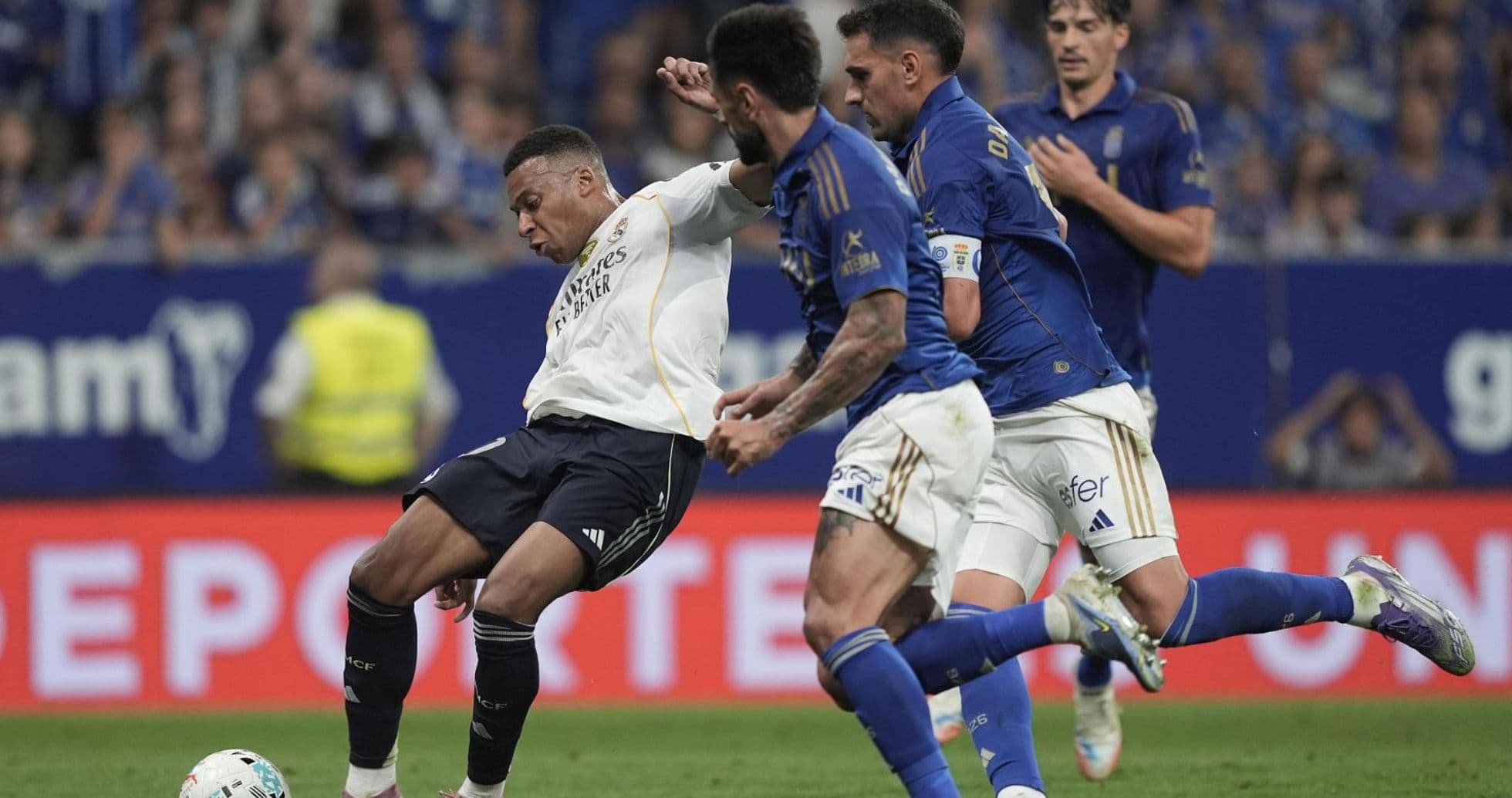
The second half’s key tactical moment came on 80', when J. Bellingham, introduced from the bench, doubled the lead. K. Mbappe, also on as a substitute, provided the assist, underlining the impact of Arbeloa’s changes. Mbappe’s presence stretched Oviedo’s back four vertically and horizontally; Bellingham’s late arrival into the box was perfectly timed, and he converted to make it 2-0, effectively sealing the match.
With no cards and no VAR interventions listed, the game’s disciplinary and review profile remained clean and uninterrupted, allowing the tactical flow to be dictated almost entirely by structure and substitutions.
Tactical Breakdown & Personnel
Arbeloa’s nominal 4-4-2 was in practice a flexible, possession-first system. T. Alexander-Arnold at right-back and A. Carreras on the left played high and narrow in build-up, often creating a three-plus-one structure with D. Alaba and R. Asencio as central distributors and Tchouameni dropping to assist circulation. This underpinned Madrid’s 65% possession and 616 passes (570 accurate, 93%), reflecting a high technical baseline and patient progression.
In midfield, Camavinga and Tchouameni controlled the rhythm. Their double pivot allowed the wide midfielders, F. Mastantuono on the right and B. Diaz on the left, to push inside and combine. Diaz, in particular, was central to Madrid’s chance creation, registering the assist for G. Garcia’s opener and frequently drifting between Oviedo’s lines. The four-man midfield often morphed into a box with one forward dropping off, making it difficult for Oviedo’s three central midfielders to maintain access.
Up front, G. Garcia and Vinicius Junior offered complementary profiles. Garcia played more as a reference point and penalty-box finisher, evidenced by his 44' goal from close range. Vinicius roamed wider, stretching Oviedo’s back line and creating one-v-one scenarios that opened central lanes for late runners. Madrid’s shot profile—19 total shots, 11 inside the box—speaks to how effectively they reached dangerous central zones.
The substitutions sharpened this structure rather than altering it radically. At 64', D. Carvajal (IN) came on for T. Alexander-Arnold (OUT), adding defensive assurance and more conservative positioning on the right as Madrid protected their lead. Simultaneously, J. Bellingham (IN) replaced A. Tchouameni (OUT), injecting vertical running and late-box arrivals into midfield. On 69', K. Mbappe (IN) came on for G. Garcia (OUT), shifting Madrid into a more transition-ready shape; Mbappe’s pace threatened depth and forced Oviedo’s back line to retreat, creating space between the lines. Later, C. Palacios (IN) for B. Diaz (OUT) and D. Yanez (IN) for F. Mastantuono (OUT) at 77' maintained intensity and fresh legs in wide and advanced midfield roles.
Defensively, Real Madrid’s structure was rarely broken. They conceded only nine shots, just one on target, and T. Courtois required only one save. His goals prevented figure of 0.16 indicates he dealt competently with the limited danger presented. The low foul count (7) suggests Madrid defended largely through positioning and counter-press rather than last-ditch interventions.
Oviedo’s 4-3-3, by contrast, was pinned back for long stretches. With 325 passes (275 accurate, 85%) and 35% possession, they were forced into a more direct, opportunistic approach. The front three of I. Chaira, F. Vinas and T. Fernandez struggled to receive in advantageous positions, often isolated against Madrid’s back four. Their xG of 1.03, with only one shot on target, implies that when they did reach good areas, the final action lacked precision or was well-managed by Courtois and his defence.
Guillermo Almada Alves Jorge’s substitutions were aimed at injecting creativity and experience: S. Cazorla (IN) for I. Chaira (OUT) at 54' to improve ball retention and progression; H. Hassan (IN) for T. Fernandez (OUT) at 69' to add direct running; and later L. Ahijado (IN) for N. Vidal (OUT) and P. Agudin (IN) for N. Fonseca (OUT) at 79' to refresh the right flank and midfield. However, Madrid’s control of central zones and their compact rest defence meant Oviedo’s changes had limited structural impact.
The Statistical Verdict
The statistical profile supports the tactical reading. Real Madrid’s 19 shots to Oviedo’s 9, with a 7-1 advantage in shots on goal, aligns with their territorial dominance. Yet the xG values—1.46 for Madrid versus 1.03 for Oviedo—suggest that while Madrid took more shots, the overall chance quality gap was narrower than the scoreline might imply. This reflects Madrid’s ability to repeatedly reach the box (11 shots inside) but also Oviedo’s occasional, relatively clear opportunities.
Madrid’s passing superiority—616 passes, 570 accurate (93%)—underpinned their control, compared with Oviedo’s 325 passes, 275 accurate (85%). The foul differential (7 for Madrid, 14 for Oviedo) illustrates how the visitors were often reacting late to Madrid’s circulation and movements. In goal, Courtois’ single save and 0.16 goals prevented show a largely comfortable evening, while A. Escandell’s five saves and identical 0.16 goals prevented underline that Oviedo’s goalkeeper performed reliably but could not offset the structural imbalance in front of him.
Overall, Real Madrid translated systemic control into a professional 2-0 victory, with the bench—Mbappe and Bellingham—providing the decisive second blow that their sustained dominance deserved.