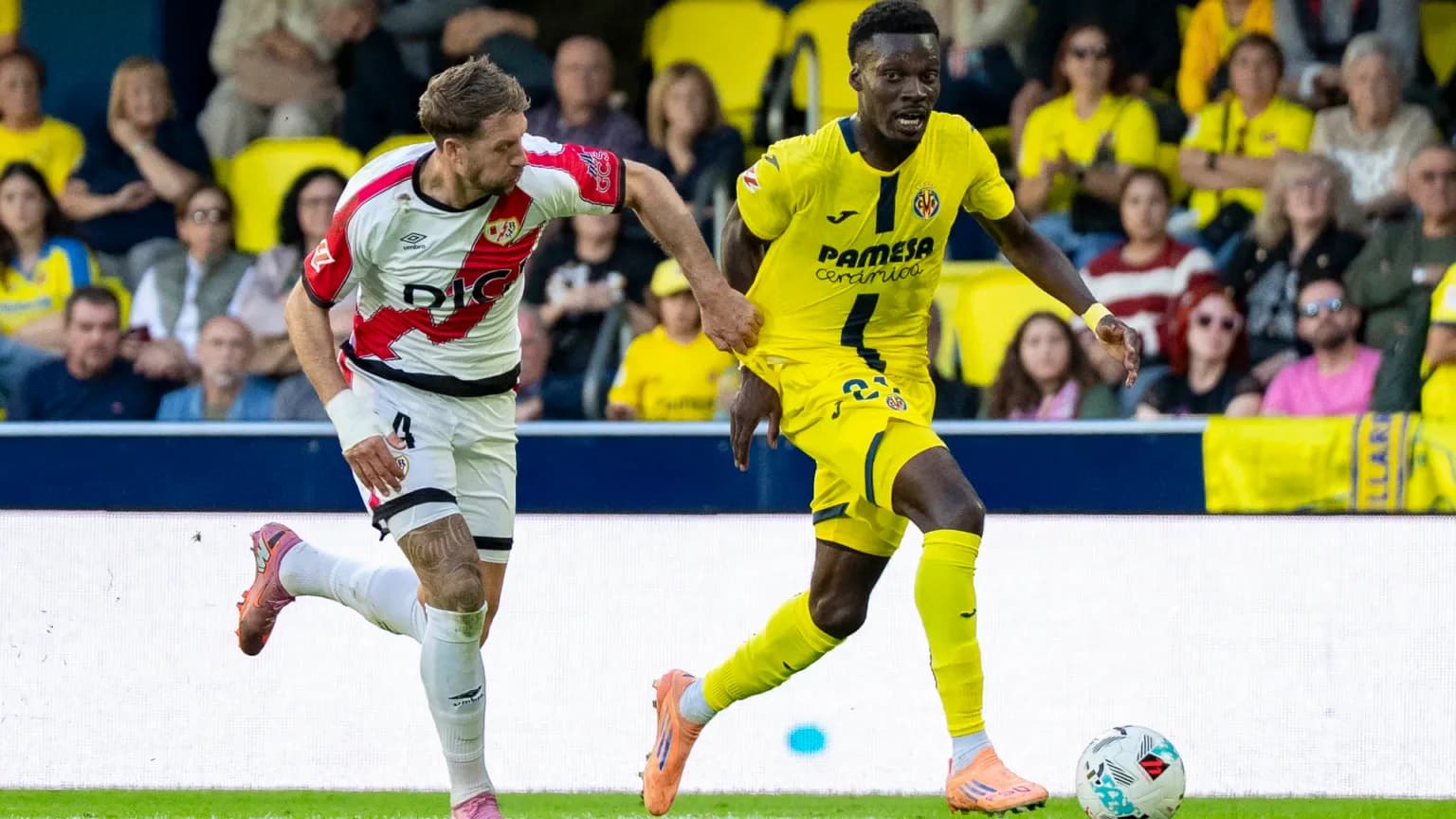
Rayo Vallecano Defeats Villarreal 2-0: A Tactical Analysis
The evening had already delivered its verdict in Vallecas. Under the tight confines of Campo de Futbol de Vallecas, Rayo Vallecano out-thought and out-fought Villarreal, claiming a 2–0 win that said as much about their collective identity as it did about the league table.
I. The Big Picture – Vallecas bends the hierarchy
Following this result in La Liga’s Regular Season - 37, the numbers frame the upset. Rayo sit 8th with 47 points, their overall goal difference at -4, the product of 39 goals for and 43 against across 37 matches. Villarreal, for all their status and firepower, remain 3rd on 69 points, with a far more muscular overall goal difference of +22 (67 scored, 45 conceded).
The contrast in seasonal DNA is stark. Rayo have built their campaign on home resilience: at home they have played 19 times, winning 7, drawing 10 and losing just 2, with 24 goals for and 15 against. That translates into a home average of 1.3 goals scored and 0.8 conceded per game. Villarreal, by contrast, are a juggernaut overall but more human away. On their travels they have played 19, winning 7, drawing 5 and losing 7, scoring 24 and conceding 27 – an away average of 1.3 goals scored and 1.4 conceded.
This match, then, was a collision between one of La Liga’s most stubborn home sides and an away side that scores freely but always leaves a door ajar. Over 90 minutes, Rayo’s 4-2-3-1 under Inigo Perez suffocated Marcelino’s 4-4-2, turning Villarreal’s usual vertical menace into a series of broken lines.
II. Tactical Voids – Suspensions and scars
Both teams arrived carrying absences that shaped the narrative. Rayo were without I. Palazon, suspended after a red card, and robbed of his blend of creativity and needle. His season tells its own story: 10 yellow cards and 1 red, plus 2 penalties scored and 1 missed, the very definition of a high-risk, high-impact winger. Add injuries to A. Garcia, Luiz Felipe and D. Mendez, plus the muscle issue for I. Akhomach, and Perez had to lean heavily on the available core.
That core was visible in the starting XI: A. Batalla in goal behind a back four of A. Ratiu, P. Ciss, F. Lejeune and P. Chavarria. In midfield, U. Lopez and O. Valentin anchored the double pivot, with J. de Frutos, O. Trejo and S. Camello operating behind the lone striker Alemao.
On the Villarreal side, the absences of J. Foyth and R. Veiga, plus P. Cabanes, subtly eroded Marcelino’s defensive options and rotational flexibility. S. Mourino, one of La Liga’s most combative defenders with 10 yellow cards and 1 yellow-red this season, had to shoulder even more responsibility in the back line alongside W. Kambwala, R. Marin and S. Cardona in front of A. Tenas.
Disciplinary tendencies were always going to matter. Rayo’s season card profile shows a yellow-card peak between 61-75 minutes at 19.80% and another late swell from 76-90 at 15.84%, while their reds spike from 61-90, including 22.22% in the 76-90 range. Villarreal, meanwhile, are at their most combustible late: 25.32% of their yellows arrive from 76-90, and 66.67% of their reds also fall in that window. In a tight game, those patterns threaten to tilt control in the final quarter.
III. Key Matchups – Hunter vs Shield, Engine Room vs Enforcer
The “Hunter vs Shield” duel was written down Rayo’s right and Villarreal’s left. J. de Frutos, Rayo’s leading scorer with 10 league goals, started wide but drifted into half-spaces. His season profile – 49 shots, 28 on target and 30 key passes – makes him both finisher and facilitator. Up against a Villarreal defence that concedes an away average of 1.4 goals per game, he became the spearhead of every counter and transition.
Behind him, A. Ratiu was quietly decisive. Over the season he has produced 4 assists, 38 interceptions and 7 blocked shots, and his 1316 completed passes at 82% accuracy underline how often he is the outlet to escape pressure. In this match, his overlapping runs and recovery sprints limited Villarreal’s wide threats, especially from T. Buchanan and A. Moleiro.
For Villarreal, the primary hunter on the night was meant to be A. Perez and T. Oluwaseyi, but the broader attacking aura of the team still revolved around their season’s stars on the bench: G. Mikautadze and N. Pepe. Mikautadze’s 12 goals and 6 assists, supported by 51 shots (29 on target) and 26 key passes, usually stretch defensive lines, while Pepe’s 8 goals and 6 assists with 55 key passes and 121 dribble attempts make him one of the division’s most direct threats. Yet from the start, Villarreal’s 4-4-2 looked more static than usual, with A. Moleiro – 10 goals and 5 assists, 36 key passes – having to drop deeper to connect play.
In the “Engine Room” duel, U. Lopez and O. Valentin had to survive the storm of S. Comesana and P. Gueye. Comesana, Villarreal’s metronome, has completed 1208 passes at 83% accuracy, with 27 key passes and a defensive line of 46 tackles, 15 blocks and 30 interceptions. He is both playmaker and enforcer, and his disciplinary record – 5 yellows and 1 red, plus a penalty conceded – hints at the edge he brings.
But in Vallecas, the engine belonged to Rayo. P. Ciss, deployed as a centre-back, brought his midfielder’s aggression into the back line. Over the season he has blocked 16 shots and made 35 interceptions, and that sense of stepping out to break Villarreal’s rhythm was key. Each time Villarreal tried to punch vertical passes into the front two, Ciss and Lejeune squeezed the space, with Lopez sweeping the second balls.
IV. Statistical Prognosis – Why this 2–0 made sense
Following this result, the numbers do not feel like an anomaly; they feel like an expression of trends. Rayo’s home average of 1.3 goals scored against Villarreal’s away average of 1.4 conceded sits almost exactly on the 2–0 margin they produced. Their home defensive average of 0.8 goals conceded per game held firm against a Villarreal attack that, away from home, averages 1.3 goals.
Rayo’s season-long habit of clean sheets at home – 8 in 19 matches – aligned with Villarreal’s modest away record of just 3 clean sheets in 19. In a game where the home side controlled the tempo and the visitors chased, the xG balance would logically tilt towards Rayo: structured possession, clearer chances, and a defence drilled in suffering without breaking.
In tactical terms, Perez’s 4-2-3-1 strangled the central channels where Villarreal’s creators thrive, forcing them wide and into crosses against a back line that thrives on aerial duels and blocked shots. Marcelino’s 4-4-2, so devastating when it can run in waves, was reduced to isolated forays, starved of the usual rhythm from Comesana and Moleiro.
In Vallecas, hierarchy bent to structure and context. A top-three side with a +22 goal difference ran into one of the league’s most awkward home puzzles – a team that concedes just 0.8 goals per game at home and has forgotten how to lose in front of its own crowd. The 2–0 scoreline was not a shock twist; it was the logical conclusion to a season-long script.