Olympiakos Piraeus vs NEC Nijmegen: Tactical Analysis of UEFA Champions League Draw
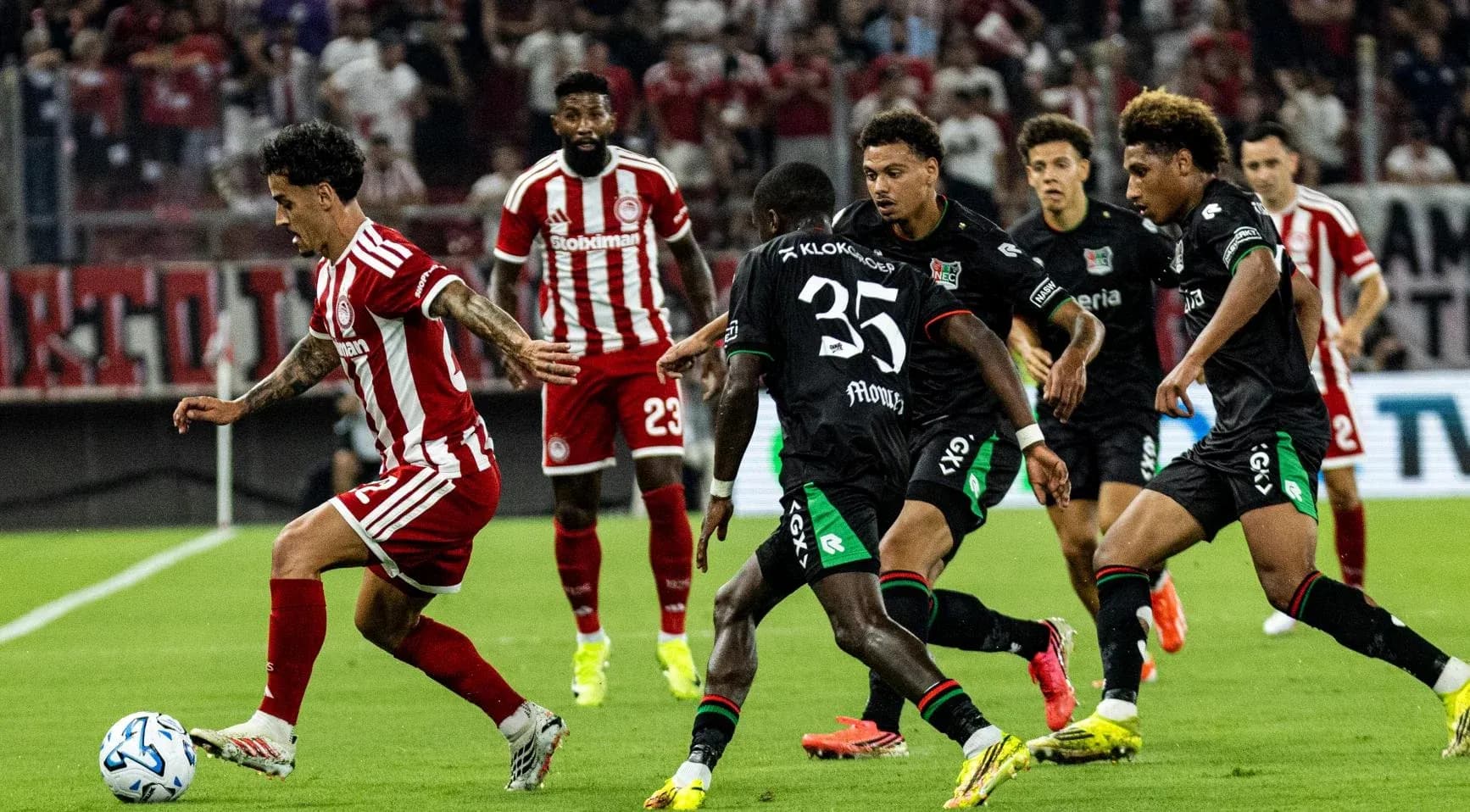
Olympiakos Piraeus and NEC Nijmegen produced a tactically tight 0-0 in the UEFA Champions League 3rd Qualifying Round at Georgios Karaiskakis Stadium, a match defined more by structure and adjustments than by final-third efficiency. Olympiakos, in a 4-2-3-1, had the territorial edge and a slight initiative with 54% possession, but NEC’s 3-4-2-1 block and disciplined work without the ball ensured that the tie remained finely balanced over 90 minutes.
Positional Structures
Olympiakos’ positional structure was clear from the outset. With B. Popovic in goal, a back four of M. Saliakas, P. Retsos, D. Carmo and B. Onyemaechi supported a double pivot of Dani García and C. Mouzakitis. Ahead of them, Rodinei, Chiquinho and J. Roca operated behind lone striker A. El Kaabi. The 4-2-3-1 aimed to create central overloads through Chiquinho and Roca stepping inside, while full-backs Saliakas and Onyemaechi provided width.
NEC’s 3-4-2-1, with G. Crettaz in goal behind a back three of T. Storm, P. Sandler and D. Fonville, prioritised compactness. Wing-backs S. Ouaissa and C. Bischoff flanked a central pair of J. Monteiro and D. Nejasmic, with N. Lebreton and B. Linssen supporting T. Chery up front. Their shape was designed to crowd the central zones where Olympiakos wanted to combine, forcing the hosts into wider, less dangerous routes.
Match Statistics
The match statistics underline the balance between Olympiakos’ initiative and NEC’s resilience. Olympiakos registered 12 total shots to NEC’s 13, but with 5 shots on goal versus NEC’s 4, the hosts managed a marginally better shot quality in terms of accuracy. NEC, however, blocked 4 shots to Olympiakos’ 2, reflecting the Dutch side’s commitment to protecting the box and the effectiveness of their back three in stepping out to confront shooters.
Possession was narrowly in Olympiakos’ favour at 54% to 46%, and their passing volume reflected that: 394 total passes with 264 accurate, a completion rate of 67%. NEC, with 348 passes and 254 accurate (73%), were more efficient with the ball when they had it, suggesting a more selective and vertical use of possession, consistent with a counter-attacking posture. Olympiakos’ lower accuracy percentage hints at more ambitious, riskier passing in the final third, trying to unpick NEC’s compact block.
Set-Piece Dynamics
Set-piece dynamics also told part of the story. Olympiakos earned 5 corner kicks to NEC’s 2, reinforcing the sense of territorial pressure around the NEC box. Yet NEC’s structure on defensive set pieces, combined with Crettaz’s presence, meant those situations did not translate into goals. Olympiakos were caught offside twice, NEC six times, which aligns with NEC’s attempts to spring forward quickly behind the line and Olympiakos’ higher defensive positioning.
Tactical Changes
The key tactical turning point for Olympiakos came immediately after half-time. At 46', G. Martins (IN) came on for J. Roca (OUT), a move that shifted the creative responsibility in the central attacking zones and hinted at a desire for more direct incision between the lines. This was followed by a double change at 56': Jota Silva (IN) for Chiquinho (OUT) and L. Pirola (IN) for D. Carmo (OUT). The first substitution freshened the attacking midfield, adding a different profile in the half-spaces, while the second adjusted the left side of the defence, likely to balance build-up angles and deal with NEC’s transitions.
At 57', P. Maffeo (IN) replaced M. Saliakas (OUT), renewing energy on the right flank and maintaining the full-back-driven width that underpinned Olympiakos’ 4-2-3-1. At 64', Z. Smajlovic (IN) came on for P. Retsos (OUT), meaning three-quarters of the original back four had been changed by mid-second half. This level of defensive rotation suggests Mendilibar was chasing a higher tempo and possibly more aggressive rest-defence, accepting some continuity risk at the back to sustain pressure.
Discipline and Fouls
Discipline-wise, Olympiakos walked a fine line in midfield and defence. At 11', David Carmo (Olympiakos Piraeus) received a yellow card — Foul, shaping his subsequent duels and perhaps influencing the decision to replace him at 56'. At 67', Dani García (Olympiakos Piraeus) was also booked — Foul, underlining the physical intensity in the central zones as NEC tried to break through pressure.
NEC’s substitutions were more about maintaining the integrity of their 3-4-2-1 while injecting fresh legs to preserve defensive concentration and counter threat. At 70', E. Mor (IN) came on for S. Ouaissa (OUT), a move that could tilt the right flank more towards transition threat. Simultaneously, B. Pereira (IN) replaced T. Storm (OUT), refreshing the right side of the back three. At 74', D. Tadic (IN) for B. Linssen (OUT) and I. Hansen-Aaroen (IN) for P. Sandler (OUT) rebalanced both the forward line and midfield, ensuring NEC could still connect counters and protect central spaces late on.
In added time, at 90', W. T. Willumsson (IN) replaced J. Monteiro (OUT), adding a new profile in midfield just as NEC sought to see out the draw. One minute later, at 90+1', Willum Thor Willumsson (NEC Nijmegen) was booked — Foul, illustrating the late-game tension and NEC’s willingness to commit to duels to preserve their clean sheet.
Goalkeeper Performances
From a defensive standpoint, both goalkeepers were central, even if their names are not directly tied to the save statistics in the data. The numbers show the Olympiakos goalkeeper making 4 saves and the NEC goalkeeper making 5, underscoring that despite the 0-0 scoreline, both sides generated efforts that required decisive interventions. NEC’s higher save count matches Olympiakos’ slight edge in shots on goal, while Olympiakos’ 4 saves reflect NEC’s capacity to create meaningful chances despite less possession.
Final Thoughts
Fouls (11 by Olympiakos, 16 by NEC) and the card distribution (2 yellows for Olympiakos, 1 for NEC) reinforce the image of a physically committed contest, with NEC slightly more aggressive in breaking up play. Off the ball, NEC’s 3-4-2-1 compressed the central lanes and forced Olympiakos to rely on crosses and half-spaces, while Olympiakos’ 4-2-3-1 and later defensive reshuffles tried to pin NEC back and guard against counters simultaneously.
In the end, the statistical and tactical picture is coherent: Olympiakos carried more of the ball, produced marginally more on-target efforts and more corners, but NEC’s compact defensive structure, higher passing efficiency and shot-blocking ensured the tie remained goalless, setting up a finely poised second leg.