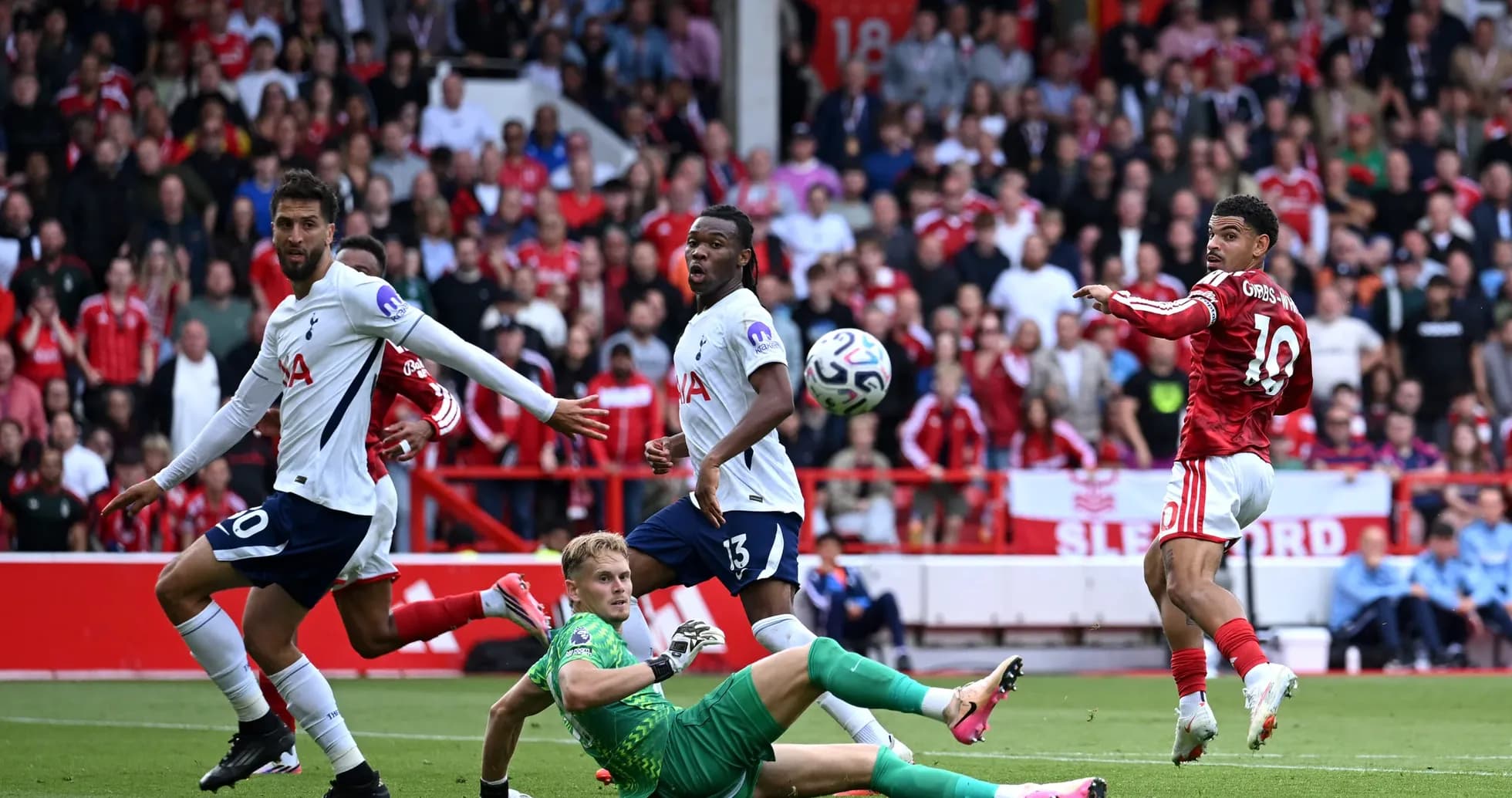
Nottingham Forest vs Tottenham: A Tactical Stalemate at City Ground
Under the grey Nottingham sky at the City Ground, this was a meeting of two sides still searching for themselves. Nottingham Forest and Tottenham arrived in Round 3 of the Premier League with no wins between them, and they left it with a goalless stalemate that said as much about their evolving identities as it did about their current limitations.
I. The Big Picture – Two Projects, One Stalemate
Heading into this game, Forest were 16th with 2 points from 3 matches, their overall goal difference at -1 after scoring 2 and conceding 3. The split told a clear story: at home they had yet to score, with 0 goals for and 1 against across 2 matches; on their travels they had been far more open, scoring 2 and conceding 2 in a single away outing. Tottenham arrived in deeper trouble: 18th, just 1 point from 3 games, and an overall goal difference of -5 after failing to score at all while conceding 5. At home they had lost their only match 0-2; away, they had drawn one and lost one, conceding 3 and still not finding the net.
Those numbers framed the 0-0 as almost inevitable: Forest’s home bluntness versus Tottenham’s season-long attacking drought. Yet tactically, there was plenty happening beneath the surface.
Oliver Glasner doubled down on Forest’s structural identity, rolling out the now-familiar 3-4-2-1. Matz Sels anchored a back three of Jair, Nikola Milenković and Murillo, with Neco Williams and Ola Aina stretching the pitch as wing-backs. Xaver Schlager and James McAtee formed the central hinge, while Dan Ndoye and Morgan Gibbs-White floated behind lone forward Liam Delap.
For Tottenham, Roberto De Zerbi’s 4-2-3-1 looked like a possession side still missing its cutting edge. A. Kinský started in goal behind a back four of Pedro Porro, Jan Paul van Hecke, Micky van de Ven and Destiny Udogie. Sandro Tonali and Rodrigo Bentancur sat as the double pivot, with Sávio, Conor Gallagher and Mathys Tel supporting Omar Marmoush as the nominal striker.
II. Tactical Voids – Absences and Discipline
The absentees list weighed more heavily on the visitors. Dejan Kulusevski, James Maddison, W. Odobert and Xavi Simons all missed out, stripping Tottenham of creativity between the lines and one‑v‑one threat in wide areas. In that context, the reliance on Gallagher’s late runs and Sávio’s improvisation became more pronounced, but also easier for Forest’s back three to anticipate.
Forest’s only listed absentee was N. Savona with a knee injury, a loss in depth rather than structure. Glasner could still field his preferred formation; the continuity showed in how cleanly Forest’s 3-4-2-1 slid between a back five without the ball and a lopsided front four when they attacked.
From a disciplinary standpoint, Forest came into this match as a side that tends to collect their cautions in the middle third of games. Their yellow card profile this season is led by the 46-60 minute window, which accounts for 50.00% of their bookings, with smaller spikes in the 16-30, 31-45 and 76-90 ranges (each at 16.67%). Tottenham’s bookings are more evenly distributed: 25.00% in each of 0-15, 31-45, 46-60 and 76-90. That spread reflects a Spurs side that can be rushed or frustrated in any phase of the contest.
On the individual level, Aina’s disciplinary edge is a double-edged sword for Forest. Across the campaign he has already taken 2 yellows, and his aggressive dueling on the right flank remains both a pressing weapon and a risk against dribblers like Sávio. For Spurs, Udogie and Mateus Fernandes each carry a yellow this season, with Fernandes’ 5 fouls committed in just 142 minutes hinting at a midfielder who can tilt from assertive to reckless when chasing the game.
III. Key Matchups – Hunter vs Shield, Engine Room Battles
With no league-wide top scorers data available and Tottenham yet to score, the “Hunter vs Shield” narrative shifted toward creators and structures rather than pure finishers.
For Forest, Gibbs-White is the clear attacking reference point. Heading into this match he had 1 goal and 1 assist in 3 league appearances, with 7 shots (2 on target) and 81 passes at 82% accuracy. He is not just Forest’s most productive attacker; he is their conduit between midfield and Delap. His duel numbers – 25 contested, 12 won – underline how often he operates under pressure and still finds ways to progress play.
Tottenham’s “shield” against him was a layered combination of van de Ven stepping out, Bentancur’s positional discipline, and Gallagher tracking back from the No. 10 role. Van de Ven’s pace and front-foot defending allowed Spurs to hold a relatively high line, compressing the space Gibbs-White usually enjoys between the lines. Without Kulusevski and Maddison to pin Forest back, though, Tottenham’s own counter-threat was limited, meaning their back four often had to defend longer spells of possession without the relief of sustained attacking phases.
In the engine room, Schlager and McAtee faced Tonali and Bentancur in a battle of tempo and control. Forest’s central pair had to balance screening against Gallagher’s surges with feeding quick transitions into Ndoye and Gibbs-White. Tonali’s role was more orchestral, recycling possession and trying to drag Forest’s midfield block out of shape, while Bentancur patrolled the lanes in front of van Hecke and van de Ven.
Wide, the duel between Aina and Sávio was pivotal. Aina’s 7 tackles and 4 successful dribbles this season show a player comfortable both defending and driving forward. Sávio’s brief is to destabilise that certainty, dragging Aina into uncomfortable positions and opening half-spaces for Tel to drift into. On the opposite flank, Williams versus Udogie was more about territory: Williams pushing high to pin Udogie, and Udogie’s athleticism offering Spurs one of their few natural outlets on the break.
IV. Statistical Prognosis – A Stalemate That Fits the Numbers
From a statistical lens, this 0-0 feels like the logical intersection of two imperfect attacks and two defences still under construction.
Forest, overall, average 0.7 goals for per match this season, but that figure splits starkly: 0.0 at home and 2.0 away. They also average 1.0 goals against overall, with 0.5 at home and 2.0 away, and have already kept 1 clean sheet while failing to score in 2 of their 3 games. Their single penalty this season was converted, maintaining a 100.00% record from the spot so far.
Tottenham’s profile is even starker: 0.0 goals for per match overall, home and away, with 1.7 goals against overall (2.0 at home, 1.5 on their travels). They have managed 1 clean sheet but have failed to score in all 3 games. With no penalties awarded yet, there is no relief from set-piece variance either.
Blend those numbers with the tactical shapes on show and the narrative crystallises. Forest’s back three, shielded by Schlager and McAtee, is structurally solid enough at home to limit a Spurs side devoid of its key creators. Tottenham’s high defensive line, anchored by van de Ven and van Hecke, can suffocate a Forest attack that still lacks a consistent home goal threat beyond Gibbs-White’s invention.
In xG terms, this was always likely to be a low-event contest: a Forest side that grinds at home against a Tottenham team that controls passages of play without incision. The 0-0 does not solve either club’s attacking problems, but it underlines their current truths: Forest are hard to blow away at the City Ground, and Tottenham, for all their technical quality, remain a project still searching for a cutting edge.